
The Data Pipeline Your AI Model Deserves: Why Unstructured Data Broke ETL and What Replaces It?
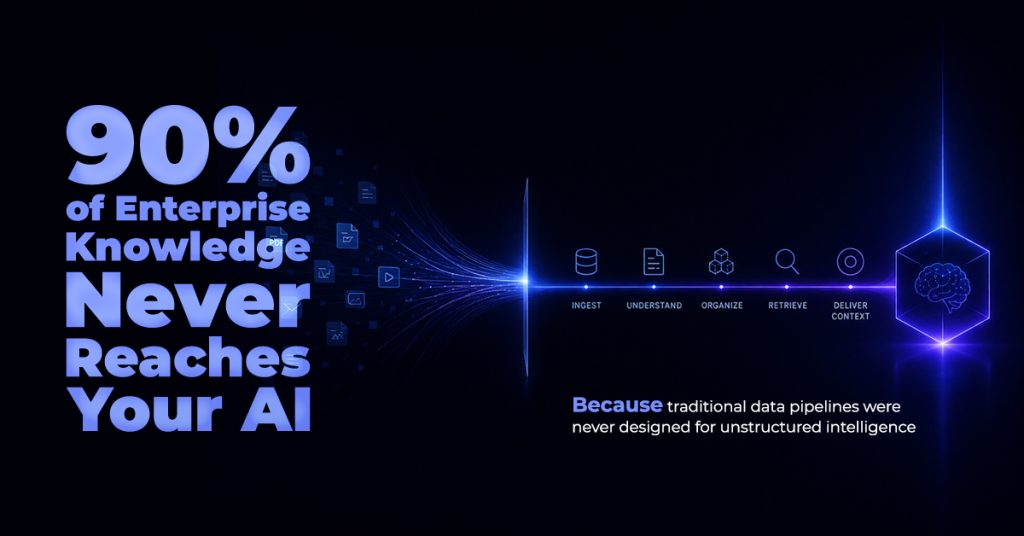
Many organizations assume that if their AI initiative is underperforming, the problem lies with the model. They think that the model isn’t accurate enough. The prompts need improvement. A larger LLM might solve the issue.
In reality, the root cause is that the AI system cannot access, understand, or retrieve the right information when it needs it.
Over the last decade, enterprises have invested heavily in collecting and storing data. CRM systems track customer interactions, ERP platforms manage operations, cloud applications generate logs, and collaboration tools store millions of documents and conversations. Yet despite having more data than ever before, many organizations struggle to make that information usable for AI.
According to IBM, unstructured data accounts for approximately 90% of enterprise-generated data. That means the vast majority of business knowledge exists outside the environments traditional data pipelines were originally designed to handle.
This shift has exposed a growing gap between conventional data engineering practices and modern AI requirements.
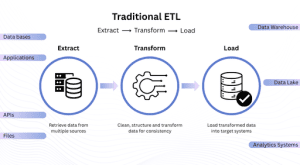
Traditional ETL pipelines were built to move and transform structured data. AI systems need something more. They need pipelines that can discover, understand, organize, retrieve, and continuously deliver context.
In this article, we’ll explore why unstructured data has challenged traditional ETL architectures, how AI-ready data pipelines are evolving to address these challenges, and what enterprises should consider when building data foundations for modern AI applications.
What Is an AI Data Pipeline?
An AI data pipeline is a system that collects, prepares, enriches, and delivers data for AI models and AI-powered applications. These AI-driven data pipelines focus on making data usable for machine learning models, large language models (LLMs), recommendation engines, analytics platforms, and Retrieval-Augmented Generation (RAG) systems.
This distinction is important.
A traditional pipeline may successfully move thousands of documents into storage. However, an AI model still cannot use those documents unless the content has been processed in a way that allows the model to understand and retrieve relevant information.
Modern AI data pipelines typically handle:
- Data ingestion from multiple enterprise sources
- Document parsing and content extraction
- Data cleaning and normalization
- Metadata generation
- Content chunking
- Embedding generation
- Semantic indexing
- Retrieval optimization
- Monitoring and governance
Traditional pipelines make data available, where AI pipelines make data understandable.
That difference is becoming increasingly important as organizations move from analytics-driven architectures to AI-driven architectures.
Why Unstructured Data Exposes ETL’s Biggest Limitation?
For years, ETL worked exceptionally well because enterprise data was largely structured.
Organizations collected customer records, financial transactions, inventory information, operational metrics, and reporting data. These datasets fit naturally into tables, columns, and predefined schemas.
The ETL process was designed for exactly this environment:
- Extract data from source systems
- Transform it into a standardized format
- Load it into a warehouse for reporting and analysis
The model worked because the data itself was predictable.
Unstructured data changed that equation.
Today, a significant portion of enterprise knowledge exists in formats that do not conform to predefined structures:
- Product documentation
- Customer emails
- Internal wikis
- Technical manuals
- Contracts
- Research reports
- Meeting transcripts
- Support conversations
- Images and multimedia files
These assets contain valuable business knowledge, but they do not fit neatly into rows and columns. Most importantly, they contain meaning that traditional ETL processes cannot fully interpret.
For example, consider a 200-page product manual.
A traditional ETL pipeline can ingest the document and store it. However, it cannot automatically determine:
- Which sections are most important
- What business concepts are discussed
- Which departments own the information
- Whether the content is outdated
- Which users should access specific sections
- How the information should be retrieved for future AI queries
The document is available, but it is not yet AI-ready.
This is where many organizations begin to encounter challenges. Their data infrastructure was built for reporting and analytics, not for AI reasoning and knowledge retrieval.
Why AI Needs More Than Traditional ETL?
The fundamental challenge is that AI systems consume information differently from traditional business applications.
A reporting dashboard needs structured metrics, where an AI assistant needs context.
When a user asks an enterprise AI assistant:
“What are our refund policies for enterprise customers?”
The system does not simply retrieve a database record. It may need to:
- Search across policy documents
- Identify the latest approved version
- Retrieve relevant sections
- Understand relationships between documents
- Assemble contextual information
- Generate a coherent response
This requires data understanding. Several limitations emerge when traditional ETL pipelines are used as the foundation for AI systems.
AI Requires Semantic Understanding
Traditional ETL focuses on structure. However, AI focuses on meaning.
Two documents may use different terminology while describing the same concept. AI systems need pipelines capable of identifying those relationships.
AI Requires Context Preservation
Enterprise documents often contain interconnected information. Breaking content into isolated records can remove the context that AI models need to generate accurate responses.
AI Requires Retrieval Optimization
AI applications must retrieve the right information quickly. Simply storing data is no longer enough. Information must be organized for semantic search and contextual retrieval.
AI Requires Continuous Knowledge Updates
Enterprise knowledge changes constantly. Policies evolve, products change, documentation gets updated.
AI pipelines must continuously process and refresh information to keep responses accurate.
AI Requires Governance and Traceability
Organizations increasingly need visibility into where AI-generated responses originate.
Users, auditors, and compliance teams want to understand:
- Which document was used
- When it was updated
- Whether it is approved
- Who owns it
This level of governance extends far beyond traditional ETL responsibilities.
What Replaces ETL in the Age of AI?
One of the biggest misconceptions in the industry is that AI is replacing ETL.
ETL remains a critical component of modern data architecture. The change is in the scope of the pipeline.
Traditional ETL is becoming part of a much broader AI-ready architecture. The goal is to transform enterprise knowledge into something AI systems can understand and use.
Traditional ETL
Extract → Transform → Load
AI-Ready Data Pipeline
Ingest → Parse → Clean → Enrich → Chunk → Embed → Index → Retrieve → Generate → Monitor
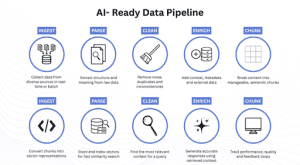
The traditional pipeline ends once data reaches storage. But the AI pipeline continues well beyond storage.
Modern AI systems require additional layers that prepare information for semantic search, contextual retrieval, and intelligent reasoning. These layers include:
- Document intelligence
- Metadata enrichment
- Embedding generation
- Vector indexing
- Retrieval systems
- Evaluation frameworks
- Observability and monitoring
Organizations are no longer building pipelines solely for dashboards and analytics. They are building pipelines that power enterprise search, AI assistants, knowledge management systems, recommendation engines, and generative AI applications.
And that requires a fundamentally different approach to how data is prepared, organized, and delivered.
Inside a Modern AI-Ready Data Pipeline
Understanding the difference between a traditional pipeline and an AI-ready pipeline becomes much easier when we look at the individual components.
Unlike conventional ETL systems, AI pipelines are designed to transform raw information into usable knowledge that AI models can retrieve, understand, and reason over.
Let’s break down the key stages.
1. Data Ingestion
Organizations today operate across dozens, sometimes hundreds, of platforms. Valuable business knowledge may reside in:
- CRM systems
- ERP platforms
- Customer support tools
- Internal knowledge bases
- Cloud storage
- Databases
- SharePoint repositories
- Collaboration platforms
- Third-party SaaS applications
An AI-ready pipeline must be able to ingest data from all these sources while maintaining consistency and traceability.
The goal is to create a unified knowledge layer that AI applications can access.
2. Document Parsing and Content Extraction
Once data enters the pipeline, the next challenge is making it readable. Enterprise information rarely arrives in a clean format. It may exist as:
- PDF files
- Scanned documents
- PowerPoint presentations
- Contracts
- Emails
- Images
- Product manuals
- Research reports
Before AI can use this information, the content must be extracted and converted into machine-readable text. This stage often involves:
- Optical Character Recognition (OCR)
- Document structure analysis
- Table extraction
- Image-to-text processing
- Metadata identification
Poor parsing at this stage often creates downstream issues for AI systems. If important information is lost during extraction, retrieval quality and response accuracy will suffer later.
3. Data Cleaning and Normalization
Raw enterprise data is rarely perfect. Documents may contain:
- Duplicate content
- Formatting inconsistencies
- Encoding errors
- Outdated versions
- Missing information
Cleaning and normalization help standardize content before it enters the retrieval layer.
This process improves:
- Search quality
- Embedding quality
- Retrieval accuracy
- Response consistency
For enterprise AI applications, data quality remains just as important as model quality.
4. Chunking
One of the most important concepts in modern AI pipelines is chunking.
Large Language Models cannot efficiently process hundreds of pages of content at once. Instead, documents are divided into smaller, meaningful sections called chunks.
For example:
A 150-page employee handbook may be divided into sections such as:
- Leave policies
- Benefits
- Expense reimbursement
- Travel guidelines
- Performance reviews
This allows retrieval systems to fetch only the most relevant information when a user submits a query. Poor chunking is one of the most common reasons enterprise AI assistants provide incomplete or inaccurate responses.
5. Metadata Enrichment
This is where AI pipelines become significantly more intelligent than traditional ETL systems. Metadata adds context to content. However, for every document or chunk, organizations may attach information such as:
- Department
- Author
- Creation date
- Approval status
- Version number
- Customer segment
- Product category
- Security classification
Metadata helps retrieval systems understand not just what information exists, but when and how it should be used.
6. Embedding Generation
This is where modern AI architecture starts diverging significantly from traditional data engineering.
Embeddings convert content into numerical representations that capture semantic meaning.
Instead of searching for exact keywords, AI systems can search for meaning.
For example:
A user searches:
“How do I claim travel expenses?”
The relevant document might contain:
“Employee reimbursement guidelines for business trips.”
Traditional keyword search may miss the connection. Embedding-based retrieval recognizes that both statements describe similar concepts. This dramatically improves search and retrieval quality.
7. Vector Indexing
Once embeddings are generated, they are stored in a vector database.
Unlike traditional databases that organize information by rows and columns, vector databases organize information based on semantic similarity. This enables AI systems to perform:
- Semantic search
- Similarity matching
- Context retrieval
- Knowledge discovery
Popular vector databases include Pinecone, Weaviate, Milvus, and Chroma. These technologies have become foundational components of enterprise AI architectures.
8. Retrieval and Context Assembly
When a user submits a query, the retrieval layer identifies the most relevant information from the vector index. Instead of sending an entire knowledge repository to the model, the system retrieves only the most relevant chunks.
This process significantly improves:
- Accuracy
- Context relevance
- Explainability
- Cost efficiency
The retrieved information is then assembled into context and provided to the language model. This is the foundation of Retrieval-Augmented Generation (RAG).
9. Monitoring and Evaluation
The pipeline does not end after deployment.
AI systems require continuous monitoring to ensure they remain accurate and trustworthy. Organizations increasingly track:
- Retrieval accuracy
- Hallucination rates
- User satisfaction
- Latency
- Cost per query
- Knowledge freshness
- Source attribution
This helps teams identify performance issues before they impact business users.
Why RAG Became the Turning Point for Enterprise AI
For many organizations, Retrieval-Augmented Generation (RAG) has become the missing link between enterprise knowledge and generative AI.
Before RAG, businesses faced a difficult choice. They could either:
- Rely entirely on a pre-trained model’s knowledge, or
- Fine-tune models using internal data.
Both approaches introduced limitations, such as:-
- Pre-trained models often lack organization-specific knowledge.
- Fine-tuning can be expensive, difficult to maintain, and challenging to update.
Know the Advantages of RAG
Instead of storing all enterprise knowledge inside the model, RAG retrieves relevant information from trusted data sources at query time and provides that context to the model before generating a response. This approach offers several advantages:-
Better Accuracy
Responses can be grounded in enterprise-approved information rather than relying solely on model memory.
Reduced Hallucinations
When the model receives relevant context, it is less likely to generate unsupported answers.
Faster Knowledge Updates
Organizations can update documents without retraining models.
Improved Explainability
Many RAG systems can provide citations and source references for generated answers.
This is one of the reasons RAG has become a foundational architecture for enterprise AI assistants, internal search systems, customer support platforms, and knowledge management solutions.
The New Data Engineering Stack for AI Systems
As AI adoption grows, the modern data engineering stack is evolving rapidly. Today’s enterprise AI environments often include technologies such as:
Data Lakes and Lakehouses
Centralized platforms that store structured, semi-structured, and unstructured data.
Data Orchestration Tools
Solutions that automate ingestion, transformation, scheduling, and workflow management.
Document Intelligence Platforms
Tools that extract and process information from enterprise documents.
Embedding Models
Models that convert content into semantic vector representations.
Vector Databases
Specialized storage systems optimized for semantic search and retrieval.
Metadata Catalogs
Systems that track data ownership, lineage, governance, and business context.
Observability Platforms
Monitoring tools that provide visibility into data quality, retrieval performance, and AI behavior.
Governance Frameworks
Controls that ensure security, compliance, access management, and auditability. Together, these components form the foundation of enterprise-grade AI infrastructure.
It is about making knowledge discoverable, trustworthy, and usable by AI systems.
The Enterprise Risks of Poor AI Data Pipelines
Many organizations focus heavily on model selection while underestimating the importance of data infrastructure. This often leads to disappointing AI outcomes. A weak data pipeline can create risks such as:
Hallucinated Responses
AI systems may generate incorrect information when relevant context is unavailable.
Incomplete Answers
Important documents may never be retrieved because they were poorly indexed or chunked.
Compliance Concerns
Outdated or unauthorized content may appear in AI-generated responses.
Knowledge Silos
Valuable information remains trapped inside disconnected systems.
User Distrust
Employees quickly stop using AI tools when answers become inconsistent.
Rising Costs
Poor retrieval quality often increases token usage and inference costs.
In many enterprise environments, improving the data pipeline produces greater business value than upgrading the underlying model.
Signs Your Current Data Pipeline Is Holding Back Your AI Initiatives
If your organization is investing in AI, it is worth evaluating whether your data infrastructure is prepared to support those initiatives.
Common warning signs include:
- Your AI assistant struggles to answer questions based on internal documents.
- Teams spend significant time manually preparing content for AI projects.
- Search results depend heavily on exact keywords.
- Knowledge exists across disconnected systems.
- Responses become inconsistent as document volumes grow.
- Users frequently question AI-generated answers.
- Your AI pilot performs well during demonstrations but struggles in production.
- Governance teams lack visibility into how answers are generated.
How Sarvika Helps Businesses Build AI-Ready Data Pipelines
Sarvika Technologies helps organizations bridge the gap between traditional data infrastructure and modern AI requirements.
Our teams work with enterprises to design and implement AI-ready data architectures that support generative AI, enterprise search, intelligent assistants, analytics platforms, and digital transformation initiatives. Our expertise includes:
- Data engineering and modernization
- Unstructured data processing
- AI-ready data pipelines
- Retrieval-Augmented Generation (RAG) implementation
- Enterprise search solutions
- Cloud-native architecture
- AI integration and deployment
- Governance and monitoring frameworks
Conclusion
For years, traditional ETL pipelines served organizations exceptionally well. They helped businesses collect, transform, and analyze structured data at scale.
However, the rise of AI has changed what organizations expect from their data infrastructure.
Modern AI systems must work with unstructured information, understand context, retrieve relevant knowledge, and continuously adapt to changing business environments. This requires capabilities that extend far beyond traditional ETL.
The future belongs to AI-ready data pipelines that combine ingestion, document intelligence, metadata enrichment, semantic search, retrieval, governance, and monitoring into a unified architecture.
Organizations that invest in these foundations today will be better positioned to build accurate, trustworthy, and scalable AI solutions tomorrow.
Because in the age of AI, competitive advantage will not come from having more data. It will come from having data that your AI can actually understand and use.

Muskan Lakhotia
Senior Content Writer
Muskan Lakhotia is a Senior Content Writer at Sarvika Technologies, where she turns complex ideas into content that feels clear, sharp, and worth reading. She works across digital transformation, enterprise solutions, and service-led storytelling, with a focus on creating narratives and strategies that inform & engages with the audience. Curious by instincts and strategic with plans, she enjoys shaping content that gives brands a stronger voice, a clearer point of view, and a more human way to speak to modern businesses.