
The Real Cost of Non-Compliant Software Development (And How to Avoid It)
Most software budgets have a line item for development. Almost none have one for “the fallout from skipping compliance.” That’s the gap that gets companies in trouble.
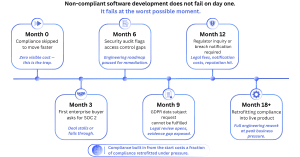
The cost of non-compliant software development rarely shows up where you’d expect it. It doesn’t hit you in the first sprint or even the first release. However, it shows up eighteen months later, when an enterprise buyer’s security team rejects your SaaS product during procurement, or a regulator opens an inquiry after a breach, or a due diligence team flags “no SOC 2 report” during a funding round and the term sheet gets quietly revised. By then, the cost isn’t a line item anymore. It’s a crisis.
This isn’t a scare piece. It’s a practical look at where non-compliance actually costs businesses money, time, and trust – and what building compliant software from the start actually looks like, using a real certification stack as the reference point rather than a hypothetical one.
What Non-Compliant Software Development Actually Means?
Non-compliant software development happens when a product is built, hosted, or maintained in a way that doesn’t meet the legal, regulatory, or industry-security standards that apply to its data, users, or market.
“That can mean patient data stored without HIPAA-required safeguards, EU user data processed without a GDPR-valid legal basis, or a SaaS platform with no SOC 2 report trying to sell into enterprise accounts that require one as a condition of purchase.”
It’s rarely one dramatic failure; that usually happens because of a stack of small decisions, such as skipping an access control here, delaying an audit log there. It quietly accumulates until a customer, auditor, or regulator asks a question nobody can answer with evidence.
The Real Cost of Non-Compliant Software Development, Broken Down
The word “cost” undersells it. Non-compliance doesn’t produce one bill, but it produces several, and they don’t all land at once.
-
Direct costs: fines, penalties, and legal fees
These are the costs people picture first, and they’re absolutely real.
GDPR gives regulators the power to fine companies up to €20 million or 4% of global annual revenue, whichever is higher. A structure specifically designed so the penalty scales with the size of the company, not the size of the violation.
HIPAA works on a tiered system based on the level of negligence involved, and penalties can run into the millions annually per violation category when a pattern of non-compliance is uncovered rather than a one-off mistake.
SOC 2 doesn’t technically carry a “fine” in the same sense. There’s no regulator issuing penalties for failing an audit. But a failed or qualified SOC 2 report triggers its own chain of costs: remediation work, a re-audit (which means paying your auditor again), and in many cases a stalled or lost enterprise deal that was contractually contingent on a clean report.
Add legal fees for breach notification, regulatory response, and contract renegotiation, and the direct cost of non-compliance for even a mid-sized incident can outstrip the entire annual budget a company would have spent building compliance in from day one.
-
Indirect costs: the ones nobody budgets for
This is where the real damage lives, and it’s the part most cost breakdowns skip.
Enterprise buyers now ask for a SOC 2 report or ISO 27001 certificate before procurement even opens a serious conversation. No report means no shortlist, regardless of how good the product is. That’s not a compliance cost, but it’s a revenue cost, and it compounds every quarter you go without it.
Then there’s the internal cost. Every hour an engineering team spends retrofitting access controls, rewriting data-handling logic, or rebuilding audit trails after the fact is an hour not spent on the roadmap.
Compliance debt behaves a lot like technical debt: cheap to ignore early, expensive to unwind later, and it always comes due at the worst possible time, usually right when a big customer’s security team starts asking questions.
Reputational cost is harder to put a number on, but it’s not smaller for that. A breach disclosure or a public compliance failure follows a company through every future sales conversation. Prospects search for it. Investors ask about it. It becomes a permanent asterisk next to the brand.
Non-Compliant Software Risks Businesses Consistently Overlook
Some risks get attention because they’re dramatic. Others get ignored because they’re boring – right up until they aren’t.
- Security debt disguised as “we’ll fix it later.” Unpatched dependencies and skipped access reviews don’t announce themselves. They sit quietly until an attacker or an auditor finds them.
- Software license non-compliance. Using open-source or commercial components outside their license terms creates legal exposure that has nothing to do with data security and everything to do with contract law.
- Audit failure exposure. Companies that have never been audited often assume they’d pass one. Most don’t, on the first attempt, because “we think we’re secure” and “we can prove we’re secure” are different things.
- Vendor lock-in from unvetted stacks. Choosing infrastructure or dev partners without checking their own compliance posture means inheriting their gaps as your own.
- Breach liability that outlives the incident. Regulatory exposure and contractual liability from a breach can surface years after the actual event, especially in healthcare and financial data contexts.
None of these require a catastrophic event to become expensive. They just require time.
HIPAA Compliance Risks in Software Development
Healthcare software carries a specific kind of risk, because the data itself (protected health information) is regulated at a level most other data isn’t. HIPAA violations in software development usually don’t come from a single bad decision. They come from treating compliance as a checklist applied after the product is built, rather than a set of architectural requirements baked in from the start.
Encryption at rest and in transit, strict access logging, business associate agreements with every vendor touching PHI, and breach notification workflows aren’t features you bolt onto a healthcare app in month eleven. They’re structural decisions that shape how the database is designed, how APIs authenticate, and how third-party integrations get vetted in the first place. A HIPAA-compliant custom software vendor treats these as day-one requirements, not a pre-launch audit item.
The companies that get burned here are usually the ones that moved fast on features and assumed compliance could be retrofitted. It technically can be, but retrofitting HIPAA compliance into a live product handling real patient data is a slower, more expensive, and riskier process than building it in from the architecture stage.
GDPR Software Compliance Mistakes That Keep Repeating
GDPR mistakes tend to follow a pattern, and it’s not usually ignorance of the law. It’s underestimating how much of it touches the actual codebase.
Data residency assumptions are a common one. Teams assume “our cloud provider has EU regions” solves the problem, without checking where backups, logs, and analytics data actually flow. Consent architecture is another: building a cookie banner is not the same as building a system that can prove, on request, exactly what a specific user consented to and when. And third-party sub processor gaps are almost universal: a product can be fully GDPR-compliant in its own code and still be non-compliant because a sub processor it relies on isn’t.
The mistakes rarely come from a single bad developer. They come from treating GDPR as a legal document to read once rather than a set of ongoing engineering constraints, such as data minimization, right-to-erasure workflows, and processing records that need to stay accurate as the product evolves.
SOC 2 for Startups: Why Enterprise Buyers Increasingly Expect It
There was a stretch of years when SOC 2 was something only enterprise-stage companies worried about. That window has closed. Mid-market and even early-stage B2B SaaS companies now routinely lose deals to competitors who show up to the sales conversation with a SOC 2 report already in hand.
The reason is straightforward: procurement teams have standardized their vendor risk process, and SOC 2 (or ISO 27001) has become the default proof point they ask for. Without it, a startup isn’t necessarily disqualified — but it’s added friction, extra review cycles, and often a slower path to signature that a competitor with the report simply doesn’t face.
Starting the SOC 2 process early, even a Type I report before a full Type II, tends to pay for itself in shortened sales cycles alone.
SOC 2 Audit Failure: What Actually Happens
There’s a common misconception that failing a SOC 2 audit results in some kind of formal penalty. It doesn’t, at least not in the regulatory sense. There’s no government body issuing fines for a qualified opinion. The real cost is more mundane and, in some ways, more damaging.
A failed or qualified audit means remediation work against the auditor’s findings, a follow-up review, and another invoice from the audit firm. Meanwhile, any deal that was contractually waiting on a clean report stalls or falls through. Prospects who see a qualified opinion often read it as a signal about how the company handles risk generally, not just the specific control that failed. That perception is hard to undo with a follow-up email.
Non-Compliant Software Risk Management: A Practical Framework
Fixing this doesn’t require a massive compliance department. It requires a consistent loop, applied honestly.
Assess. Know what regulations and standards actually apply to the product based on the data it touches and the markets it serves before assuming what “good enough” looks like.
Remediate. Fix the gaps the assessment finds, starting with the ones tied to actual data exposure or contractual requirements, not the easiest ones to close first.
Monitor. Compliance isn’t a one-time state. Access controls drift, new integrations get added, and regulations get updated. Ongoing monitoring catches the gap before an auditor or attacker does.
Certify. Formal certification, like SOC 2, ISO 27001, HIPAA attestation — turns internal confidence into external proof. That distinction matters more than most teams realize until a customer asks for evidence.
SaaS Security Compliance Checklist: What to Look for in a Dev Partner
If you’re evaluating a development partner rather than building the compliance function in-house, the checklist looks a little different. It’s less about your own controls and more about what the vendor can actually demonstrate.
- Do they hold current, verifiable certifications, not just a claim on their website? Can you request an actual certificate or auditor’s report?
- Do they have documented experience building for regulated industries specifically, not just general SaaS?
- Can they explain how compliance gets built into their development process, rather than treated as a final QA step?
- Do they have a track record with the specific frameworks your product needs, such as HIPAA for healthcare, GDPR for EU users, SOC 2 for enterprise SaaS?
- Will they put compliance commitments in the contract, not just in a sales conversation?
Why a Certified Partner Changes the Equation?
This is where the difference between claimed compliance and documented compliance actually matters.
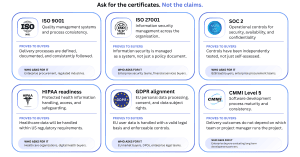
A lot of development agencies talk about “security-first development” or “compliance-ready processes” in their marketing copy. Far fewer can produce the paperwork behind it. Sarvika’s certification stack is built specifically to close that gap: ISO 9001 for quality management, ISO 27001 for information security management, SOC 2 for the operational controls enterprise buyers ask for by name, HIPAA readiness for healthcare projects, GDPR alignment for products handling EU user data, and CMMI Level 5 for process maturity and continuous improvement.
CMMI Level 5 deserves a specific mention because it speaks directly to process maturity and continuous improvement. At this level, an organization goes beyond having defined and consistently applied processes. It uses quantitative understanding of performance to continuously improve and optimize those processes. For a client, that means software delivery is supported by a mature process environment designed to measure performance, identify improvement opportunities, and respond systematically to change. For a client, that translates into predictable delivery and fewer surprises tied to process inconsistency, which is a different (and equally real) risk than a data breach.
Together, this stack isn’t a marketing claim. It represents independently verifiable certifications, attestations, and process-maturity credentials that a client can review before signing a contract, rather than simply taking a claim on a pitch deck at face value.
How Does Sarvika Build Compliance Into Software Development?
Sarvika treats applicable security, privacy, quality, and compliance requirements as architecture inputs rather than pre-launch checks.
That means identifying relevant requirements before development begins, designing data flows and access controls accordingly, integrating security testing throughout the software lifecycle, maintaining the documentation and evidence required for assurance, and reviewing controls as applications and infrastructure evolve.
This approach helps reduce compliance debt: the expensive rework that appears when security controls, audit trails, data-handling rules, or governance requirements are discovered only after a product is already live.
For organizations evaluating a software development partner, credentials matter—but so does the engineering process behind them. Sarvika maintains independently verifiable security, quality, assurance, and process-maturity credentials relevant to enterprise software development and regulated environments.
The objective is not simply to help software pass an audit. It is to build systems whose architecture, engineering practices, and operational controls can stand up to scrutiny throughout their lifecycle.
The Bottom Line
Non-compliant software development doesn’t fail loudly. It fails slowly, through lost deals, stalled audits, and engineering time spent fixing what should have been built the first time correctly. The companies that avoid this aren’t necessarily the ones with the biggest compliance budgets — they’re the ones that treat compliance as part of the build, not an afterthought bolted onto it.
If you’re evaluating a development partner for a project that touches regulated data, ask for the certificates, not the claims. Sarvika can show you ISO 9001, ISO 27001, SOC 2, HIPAA readiness, GDPR alignment, and CMMI Level 5 – documented, current, and verifiable. Talk to our team about what a compliant build actually looks like for your product before the first line of code gets written.
Frequently Asked Questions
1.What is the average cost of non-compliant software development?
There’s no single average. It depends on the framework violated and the scale of the exposure, but costs typically combine regulatory fines, audit remediation fees, and lost enterprise revenue from failed procurement reviews. The indirect costs, particularly lost deals, often exceed the direct fines.
2. Is SOC 2 required for startups?
Not legally, but it’s increasingly required commercially. Most enterprise B2B buyers now ask for a SOC 2 report during procurement, so lacking one can disqualify a startup from deals regardless of product quality.
3. What happens if my software fails a compliance audit?
There’s typically no regulatory fine for a failed SOC 2 or ISO 27001 audit specifically, but it triggers remediation costs, a follow-up audit, and often stalls or ends deals that were contingent on a clean report.
4. What’s the difference between GDPR and HIPAA compliance for software?
GDPR governs personal data of EU residents across any industry, with penalties tied to global revenue. HIPAA governs protected health information specifically within the US healthcare context, with tiered penalties based on the level of negligence involved.
5. What does CMMI Level 5 mean for a software vendor?
CMMI Level 5 represents the Optimizing maturity level. It indicates that an organization has moved beyond defined and quantitatively managed processes toward continuous process improvement and optimization. For software buyers, it provides an independent signal that process performance is measured, improvement opportunities are systematically identified, and the organization has established practices for continuously improving how it delivers software.

Sarvika Technologies
Sarvika Tech is a team of young, energetic, and technology-loving people on the journey to help companies achieve their goals by supporting their IT needs. In a nutshell, we are a people’s company where the priority is their knowledge enhancement and career development. We believe that focusing on our most important asset, the team, will enable us to push boundaries and deliver ingenious IT solutions.