
AI Implementation Failures: Common Causes and How to Avoid Them
Artificial Intelligence can work perfectly in a pilot and still fail as a business initiative.
The model may generate accurate predictions. The Generative AI assistant may answer correctly. An AI agent may complete a controlled workflow. Yet months later, the solution is still not operating at scale—or employees have stopped using it, integration remains incomplete, governance has blocked deployment, or the economics no longer justify the investment.
This gap between AI capability and enterprise implementation is becoming one of the defining challenges of AI adoption.
McKinsey reported in late 2025 that AI use had reached 88% of surveyed organizations, while only 7% said AI had been fully scaled across their organizations. Its research increasingly points toward workflow redesign, governance, data foundations, and operating-model changes as critical to achieving value from AI.
The lesson is important:
AI implementation failures rarely begin with the model alone. They occur when enterprises prove that AI can work but fail to engineer the business, data, architecture, governance, and operating environment required to make it work reliably at scale.
Understanding why AI projects fail therefore requires looking beyond model accuracy.
What Is an AI Implementation Failure?
An AI implementation failure does not necessarily mean that the underlying model is technically unsuccessful.
An initiative can fail even when the technology works.
An AI project should be considered unsuccessful when it cannot move into dependable production use, does not improve the intended business outcome, creates unacceptable operational or regulatory risk, costs significantly more than the value it produces, or is abandoned because employees and business processes never adopt it.
This distinction explains why impressive proofs of concept do not always become successful enterprise AI systems.
A pilot answers:
Can the technology do this?
Production must answer much harder questions:
Can it do this reliably, securely, economically, repeatedly, and inside the way the business actually operates?
Those are different tests.
Why Do AI Projects Fail?
RAND’s research into unsuccessful AI initiatives identified several recurring causes, including poor problem definition, insufficient data, technology-first thinking, inadequate infrastructure, and selecting problems that AI is not well suited to solve.
Enterprise experience increasingly shows that these causes are interconnected. A weak business problem leads to the wrong success metrics. Poor data creates unreliable outputs. Legacy architecture complicates integration. Governance introduced too late creates expensive redesign. And even technically capable systems fail when workflows and people do not change around them.
The most common AI implementation failures can therefore be understood across seven areas.
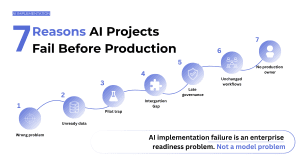
1. The Business Problem Was Never Suitable for AI
Some AI projects fail before a developer writes a single line of code.
The organization begins with a technology—an LLM, AI agent, recommendation engine, predictive model, or computer-vision system—and then searches for somewhere to use it.
The sequence should be reversed.
A successful enterprise AI implementation starts with a decision, workflow, constraint, or business outcome that needs to improve.
Before development, the organization should be able to answer:
What decision will AI improve?
What measurable business outcome should change?
Is enough reliable information available to make that decision?
What happens when the AI is wrong?
Who or what will act on the output?
Is AI economically better than a simpler automation or software solution?
That last question is frequently overlooked.
Not every automation problem needs AI. Not every prediction creates enough value to justify the infrastructure, integration, governance, inference, monitoring, and maintenance required to operate an AI system.
One well-known example is Zillow Offers. When Zillow announced the wind-down of the business in 2021, its CEO said unpredictability in forecasting home prices had exceeded what the company anticipated and created excessive earnings and balance-sheet volatility.
The lesson is broader than forecasting accuracy: model capability has to fit the economics and risk tolerance of the business process surrounding it.
2. Enterprise Data Is Not Ready for Production AI
An enterprise can possess enormous quantities of data and still not be AI-ready.
Production AI requires more than volume. It requires data that is current, accessible, traceable, permission-aware, sufficiently complete, and connected to the context in which a decision is being made.
McKinsey’s 2026 research on AI data readiness describes data as an increasingly important constraint as organizations move AI pilots toward scale.
The difficulty becomes visible when curated pilot datasets meet operational reality.
Production data contains missing fields, conflicting definitions, duplicates, outdated documents, inconsistent formats, edge cases, permission restrictions, and information distributed across multiple applications.
An enterprise assistant, for example, may retrieve a technically relevant document without knowing whether it is the latest approved version. A prediction model may perform well on historical training data but encounter customer behavior that has changed. A RAG application may have access to thousands of documents while still producing unreliable answers because metadata, retrieval, permissions, or document-processing pipelines are weak.
That is why AI readiness starts with data engineering, not model selection.
Before scaling an AI initiative, organizations should assess data quality, lineage, ownership, accessibility, permissions, freshness, production pipelines, and monitoring.
The question is not simply:
“Do we have data?”
It is:
“Can this AI system continuously access the right data, in the right context, with the right permissions, at the moment a business decision depends on it?”
3. A Successful AI Pilot Is Mistaken for a Production-Ready System
This is one of the most common AI implementation failures.
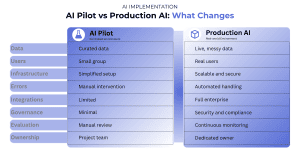
A proof of concept is intentionally simplified.
It may use curated data, limited traffic, manually reviewed outputs, a small user group, temporary infrastructure, and direct access to engineers who can intervene whenever something behaves unexpectedly.
Production removes those protections.
Suddenly the AI system must handle concurrent users, incomplete data, API failures, latency requirements, permissions, security controls, model updates, observability, cost constraints, and unpredictable user behavior.
The model is only one component.
Production also requires evaluation, monitoring, version control, rollback capability, confidence thresholds, human-review pathways, failure handling, logging, data pipelines, and operational support.
This is why the real transition is not:
Pilot → Bigger Pilot
It is:
Pilot → Production Engineering
Enterprises should therefore design the production architecture while validating the pilot, rather than discovering production requirements after the proof of concept has already been declared successful.
4. Enterprise Integration Is Underestimated
An AI system creates limited value when it remains disconnected from the systems where work happens.
Most enterprise AI must interact with some combination of ERP platforms, CRMs, data warehouses, APIs, document repositories, identity systems, cloud services, workflow platforms, or internally developed applications.
This is where otherwise capable projects frequently slow down.
Legacy applications may lack APIs. Data ownership may be unclear. Authentication models may differ between systems. Real-time information may not be available. API limits may not support AI workloads. A recommendation generated by AI may have no reliable mechanism for triggering the next business action.
This creates a crucial distinction:
Generating intelligence is not the same as operationalizing intelligence.
If an AI system identifies a high-risk customer but the output never reaches the CRM workflow used by the account team, it has produced insight without changing an outcome.
Good Generative AI workflow integration therefore needs to be designed as part of the implementation—not attached after the model is complete.
The organization should map, before development, which systems provide context, where the AI output needs to go, who or what acts on it, which APIs are required, what permissions apply, and what happens when an integration fails.
5. Governance and Security Arrive Too Late
AI pilots are often permitted to operate with fewer controls because they are experiments.
Production systems cannot.
Once AI begins using sensitive enterprise information, influencing customer interactions, making recommendations, or taking actions through agentic workflows, questions of access, privacy, accountability, auditability, accuracy, security, and human oversight become part of the architecture.
Rite Aid provides an important example of what happens when safeguards fail to keep pace with AI deployment. The U.S. Federal Trade Commission said the company’s facial-recognition program lacked reasonable procedures and safeguards, including adequate accuracy testing and protections against false positives. The resulting order prohibited the company from using facial recognition for surveillance for five years.
The broader lesson is not limited to facial recognition.
Governance introduced after development becomes a retrofit. Governance designed before development becomes architecture.
Enterprises should establish early:
- approved data sources and access boundaries,
- human-approval requirements,
- model and output evaluation criteria,
- security controls,
- auditability and logging,
- privacy requirements,
- escalation paths,
- monitoring and incident-response processes,
- and clear accountability for consequential AI decisions.
This becomes even more important with AI agents because the potential failure mode changes from producing a poor answer to taking an incorrect action.
6. The AI Works, but the Workflow Does Not Change
One of the most important lessons from current enterprise AI research is that technology deployment alone is not transformation.
McKinsey found that workflow redesign had the strongest relationship with reported EBIT impact among the organizational attributes it studied in its 2025 State of AI research. Yet only 21% of respondents using Generative AI said their organizations had fundamentally redesigned at least some workflows.
That gap explains many AI implementation failures.
Organizations deploy an AI tool alongside an existing process but leave responsibilities, incentives, approvals, handoffs, and decision rights untouched.
Employees now have one more system to check.
A customer-service agent receives an AI recommendation but still has to verify it manually across three applications.
A manager receives AI-generated insight but has no authority to act differently.
A team does not trust the output, so members repeat the old process anyway.
In these situations, the AI may technically work while productivity actually declines.
Successful AI implementation requires designing the human-AI operating model.
Organizations must decide when AI recommends, when it executes, when humans approve, when employees can override it, how uncertain outputs are escalated, and how work changes when the system becomes available.
AI adoption should therefore be treated as workflow transformation, not software installation.
7. Nobody Owns AI After Go-Live
Pilots have project teams.
Production AI systems need owners.
Someone must be accountable for uptime, model performance, data quality, security, evaluation, adoption, cost, retraining, integrations, user feedback, and what happens when the system’s behavior changes.
Without that ownership, AI slowly becomes operationally orphaned.
The engineers who built the pilot move to another project. Business sponsors return to other priorities. Operations teams inherit a system they did not design. Model or retrieval quality deteriorates, usage declines, costs rise, and nobody has a clear mandate to intervene.
Enterprise AI should therefore be treated as a continuously managed product rather than a project that ends at launch.
AI implementation costs also need to reflect this reality.
The budget should not stop at development. It must account for inference, data processing, cloud infrastructure, monitoring, evaluation, security, support, model updates, integration maintenance, and ongoing improvement.
Otherwise a technically successful deployment can become an economically unsuccessful one.
How to Avoid AI Implementation Failures
The best time to prevent AI implementation failure is before the pilot begins.
A practical AI readiness audit should examine the business problem, data, architecture, integrations, governance requirements, workflow impact, production ownership, and economics together.
Before the pilot, organizations should validate the use case against a measurable business outcome, assess production data rather than only demonstration data, map integration dependencies, establish security and governance requirements, define operational ownership, and agree on the metrics that will determine whether the initiative deserves to scale.
During development, teams should expose the system to real production conditions as early as possible. Data pipelines should run against realistic inputs. Integrations should be tested before the final deployment phase. Human-review mechanisms, evaluation, observability, security, and cost monitoring should be engineered alongside the AI capability.
Before production, establish a clear readiness gate.
The question should not be:
“Does the model work?”
It should be:
“Is the entire system ready to become a dependable business capability?”
That means assessing performance, business value, security, data reliability, integration resilience, monitoring, operating ownership, user readiness, and recovery procedures together.
After deployment, measure both AI performance and business performance.
Accuracy, latency, retrieval quality, hallucination rates, and model evaluation scores matter. But so do revenue impact, cycle-time improvement, employee adoption, customer experience, cost per transaction, risk reduction, and operational efficiency.
An AI system that performs well technically but does not improve the business outcome is not a successful implementation.
What Should You Do If an AI Project Is Already Stalled?
Not every stalled AI project should be rescued.
First determine whether the blockage is technical or organizational.
If model performance, data quality, infrastructure, or integration is preventing deployment, the initiative may need engineering intervention.
If the technology works but governance, ownership, workflow design, adoption, or business sponsorship is blocking deployment, adding more engineers may simply increase the cost without solving the real problem.
Then reassess the use case.
Business priorities change. A problem that appeared important six months ago may no longer justify the implementation effort.
From there, an enterprise essentially has three choices:
Revive the initiative when the use case remains valuable and the implementation barrier can realistically be removed.
Pivot when useful technology, data, or integration work has been created but the original use case no longer justifies the investment.
Stop when the business case, data foundation, operating ownership, or organizational commitment no longer supports production.
Stopping can feel like an AI project failure.
Sometimes it is simply good capital allocation.
Continuing to fund an initiative that will never create business value is the more expensive failure.
How Sarvika Helps Enterprises Move AI from Pilot to Production
Sarvika approaches AI implementation as an enterprise engineering problem rather than simply a model-development exercise.
Our work begins by understanding what business outcome AI needs to improve and whether the surrounding enterprise environment is ready to support it.
That can include AI readiness audits, data engineering, Generative AI workflow integration, application and API integration, cloud and AI infrastructure, AI governance, evaluation, AI code review and QA, and production monitoring.
The objective is not to create another impressive AI demonstration.
It is to engineer a system that fits the organization’s data, applications, workflows, security requirements, operating model, and economics—and can continue delivering measurable value after deployment.
Conclusion
AI implementation failures rarely occur because organizations lack access to capable AI models.
They occur because enterprises underestimate everything the model depends on.
The wrong problem is selected. Production data behaves differently from pilot data. Existing applications cannot integrate reliably. Security and governance appear late. Employees continue using old workflows. Operational ownership is unclear. Technical metrics improve while business outcomes do not.
The organizations that scale AI successfully will therefore not necessarily be those that experiment with the most models or launch the most pilots.
They will be the organizations that treat AI implementation as a coordinated business and engineering transformation spanning strategy, data, architecture, integration, governance, people, and operations.
A successful AI pilot proves that the technology can work.
A successful AI implementation proves that the enterprise can work differently because of it.

Frequently Asked Questions
- Why do AI projects fail?
AI projects commonly fail because organizations choose unsuitable business problems, lack production-ready data, underestimate integration and infrastructure requirements, introduce governance too late, fail to redesign workflows, or do not establish ownership after deployment. AI implementation failures are therefore often enterprise-readiness problems rather than model problems.
- What is the difference between an AI pilot and production AI?
An AI pilot typically validates whether a model or use case can work under controlled conditions. Production AI must operate reliably with live data, real users, enterprise integrations, security controls, monitoring, governance, cost constraints, failure handling, and ongoing operational ownership.
- What is an AI readiness audit?
An AI readiness audit evaluates whether an organization has the business case, data quality, architecture, integrations, security, governance, workflows, operational ownership, and economics required to deploy and scale an AI solution successfully.
- How can enterprises reduce AI implementation failures?
Enterprises should begin with a measurable business problem, validate data and integration requirements early, design for production during the pilot, establish governance from the beginning, redesign affected workflows, define human oversight, and measure business outcomes after deployment.
- Why is data readiness important for AI implementation?
Production AI depends on accurate, current, accessible, governed, and context-rich data. Poor data quality, weak lineage, outdated information, missing metadata, inconsistent permissions, or unreliable pipelines can make AI outputs unreliable even when the underlying model performs well.
Pilots often use curated data, limited users, manual validation, and simplified infrastructure. Production introduces concurrency, security, latency, integration dependencies, cost, monitoring, model lifecycle management, real-world data variation, and operational ownership. Projects that do not design for these conditions can stall during the transition from pilot to production.
- How should AI implementation success be measured?
Enterprises should combine technical AI metrics—such as accuracy, retrieval quality, latency, reliability, and evaluation scores, with business KPIs such as productivity, revenue impact, cycle-time reduction, customer experience, adoption, cost efficiency, and risk reduction.

Sarvika Technologies
Sarvika Tech is a team of young, energetic, and technology-loving people on the journey to help companies achieve their goals by supporting their IT needs. In a nutshell, we are a people’s company where the priority is their knowledge enhancement and career development. We believe that focusing on our most important asset, the team, will enable us to push boundaries and deliver ingenious IT solutions.