
AI in Government: Practical Use Cases for Citizen Services, Automation, and Decision-Making
AI in government should solve public problems, not create technology projects. That distinction separates initiatives that measurably improve citizen services from those that simply add another chatbot, dashboard, or pilot to an already crowded technology roadmap.
Public sector departments are past the experimentation phase: OECD data shows 35 of 36 OECD countries now use AI in at least one government function, well beyond internal back-office tasks. What matters now is not how much AI gets deployed, but where and why.
The real opportunity lies in identifying a measurable public-sector problem first: slow application processing, inaccessible services, delayed fraud detection, fragmented citizen data. Only then choose the AI capability that solves it, without compromising security, accountability, accessibility, or citizen trust.
This article explores where AI in government is already creating value, where autonomy and accountability intersect, why workforce readiness matters as much as the technology itself, and which decisions should never be fully handed to a model.
What Is AI in Government?
AI in government means applying technologies such as machine learning, natural language processing, generative AI, computer vision, OCR, intelligent automation, and conversational AI to improve public services, automate administrative work, analyse government data, and support evidence-based decisions.
What matters is matching the right AI capability to the right public-sector problem: helping citizens navigate services, extracting information from documents, or supporting officials handling complex casework while working alongside existing portals, databases, and legacy systems rather than replacing them outright.
AI in Global Governments: What Are Governments Actually Doing With AI?
Governments are moving AI from pilots into real public services. We discussed that the OECD data shows 35 of 36 OECD countries (97%) now use AI in at least one government area, automating administrative work, improving citizen services, detecting risks, and supporting decision-making:
Its public sector is using AI for procurement, policy intelligence, and public services. Korea’s e-RFP Assistance System combines GenAI with government procurement data to draft requests and check regulatory compliance, reducing document-preparation time by 70% while achieving 99.9% compliance.
A government-led GenAI trial involving 20,000+ civil servants reported average time savings of 26 minutes per day, equivalent to nearly two working weeks per person annually. The UK is also deploying AI across healthcare, planning, justice and taxation through its AI Exemplars programme.
The National Informatics Centre’s VANI multilingual conversational AI framework recorded 14 crore+ interactions in FY 2024–25 and supports government projects across legal services and transport. Separately, AI-powered systems in India’s public healthcare ecosystem have supported 196 million eSanjeevani consultations, with 12 million consultations aided by AI-recommended diagnoses.
These developments reflect how governments are bringing AI and other emerging technologies into everyday digital transformation.
Types of AI Used in Government: What Each One Solves
Governments do not rely on a single form of AI across departments. The right approach is matching the technology to the specific use case, data maturity, and risk level.
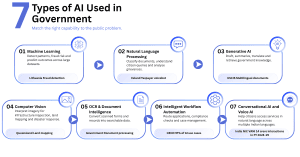
- Machine Learning (ML)
Machine learning helps departments identify patterns, predict outcomes, and detect anomalies across large datasets, supporting fraud detection, resource forecasting, and eligibility analysis.
Real-world example: Lithuania’s Special Investigation Service is developing an ML-supported risk-assessment tool to identify patterns associated with fraud and corruption in public spending.
- Natural Language Processing (NLP)
NLP lets systems understand, classify, summaries, translate, and extract information from human language useful for citizen queries, document analysis, and grievance classification.
Real-world example: Ireland’s Revenue Commissioners used NLP with speech technologies for a taxpayer voicebot, which handled up to 50% of calls end-to-end during its deployment.
- Generative AI (GenAI)
Generative AI can produce summaries, reports, drafts, and knowledge-retrieval results from government information. Adoption remains concentrated in lower-risk productivity work rather than fully automated high-impact decisions — a boundary this article returns to below.
Real-world example: The U.S. Citizenship and Immigration Services (USCIS) is developing a GenAI-enabled system to translate government documents across different formats, helping improve the speed and accessibility of multilingual services.
- Computer Vision
Computer vision lets software interpret images and video for infrastructure inspection, land-use mapping, and disaster response — turning visual information into structured insight that departments can act on faster.
Real-world example: Queensland, Australia uses machine learning and computer vision to map and classify land-use features from satellite imagery, supporting land management, biosecurity, and disaster response.
- Optical Character Recognition (OCR)
OCR converts scanned documents, forms, and handwritten records into machine-readable data. Paired with NLP, it cuts manual data entry and makes large document repositories searchable.
Real-world application: OECD research identifies document classification and processing among the structured administrative tasks where AI adoption is progressing fastest across governments.
- Intelligent Workflow Automation
Intelligent workflow automation combines AI with rules, APIs, and workflow engines to automate repetitive, information-heavy processes — application processing, document routing, compliance checks, case management — while keeping human intervention where judgement is required.
Real-world example: OECD research shows that 57% of analysed government AI use cases aim to automate, streamline, or tailor processes and services — the largest identified benefit category.
- Conversational AI and Voice AI
Conversational AI lets citizens interact with services through natural-language chat or voice instead of complex menus and forms. Multilingual versions also make government portals more accessible across languages.
Real-world example: India’s NIC VANI framework supports multilingual government chatbots, integrating translation across 22 Indic languages and voice interaction across 9 Indian languages, with more than 14 crore hits in FY 2024–25.
- Predictive Analytics and AI-Assisted Decision Support
Departments combine AI and predictive analytics to forecast demand, identify emerging risks, and priorities resources — especially valuable when officials must interpret complex datasets before high-impact decisions.
Real-world example: OECD research shows that AI use for policymaking has increased, although adoption remains more cautious than in internal operations and public services because decision-making requires stronger data quality, transparency, and assurance.
What Will the Future of AI in Government Look Like?
The use cases above show where AI is already working. The more interesting question is where it goes next. The bigger shift arrives when AI begins to understand context, coordinate across systems, and execute defined tasks on behalf of citizens or government employees.
- AI Agents That Orchestrate Government Services
Consider a citizen requesting a complex service that today spans multiple departments and forms. A future AI agent could understand the request, coordinate the underlying workflows, and ask for approval at critical stages. Estonia’s Bürokratt is already exploring this, envisioning one AI interface for multiple government services.
- Proactive Government Services
Government services could become anticipatory rather than reactive. Instead of waiting for citizens to discover they qualify, AI could identify eligible situations from authorised data and notify them proactively, shifting from “How do I apply?” to “How can I access what I already qualify for?”
- AI-Powered Digital Public Infrastructure
AI could become an intelligent layer across digital public infrastructure, such as databases, APIs, and departmental applications, working under identity, permissions, and data-governance controls rather than as another disconnected application. The OECD notes AI scales effectively only when governments have strong foundations in interoperable data and governance.
- Multilingual, Voice-First Government
The next generation of citizen services may become significantly more voice-driven and multilingual, letting citizens interact in their preferred language, through speech, while AI translates and routes them to the right service. This matters most for linguistically diverse populations and citizens facing accessibility barriers.
- AI That Helps Governments Simulate Before They Act
A more advanced application is AI-assisted scenario modelling: before changing a policy or responding to a crisis, departments could model outcomes from historical and real-time data. This doesn’t hand policy decisions to AI — officials use it to examine scenarios and decide themselves.
The Next Government AI Challenge Is Autonomy With Accountability
As AI systems move from answering questions to taking actions, such as retrieving records, updating case files, routing applications, triggering notifications – the governance question changes fundamentally. It is no longer only “is the output accurate?” It becomes “who is accountable when the system acts?”
For any AI system that can act across government workflows, departments need clear answers to five questions before granting it more autonomy:
- What data and systems did it access, and under whose authorisation?
- Which policy, rule, or eligibility criterion governed its action?
- What did it actually change — a record, a status, a communication, a payment?
- At what point does a human need to review or approve the action before it takes effect?
- How can the action be paused, reversed, or appealed if it turns out to be wrong?
The OECD’s own guidance on agentic AI in government reinforces this: traceability, human oversight, user control, and a functioning mechanism to challenge automated decisions are treated as design requirements, not optional safeguards added after deployment.
Accountability has to be engineered into the system’s architecture — audit logs, permission boundaries, escalation points — not assumed as a policy statement outside the technology. An AI agent that can’t explain what it did and why isn’t ready for autonomy, however accurate its outputs may be.
The Principle: Let AI Assist High-Impact Decisions, Never Finalise Them
Not every government decision carries the same weight, and oversight should scale with consequence. A missed appointment reminder and a benefits-eligibility denial are not the same category of risk, and treating them identically either over-controls low-risk automation or under-controls high-risk automation.
A useful working principle: if a decision can restrict a citizen’s rights, finances, liberty, safety, or access to essential services, a qualified human must authorise the final outcome — AI can prepare the analysis, but cannot be the final decision-maker. This covers eligibility determinations, enforcement actions, legal-status decisions, risk scoring, and healthcare recommendations — anything costly for a citizen to reverse.
For these categories, AI’s role should stay assistive: summarising a case file, flagging inconsistencies, forecasting risk, or drafting a recommendation — with a named official accountable for the final decision and a clear path for the citizen to challenge it.
Lower-stakes, easily reversible tasks — routing a query, translating a document, drafting a summary — can tolerate a lighter model. The dividing line isn’t the AI system’s sophistication; it’s the real-world consequence of getting it wrong.
The Government AI Workforce Needs to Evolve Too
AI can only deliver value when employees know how to work with it, question its outputs, and apply judgement where the principle above needs a human decision-maker. Without trained staff who recognise when to intervene, oversight exists only on paper.
This makes workforce development continuous, not a one-time exercise. The OECD reports 89% of OECD countries now provide some AI training, but only 36% train specifically for public services or policymaking — a gap that matters, since generic literacy won’t help an official spot a flawed recommendation.
- Move from AI literacy to AI fluency: Train employees to prompt, validate, interpret, and responsibly use AI outputs in their day-to-day government workflows.
- Train by role, not with one generic programme: Give administrators, policymakers, frontline officials, technical teams, and senior leaders training aligned with how each group will actually use AI.
- Teach employees to redesign workflows, not just automate them: Training should show teams how to identify repetitive tasks, combine AI with existing processes, and rethink services instead of automating inefficient legacy workflows as they stand.
- Build AI-assisted decision-making skills: Officials should learn how to use AI for research, forecasting, summarisation, scenario analysis, and evidence gathering while retaining accountability for consequential decisions.
- Create continuous AI learning programmes: Government AI capabilities will keep changing. Continuous upskilling, sandbox environments, and hands-on learning help public-sector teams adopt new AI models without waiting for another technology cycle.
AI in Government Meant to Solve Public Problems, Not Create Technology Projects
This is the article’s opening argument, worth restating: AI in government’s real value is solving a measurable public-sector problem, not shipping a technology project. Prioritise AI where it improves service delivery or decision-making and apply the oversight principle above wherever a decision affects a citizen’s rights.
OECD research across 200 government AI use cases shows 57% focus on automating or tailoring processes and services, evidence that the highest-value work is often the least glamorous. Start with the citizen or operational challenge, then pick the AI solution and technology partner that can solve it securely, at scale.
Turning that opportunity into a production-ready capability rarely is just a modelling exercise. However, it needs secure architecture, legacy-system integration, and governance built in from day one.
This is the engineering work our team at Sarvika does alongside government departments, without disrupting systems already in production. You connect with our skilled and experienced technology consultants to suggest the best implementation your solution requires to improve the citizen services and automation.
Frequently Asked Questions (FAQs)
1. What is the biggest challenge governments face when implementing AI?
The biggest challenge is rarely the AI model itself. Governments often struggle with fragmented data, legacy IT systems, skills gaps, and proving measurable value. Successful AI implementation therefore requires strong digital foundations, clear ownership, and a defined path from pilot to production.
2. How can governments use AI without replacing human decision-making?
Governments can deploy AI-assisted decision-making where AI analyses information, generates recommendations, or forecasts outcomes while officials retain decision authority. This human-in-the-loop approach works well where transparency and the ability to challenge outcomes remain essential — the same principle outlined earlier in this article for high-impact decisions.
3. How can government departments measure the ROI of AI projects?
Departments should measure AI against defined operational and public-service outcomes rather than model performance alone — processing time, cost per transaction, error rates, and citizen satisfaction. This matters because only 28% of OECD countries currently report measuring the impact of their government AI use cases.
4. Can AI integrate with existing government legacy systems?
Yes; governments can integrate AI with legacy applications through APIs, middleware, and secure integration layers rather than replacing every existing system. This lets departments introduce AI capabilities incrementally while protecting critical systems and building a practical path toward broader digital transformation.
5. What should government leaders consider before scaling an AI pilot?
Before scaling, leaders should validate data quality, security, integration requirements, human oversight, and measurable outcomes, and establish clear ownership after deployment. A successful pilot does not automatically justify production deployment; governments need evidence the solution operates reliably and safely at scale.

Sarvika Technologies
Sarvika Tech is a team of young, energetic, and technology-loving people on the journey to help companies achieve their goals by supporting their IT needs. In a nutshell, we are a people’s company where the priority is their knowledge enhancement and career development. We believe that focusing on our most important asset, the team, will enable us to push boundaries and deliver ingenious IT solutions.