
Orchestration Becomes the Core Skill: Why the Best AI Engineers Are Now System Architects
The AI industry is entering a new phase.
For the past few years, conversations around AI engineering revolved around prompt engineering, model selection, fine-tuning, and Retrieval-Augmented Generation (RAG). While these skills remain important, enterprises are now facing a different challenge: building AI systems that are reliable, scalable, governable, and capable of delivering business outcomes.
As organizations deploy AI agents, tool-calling workflows, memory systems, retrieval layers, and human approval loops, the complexity of AI applications is shifting away from models and toward systems.
This shift is changing the role of AI Engineers.
The most valuable AI professionals are increasingly not those who can train a model or write the perfect prompt. They are the ones who can design, orchestrate, govern, and optimize entire AI ecosystems.
In other words, AI Engineers are evolving into AI Systems Architects. In this blog, we will explore how orchestration has changed the role of AI Engineers into System Architects.
AI Engineering Has Entered Its Architecture Era
A few years ago, the defining question in artificial intelligence was straightforward:
“Which model performs best?”
Today, enterprise leaders are asking a different question:
“How do we make AI work reliably inside our business?”
That change may seem subtle, but it represents one of the biggest shifts happening in AI engineering.
The rise of foundation models has dramatically lowered the barrier to AI adoption. Organizations no longer need billion-dollar research budgets to access state-of-the-art intelligence. Models from OpenAI, Anthropic, Google, Meta, and other providers are now accessible through APIs and cloud platforms.
In many ways, AI models are beginning to resemble cloud infrastructure.
Few organizations build their own cloud providers. They consume cloud services and focus on building business value on top of them. The same pattern is emerging in AI.
Most enterprises are integrating them into products, workflows, customer experiences, and business processes. This is where a new challenge appears. An enterprise AI system today rarely consists of a single model.
Instead, it may involve:
- Multiple AI agents
- Retrieval systems
- Vector databases
- Tool integrations
- Workflow automation
- Human approval layers
- Evaluation pipelines
- Governance controls
The complexity is inside the system. This evolution is already visible across the industry. According to McKinsey’s latest State of AI research, organizations are increasingly focusing on embedding generative AI into workflows rather than treating it as a standalone capability. Business value is being created not simply through model access, but through the ability to integrate AI into operational processes. That shift has profound implications for AI talent.
The next generation of AI leaders will not be defined solely by their ability to build intelligent models. They will be defined by their ability to coordinate intelligence across systems. And that is exactly why orchestration is becoming one of the most important skills in enterprise AI.
AI Engineers Are Solving Different Problems Than They Were Three Years Ago
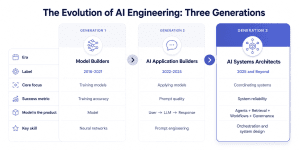
One of the clearest ways to understand the industry’s transformation is to examine how the role of AI Engineers has evolved. The profession itself has gone through multiple generations in a remarkably short period of time.
Generation 1: Model Builders (2016–2021)
During the deep learning boom, AI engineering was heavily focused on model development.
Success was measured by:
- Training accuracy
- Model architecture
- Dataset quality
- GPU infrastructure
- Research innovation
The core challenge was teaching machines how to learn. Engineers spent significant time working on neural networks, optimization techniques, training pipelines, and experimentation.
In this era, building the model was the product.
Generation 2: AI Application Builders (2022–2024)
The arrival of large language models changed the equation. Suddenly, developers could access powerful intelligence without training their own models.
The focus shifted toward:
- Prompt engineering
- Fine-tuning
- Retrieval-Augmented Generation (RAG)
- AI copilots
- LLM-powered applications
The challenge was applying intelligence. This period produced an explosion of AI-powered products and experimentation across industries.
However, many applications remained relatively simple.
The architecture often looked like this:
User → LLM → Response
Generation 3: AI Systems Architects (2025 and Beyond)
Today, enterprises are entering a third phase. Organizations are no longer building isolated AI applications. They are building AI ecosystems.
A modern enterprise AI system may include:
- Multiple specialized agents
- Knowledge retrieval systems
- Tool-calling frameworks
- Approval workflows
- Security controls
- Evaluation frameworks
- Monitoring platforms
- Compliance layers
The challenge is coordinating intelligent systems. This is why the role of the AI Engineer is evolving.
Increasingly, the most valuable professionals are not simply model experts. They are system designers capable of connecting intelligence, workflows, data, governance, and business processes into a unified architecture. The AI Engineer is becoming an AI Systems Architect in many organizations. And orchestration sits at the center of that transformation.
The Great Shift: Enterprise AI Value Is Moving Away From Models
When ChatGPT entered the mainstream in late 2022, much of the industry’s attention focused on models. Every discussion centered around:
- Which model was more powerful?
- Which model had better benchmarks?
- Which model generated better outputs?
- Which company had the strongest foundation model?
The capabilities of foundation models were improving at an extraordinary pace. However, as the market matured, something interesting happened. Access to advanced AI became increasingly democratized.
Today, enterprises can choose from:
- GPT models from OpenAI
- Claude models from Anthropic
- Gemini models from Google
- Llama models from Meta
- Open-source alternatives
This changes where value is created.
A useful comparison can be found in cloud computing. When cloud platforms first emerged, infrastructure was a competitive advantage.
Today, every company has access to world-class infrastructure. Competitive advantage comes from how organizations use that infrastructure to build products and deliver customer value.
AI is following a similar trajectory. The future winners are unlikely to be the organizations with exclusive access to models. They will be the organizations that can design better systems around those models.
Consider two enterprises using the same foundation model. One organization deploys a simple chatbot. The other builds:
- AI agents
- Retrieval systems
- Workflow automation
- Human oversight mechanisms
- Continuous evaluation pipelines
Both organizations have access to identical intelligence. Yet one creates substantially more business value.
The difference is the architecture.
This is why enterprise AI discussions are increasingly shifting from model performance to questions such as:
- How do agents collaborate?
- How should memory be managed?
- How should workflows be orchestrated?
- How do we govern AI decisions?
- How do we measure reliability?
That is why the center of gravity in AI engineering is moving upward—from models to architecture.
Why Orchestration Is Becoming the New Competitive Advantage?
In the early days of generative AI, the biggest challenge was gaining access to capable models. Today, access is no longer the problem. OpenAI, Anthropic, Google, Meta, and a growing ecosystem of open-source providers have made advanced AI capabilities widely available.
This is why orchestration is rapidly becoming one of the most strategic capabilities in enterprise AI.
-
From Single Models to AI Ecosystems
Enterprise AI has evolved far beyond simple prompt-and-response applications. Modern AI solutions consist of multiple interconnected components, including agents, retrieval systems, memory layers, governance controls, and human approvals that must work together seamlessly. The challenge is no longer building intelligence; it is designing systems that can coordinate intelligence effectively.
-
Intelligence Is Becoming a Commodity
Access to advanced AI models is no longer limited to a handful of organizations. With GPT, Claude, Gemini, Llama, and other foundation models widely available, the competitive advantage is shifting away from owning intelligence and toward orchestrating it. The organizations that create the most value will be those that can integrate AI into business workflows and operational systems.
-
Agentic AI Is Accelerating the Shift
The rise of AI agents is pushing orchestration to the center of enterprise AI architecture. Unlike traditional AI applications that only generate outputs, agents can perform actions, interact with tools, and collaborate with other systems. As organizations deploy multiple agents across business functions, coordinating their behavior becomes a critical engineering and architectural challenge.
The Rise of the AI Systems Architect
As enterprise AI systems become more sophisticated, the role of the AI Engineer is evolving beyond model development and prompt design. Organizations are no longer building isolated AI applications; they are building interconnected ecosystems that combine agents, retrieval systems, memory layers, business workflows, governance controls, and human oversight.
This shift is giving rise to a new role: the AI Systems Architect.
AI Systems Architects focus on how intelligence flows across the organization. They design the frameworks that enable AI agents, tools, data systems, and human decision-makers to work together reliably and securely. Their responsibility extends beyond generating outputs to ensuring that AI systems are scalable, observable, governed, and aligned with business objectives.
These architects are becoming the bridge between technology and business value. As orchestration becomes central to enterprise AI, the professionals who can design and coordinate these complex systems will play a critical role in determining which AI initiatives succeed and which fail.
AI Engineers Are Being Elevated, Not Replaced
There is a common misconception that orchestration platforms will automate much of the AI engineering work. The reality appears to be the opposite.
Orchestration shifts where that complexity exists. Instead of spending most of their time training models or refining prompts, AI Engineers increasingly focus on:
- System architecture
- Workflow design
- Agent coordination
- Governance frameworks
- Evaluation pipelines
- Reliability engineering
Their responsibilities expand rather than shrink. This is why orchestration should not be viewed as a threat to AI Engineers. It should be viewed as an opportunity where the profession is moving higher up the value chain.
The Best AI Engineers Are Becoming Systems Thinkers
One of the defining characteristics of modern AI leaders is systems thinking. Systems thinkers understand that enterprise AI success rarely depends on a single component.
A great model cannot compensate for:
- Poor data
- Weak retrieval
- Broken workflows
- Missing governance
- Inadequate evaluation
Likewise, an average model can often deliver exceptional business value when embedded within a well-designed system.
This is why organizations increasingly value engineers who can see the entire architecture rather than focusing exclusively on individual components. The ability to connect models, agents, workflows, humans, security controls, and business processes is becoming one of the most important skills in AI.
The New Responsibilities Created by AI Orchestration
As orchestration becomes central to enterprise AI, the responsibilities of AI Engineers are expanding. The modern AI Systems Architect is responsible for far more than model performance. They are responsible for how intelligence operates across the organization.
Designing Agent Ecosystems
Most enterprises will not operate a single AI agent. They will operate many. Different agents will specialize in:
- Research
- Customer support
- Operations
- Software development
- Internal knowledge management
Someone must define:
- Agent responsibilities
- Communication patterns
- Escalation logic
- Decision boundaries
This is architectural work.
Designing Retrieval and Knowledge Architectures
Many enterprise AI systems depend on retrieval rather than training. The quality of these architectures often has a greater impact on business outcomes than model selection itself. This means AI professionals increasingly design:
- Knowledge repositories
- Vector databases
- Context pipelines
- Retrieval workflows
- Memory systems
Building Evaluation Systems
One of the fastest-growing disciplines in AI is evaluation engineering. Organizations are realizing that:
If you cannot measure AI performance, you cannot trust AI performance. In many enterprises, evaluation is becoming as important as development.
Modern AI Systems Architects design evaluation frameworks that assess:
- Accuracy
- Reliability
- Safety
- Cost efficiency
- User satisfaction
Creating AI Observability Layers
Traditional software systems require monitoring, whereas AI systems require observability. The ability to understand why an AI system behaves a certain way is becoming a core architectural requirement. Observability is rapidly becoming one of the defining responsibilities of AI Systems Architects. Organizations need visibility into:
- Agent behavior
- Retrieval quality
- Model outputs
- Cost patterns
- Failure modes
- Workflow bottlenecks
Skills Required for Today’s AI Engineers
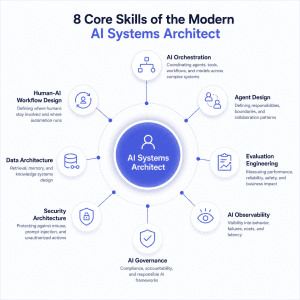
If orchestration is becoming the center of enterprise AI, then the skills required for success are evolving as well. It means they are no longer sufficient on their own. The next generation of AI Engineers will need a broader set of capabilities.
AI Orchestration
Understanding how agents, tools, workflows, models, and humans coordinate across complex systems.
Agent Design
Defining responsibilities, collaboration patterns, escalation paths, and operational boundaries for AI agents.
Evaluation Engineering
Designing systems that continuously measure performance, reliability, safety, and business impact.
AI Observability
Creating visibility into system behavior, failures, costs, latency, and user outcomes.
AI Governance
Building frameworks for compliance, accountability, security, and responsible AI operations.
Security Architecture
Protecting AI systems against misuse, prompt injection, unauthorized actions, and operational risks.
Data Architecture
Designing the retrieval, memory, and knowledge systems that modern AI applications depend upon.
Human-AI Workflow Design
Determining where humans should remain involved and where automation can safely operate.
How Sarvika Helps Organizations Build AI Systems That Scale?
We help organizations bridge the gap between AI capability and enterprise execution. Our teams work across:
- AI Engineering
- Agentic AI Development
- Enterprise AI Architecture
- Data Engineering
- AI Governance
- Workflow Automation
- AI Platform Design
We focus on building AI ecosystems rather than isolated AI features, which include designing:
- Orchestrated AI workflows
- Agent-based architectures
- Retrieval and knowledge systems
- Evaluation frameworks
- Governance models
- Scalable deployment strategies
As enterprise AI becomes increasingly system-centric, organizations need architectures that balance innovation with reliability, scalability, security, and operational control. That is where strong orchestration and systems thinking become critical.
Conclusion
The AI industry is entering a new chapter.
- The first wave of innovation focused on building increasingly capable models.
- The second wave focused on applying those models to real-world problems.
- The next wave will focus on coordinating intelligence across increasingly complex ecosystems.
This is why orchestration is becoming one of the most important disciplines in enterprise AI. It is no longer enough to understand models. Organizations must understand how models interact with data, agents, tools, workflows, security systems, and governance frameworks.
The center of gravity in AI engineering is shifting. They do:
- From intelligence generation to intelligence coordination.
- From model expertise to system design.
- From isolated AI applications to orchestrated AI ecosystems.
Their role is evolving. The highest-value AI professionals of the coming decade may not be those who build the most advanced models. They may be the ones who design the most effective systems around them. Because the first generation of AI Engineers taught machines how to think. The next generation will teach entire AI ecosystems how to work together.

Muskan Lakhotia
Senior Content Writer
Muskan Lakhotia is a Senior Content Writer at Sarvika Technologies, where she turns complex ideas into content that feels clear, sharp, and worth reading. She works across digital transformation, enterprise solutions, and service-led storytelling, with a focus on creating narratives and strategies that inform & engages with the audience. Curious by instincts and strategic with plans, she enjoys shaping content that gives brands a stronger voice, a clearer point of view, and a more human way to speak to modern businesses.