
APIs Are Quietly Becoming the Most Valuable Asset in Modern Supply Chains
Organizations have spent the last decade investing in ERP modernization, AI, warehouse automation, and predictive analytics. Yet many still cannot answer a seemingly simple question:
“Where is the inventory right now?”
The system has become obsolete. Despite these investments, many organizations continue to struggle with fragmented workflows, delayed decision-making, inventory discrepancies, disconnected partner networks, and limited end-to-end visibility.
“Our proficiency says that the biggest challenge in modern supply chains isn’t the lack of AI; it’s the lack of connected systems.”
Behind every intelligent system lies a less visible but far more critical capability: Application Programming Interfaces (APIs). Even the most advanced technologies operate in isolation, limiting the value organizations expect from their digital transformation initiatives without APIs.
This shift is about creating an integrated digital ecosystem where ERP systems, Warehouse Management Systems (WMS), Transportation Management Systems (TMS), CRM platforms, IoT devices, suppliers, logistics partners, and AI applications work together in real time.
Here’s what we will unveil:
- Why have APIs evolved from technical interfaces into strategic business assets?
- How are they reshaping modern supply chains?
- Why are organizations that adopt an API-first approach better positioned to scale operations?
Read and prepare for the next-generation supply chain ecosystems.
Supply Chain Revolution Isn’t Being Driven by AI Alone
We agree that companies are investing in Artificial Intelligence and modern technologies to build faster and more resilient operations. However, these technologies are not transforming businesses independently. Their true value emerges only when they operate within a connected supply chain ecosystem, where applications, data, partners, and business processes communicate in real time.
-
AI Is Accelerating Supply Chain Transformation
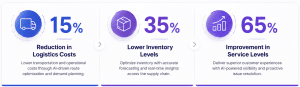
McKinsey reports that organizations implementing AI-enabled supply chain management have achieved:
- 15% reduction in logistics costs
- 35% lower inventory levels
- 65% improvement in service levels
Our Perspective:
AI delivers measurable business value only when it has access to reliable, connected, real-time operational data. Disconnected systems limit AI’s ability to make accurate decisions.
-
Future of Supply Chains Is Built on Connected Technologies
According to Gartner, the next generation of Supply Chain AI depends on building a strong digital foundation rather than scaling isolated AI use cases. Gartner highlights that many organizations struggle to realize enterprise-wide AI value because their technology ecosystems remain fragmented.
Our Perspective:
The organizations gaining the most from AI are not deploying more tools, but connecting existing systems to create a unified, intelligent supply chain.
-
Digital Transformation Is Shifting from Technology Adoption to Technology Integration
85% of operations and supply chain leaders have either increased their technology budgets in the past year or plan to increase them, while 81% are actively reconfiguring their existing technology stack to improve operational performance.
Our Perspective:
Technology spending is no longer the differentiator. Enterprises are now focused on connecting and modernizing existing systems to unlock greater business value from their digital investments.
The Uncomfortable Truth: Most Supply Chain Systems Still Don’t Speak the Same Language
The biggest bottleneck in today’s supply chain is hidden between business applications.
Every delay caused by manual reconciliation, every inventory mismatch, every shipment update that arrives too late, and every customer promise that cannot be fulfilled on time often traces back to one common issue: information isn’t flowing as quickly as the business expects.
We understand that you have upgraded your business systems with massive modern tech integrations, but the gap is in business connectivity.
“Sarvika has high-potential talents who’ll bring efficiency to the workflows to streamline the operations. We have expert programmers who adhere to AI, modern data analytics, and custom development to create a well-connected workflow for operational effectiveness.”
Where Modern Supply Chains Continue to Break Down
Disconnected systems create data silos, which lead to decision silos. The faster information moves across the supply chain, the faster businesses can respond, adapt, and compete.
Before you make any decision, here are some reasons our experts wanna share about why modern supply chains continue to break down:
- Manual Excel-based inventory reconciliation across multiple business units
- Email-driven collaboration with suppliers and logistics partners
- Delayed synchronization between order, inventory, and shipment updates
- Duplicate records across enterprise applications
- Limited real-time supply chain visibility across partner ecosystems
- Slow response to disruptions because operational data isn’t unified
- Time-consuming reconciliation before critical business decisions can be made
APIs Aren’t Just Integrations, But They’re Strategic Business Assets
Today, the APIs are strategic business assets that enable real-time supply chain integration, accelerate innovation, improve operational resilience, and prepare organizations for the next generation of AI-driven supply chains.
-
Enable Real-Time Business Connectivity
Modern enterprises rely on hundreds of business applications across procurement, warehousing, transportation, inventory, customer service, and partner ecosystems. We suggest integrating Enterprise APIs to establish real-time data integration, ensuring business-critical information flows instantly across systems without manual intervention, reducing delays and enabling faster operational decisions.
-
Accelerate Supply Chain Automation
Automation succeeds only when business applications exchange information seamlessly. We tested APIs in the systems that eliminated manual data transfers, synchronized workflows, and connected ERP, WMS, TMS, supplier platforms, and logistics systems to support intelligent supply chain automation. It improved efficiency while reducing operational complexity and repetitive tasks.
-
Build AI-Ready Supply Chain Ecosystems
The effectiveness of Artificial Intelligence in Supply Chain Management depends on accurate, connected, and continuously updated data. APIs provide the foundation for AI-powered demand forecasting, predictive analytics, intelligent inventory optimization, and autonomous decision-making by enabling secure and consistent enterprise-wide data exchange.
-
Improve Business Agility and Scalability
As organizations expand into new markets, onboard suppliers, adopt cloud platforms, or launch digital commerce initiatives. APIs enable faster integration without disrupting existing operations. This API-first architecture helps businesses scale confidently while supporting continuous innovation and future technology adoption.
-
Strengthen Supply Chain Visibility
Disconnected operations create fragmented insights. APIs connect suppliers, warehouses, transportation providers, distributors, and customer platforms to deliver end-to-end supply chain visibility, empowering leaders with real-time operational intelligence for faster, data-driven business decisions.
-
Future-Proof Digital Transformation Investments
Technology continues to evolve, but connected businesses adapt faster. APIs protect existing technology investments by simplifying application integration, enabling legacy system modernization, supporting cloud adoption, and creating flexible digital ecosystems that remain resilient as business requirements change.
The Cost of Disconnected Systems Is Higher Than Most Organizations Realize
Disconnected systems directly impact revenue, profitability, customer satisfaction, and business resilience. As supply chains become increasingly digital and data-driven, organizations can no longer afford fragmented systems that delay decisions and limit real-time visibility. Every disconnected workflow carries a hidden business cost, such as:
-
Disconnected Supply Chains Increase Operational Costs
According to McKinsey & Company, organizations adopting AI-enabled and connected supply chain capabilities have achieved up to a 15% reduction in logistics costs and 35% lower inventory levels.
The savings come from connected systems that enable accurate, real-time data exchange across the supply chain.
-
Poor Inventory Visibility Leads to Costly Business Decisions
Disconnected inventory systems often result in stockouts, overstocking, delayed replenishment, and inaccurate demand planning. Without real-time inventory visibility, organizations struggle to optimize working capital and meet customer expectations.
Inventory becomes a strategic asset only when every warehouse, supplier, and fulfillment center operates from the same real-time data.
-
Delayed Information Creates Delayed Deliveries
When order, warehouse, and transportation systems fail to exchange information instantly, shipment delays become inevitable. Customers experience inaccurate delivery commitments, while operations teams spend valuable time resolving preventable issues.
Customers experience delayed deliveries, inconsistent communication, and broken promises.
-
Manual Processes Quietly Reduce Productivity
Spreadsheets, email approvals, duplicate data entry, and manual reconciliation continue to consume thousands of productive hours across supply chain operations. These inefficiencies slow decision-making and increase operational costs.
The hidden cost of manual work is the lost opportunity to make faster, smarter business decisions.
-
Disconnected Systems Limit Business Growth
As organizations expand suppliers, warehouses, distribution centers, and digital sales channels, disconnected applications become increasingly difficult to manage. Business growth slows because technology cannot scale at the same pace.
Scalable businesses are built by connecting existing software into one intelligent ecosystem.
Stop Buying More Software. Start Connecting What You Already Have
The next phase of supply chain digital transformation isn’t about replacing every legacy system or investing in another enterprise platform. It’s about unlocking the full potential of the technologies you already own. Organizations that prioritize API-driven integration, connected infrastructure, and real-time data exchange consistently outperform those that continue adding disconnected software to an already fragmented technology landscape.
Instead of investing in…
- Another warehouse management platform.
- Another transportation application.
- Another planning dashboard.
- Another reporting tool.
- Another standalone business application.
Organizations should focus on building…
- Connected digital infrastructure that enables enterprise-wide collaboration.
- API-driven integration between ERP, WMS, TMS, CRM, and partner ecosystems.
- Real-time data synchronization across every supply chain function.
- Scalable digital architecture that supports future business growth.
- Intelligent business ecosystems that are ready for AI, automation, and advanced analytics.
Building an API-First Supply Chain Requires More Than Integration
Successful API-first supply chains require a secure, scalable, and future-ready architecture that enables real-time collaboration across systems, partners, and data. Enterprises that treat APIs as strategic infrastructure focus on governance, security, scalability, and long-term maintainability.
- Build modular systems that integrate, evolve, and scale without disrupting business operations.
- Accelerate deployments with resilient, scalable, and cloud-native digital infrastructure.
- Develop independent, reusable services that improve flexibility and accelerate innovation.
- Enable real-time communication between systems through intelligent event-based workflows.
- Centralize API governance, security, documentation, and lifecycle management across the enterprise.
- Protect business-critical data with Zero Trust security, authentication, encryption, and policy enforcement.
- Support growing transaction volumes without compromising speed, reliability, or user experience.
How Can Sarvika Help Build an API-Driven Supply Chain?
Sarvika Technologies modernizes fragmented supply chain ecosystems into intelligent, connected, and scalable digital platforms that accelerate innovation and operational excellence. Our engineering teams help design technology ecosystems that deliver measurable business outcomes.
- Event-Driven Architecture
Implement event-driven ecosystems that enable instant synchronization across supply chain operations.
- Digital Engineering & Transformation
Deliver end-to-end digital engineering solutions that modernize enterprise technology landscapes and future-proof supply chain operations.
- Enterprise Systems Integration
Connect ERP, WMS, TMS, CRM, supplier platforms, and third-party applications through seamless integrations.
- Enterprise API Architecture
Design scalable, reusable, and secure API ecosystems that simplify enterprise-wide application connectivity.
Final Thoughts
Modern supply chain management is defined by how intelligently those technologies work together. API-first architecture, enterprise integration, and real-time data exchange have become the foundation of resilient, scalable, and AI-powered supply chains. Organizations that prioritize connected digital infrastructure today will be better equipped to improve supply chain visibility, automate operations, and accelerate innovation tomorrow. If you’re wondering how to modernize legacy supply chain systems, how to integrate ERP, WMS, TMS, and CRM, or how APIs improve supply chain performance, the answer begins with building a connected ecosystem.
Contact Sarvika for more information. We have skilled and experienced experts who will provide free consultation on your dedicated systems for the API ecosystem for operational efficiency.
Frequently Asked Questions (FAQs)
- Why are APIs important in modern supply chain management?Application Programming Interfaces (APIs) enable seamless communication between ERP, WMS, TMS, CRM, supplier portals, and logistics platforms. They eliminate data silos, improve real-time supply chain visibility, automate workflows, and create a connected digital ecosystem that supports faster decisions, operational efficiency, and AI-driven supply chain innovation.
- How do APIs improve supply chain visibility?
APIs continuously exchange real-time data across warehouses, transportation systems, suppliers, distributors, and customer applications. This enables businesses to monitor inventory, shipments, orders, and operational performance from a unified view, helping improve forecasting, reduce delays, and strengthen end-to-end supply chain visibility. - What are the biggest challenges of disconnected supply chain systems?
Disconnected systems often lead to fragmented data, manual reconciliation, duplicate records, delayed shipments, inventory inaccuracies, and slow decision-making. By adopting API-first architecture and enterprise integration, organizations can reduce operational complexity, improve collaboration, and build a more resilient and scalable digital supply chain. - How can organizations modernize legacy supply chain systems without replacing them?
Organizations don’t always need to replace legacy systems. By implementing API-led integration, application modernization, cloud-native technologies, and microservices, businesses can connect existing applications, improve interoperability, and gradually modernize their technology landscape while protecting previous investments. - What should businesses look for in an API integration partner?
An ideal API integration partner should provide expertise in enterprise integration, API strategy, cloud engineering, data engineering, application modernization, DevSecOps, and AI enablement. More importantly, they should design secure, scalable, and future-ready digital ecosystems that support long-term business growth and continuous innovation.

Muskan Lakhotia
Senior Content Writer
Muskan Lakhotia is a Senior Content Writer at Sarvika Technologies, where she turns complex ideas into content that feels clear, sharp, and worth reading. She works across digital transformation, enterprise solutions, and service-led storytelling, with a focus on creating narratives and strategies that inform & engages with the audience. Curious by instincts and strategic with plans, she enjoys shaping content that gives brands a stronger voice, a clearer point of view, and a more human way to speak to modern businesses.