
AI-Native Academic Operating System
 2 min read
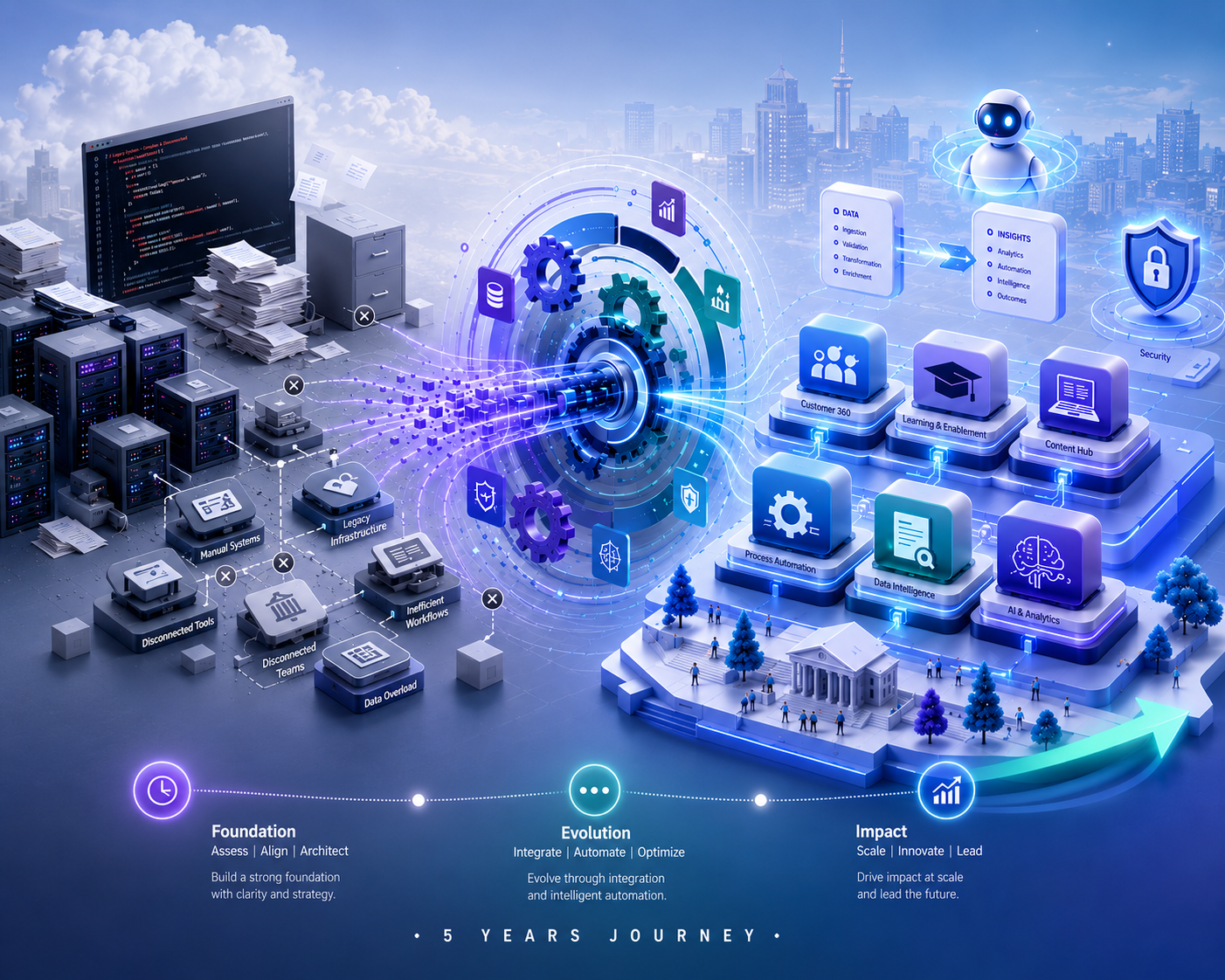
Educational institutions rarely struggle because they lack software. They struggle because their systems were built over time, in fragments. Student records live in one place. Learning operations live somewhere else. Assessments, transcripts, course content, credit audits, communication workflows, and administrative processes often operate across disconnected systems.
Over time, this creates operational complexity.
For this client, the challenge began with a legacy code-based student management system that had grown difficult to understand, extend, and modernize. The existing system contained years of institutional logic, academic workflows, student data, operational dependencies, and custom features that could not simply be replaced overnight.
Sarvika’s role was not just to rebuild software.
It was to understand the institution’s academic operations deeply enough to transform a legacy system into a modern, connected, AI-native academic operating system.
This became a multi-year modernization journey spanning legacy system analysis, feature transformation, data migration, LMS replacement, operational adoption, automation, training, and AI-enabled academic workflows.
Today, after a five-year transformation process, the institution operates on a modernized academic infrastructure designed for continuity, scalability, governance, and intelligent operations.
The Challenge
The client came to Sarvika with an existing student management system built on legacy code. The system was already central to their operations, but its age and complexity created several challenges.
- Codebase Complexity The codebase was difficult to understand. Features had evolved over time without modern architecture, making the platform increasingly difficult to extend and modernize.
- Data Migration & Redesign Data structures needed to be interpreted, cleaned, migrated, and redesigned to support a future-ready academic platform.
- Deeply Embedded Academic Workflows Academic workflows were deeply embedded into the old platform, which meant modernization required more than technical rebuilding. It required operational translation.
- Legacy System Understanding Sarvika had to understand what the old system did, why it worked that way, which features mattered, which workflows had changed, and how the institution’s academic operations could be transformed without disrupting continuity.
- High LMS Dependency & Cost The client was paying a significant recurring cost every year for an external LMS. Although expensive, it remained essential to learning operations.
- LMS Replacement Requirement The institution needed a modern alternative that could provide the same core LMS capabilities while integrating more naturally with its student management ecosystem.
The challenge was not only to replace systems. It was to create a unified academic infrastructure that could support students, administrators, teachers, learning workflows, assessments, transcript audits, course content, and future AI use cases within one connected environment.
Sarvika’s Approach
Sarvika approached the project as a long-term modernization program rather than a one-time software rebuild.
- Legacy System Analysis & Discovery The first step was understanding the legacy student management system. This meant studying the existing codebase, identifying core features, mapping institutional workflows, interpreting historical data, and understanding how academic operations depended on the system.
- Modern Foundation Rebuilding From there, Sarvika transformed the legacy features and data into a modern student management foundation. This foundation became the operational backbone for the institution.
- Connected Academic Ecosystem Instead of keeping student management and learning management as disconnected systems, Sarvika helped the client move toward a connected academic ecosystem.
- LMS Modernization & Cost Reduction The expensive third-party LMS was removed and replaced with a custom LMS built around the client’s actual workflows. The custom LMS provided the required learning features while reducing dependency on a costly external platform.
- Unified Academic Operations More importantly, the LMS became part of the same academic operating environment, enabling stronger integration across institutional processes.
This allowed student data, course activity, learning progress, assessments, administrative workflows, and academic records to work together with much stronger continuity.
Building a Custom LMS to Reduce Recurring Cost
One of the most important business outcomes of the modernization was replacing the high-cost external LMS.
The client had been paying heavily every year for LMS capabilities that were necessary, but not fully aligned with their long-term infrastructure goals. Sarvika built a custom LMS that delivered the same essential learning management capabilities while integrating directly with the broader student management system.
This helped the client reduce recurring platform dependency and gain more control over their academic technology stack. The custom LMS was not positioned as a standalone product. It became part of a broader academic operating system.
That distinction mattered.
Because once the LMS became connected to the student management foundation, the institution could create more unified workflows across learning, administration, assessments, progress tracking, and student support.
The Adoption & Change Management Journey
Modernization was not only a technical challenge. It was also an operational change-management journey.
After years of working with legacy systems and manual workflows, the client faced challenges in adopting the new system. Automation changed how teams worked. New workflows required new habits. Administrators, academic teams, and users needed training, support, and time to fully transition.
Sarvika supported this adoption process through training, operational changes, workflow refinement, and continuous improvement.
The transformation took place over five years. That timeline reflects the real nature of institutional modernization.
Large academic systems cannot be replaced successfully through technology alone. They require careful migration, stakeholder alignment, workflow redesign, training, adoption support, and operational patience.
Today, the system has been successfully adopted and modernized.
Introducing AI into Academic Operations
Once the core infrastructure was modernized, Sarvika helped introduce AI into the academic ecosystem in a way that was embedded, contextual, and operationally useful.
This was not about adding a generic chatbot on top of the system. It was about building contextual intelligence into academic workflows. The AI agent now supports both administrators and students.
- For Administrators It helps reduce manual labor by assisting with operational tasks, answering system-aware questions, and supporting workflows that previously required repetitive human effort.
- For Students It becomes a learning support layer that helps students engage with academic information and course-related guidance in a more accessible way.
- Course Content Creation Sarvika also provided AI support for course content creation, helping academic teams accelerate the process of building and improving learning material.
- Transcript Reading & Credit Audits The system can read transcript information and copy relevant data into forms, making credit audits easier, faster, and less manual.
This is especially valuable in academic environments where credit evaluation, transcript review, and audit workflows can consume significant administrative time.
The Strategic Evolution: From Automation to Intelligence
The project evolved in stages.
First, the priority was modernization.
Then, it became integration.
Then, automation.
And now, intelligence.
This progression is important because AI becomes far more effective when it operates inside a connected system. A standalone AI tool would not have enough context to understand students, courses, credits, workflows, transcripts, administrative rules, or institutional processes.
But an AI layer embedded within a modern academic operating system can support work with much greater relevance. That is the strategic difference.
Sarvika helped the client move from fragmented academic software toward institution-aware operational intelligence.
The Modernized Architecture & Outcomes
The modernized ecosystem now brings together several important layers.
Modern Student Management System + Custom LMS + Workflow Automation + Contextual AI Layer + Governance & Compliance Layer
At the foundation is the modern student management system, transformed from the legacy codebase into a more scalable and maintainable platform.
Connected to that is the custom LMS, which replaced the expensive external LMS and brought learning operations into the same institutional ecosystem.
On top of this sits workflow automation, helping reduce administrative effort and improve operational consistency.
The AI layer adds contextual intelligence across areas such as student support, admin support, course content creation, transcript reading, form filling, credit audits, and learning assistance.
Finally, the governance layer ensures that institutional data, academic records, student information, and AI interactions remain controlled within the environment.
This is what makes the system more than a student management platform or LMS. It is an AI-native academic operating system.
The Outcome
Over five years, Sarvika helped the client move from a legacy student management system and costly external LMS to a modern, integrated academic infrastructure.
- A custom-built student management system aligned with the institution’s operational needs.
- A replacement LMS that reduces dependency on expensive third-party licensing.
- Improved automation across administrative workflows and academic operations.
- AI-supported course content creation and learning material development.
- AI-assisted transcript reading and credit audit workflows.
- An intelligent AI agent that supports both administrators and students.
The modernization also created better long-term control. Instead of depending on fragmented tools, the institution now operates through a connected ecosystem that can continue to evolve.
Why This Matters
The future of education technology is not simply more AI tools. It is not another chatbot, another grading feature, or another isolated platform. The real opportunity is infrastructure.
Educational institutions need systems that understand academic operations, connect workflows, protect institutional data, support governance, reduce administrative friction, and make intelligence available where work actually happens.
That is what Sarvika helped build.
A modern academic operating system.
Designed from legacy complexity.
Strengthened through custom infrastructure.
Adopted through real operational change.
And now enhanced with AI-native intelligence for the future of education.