Problem
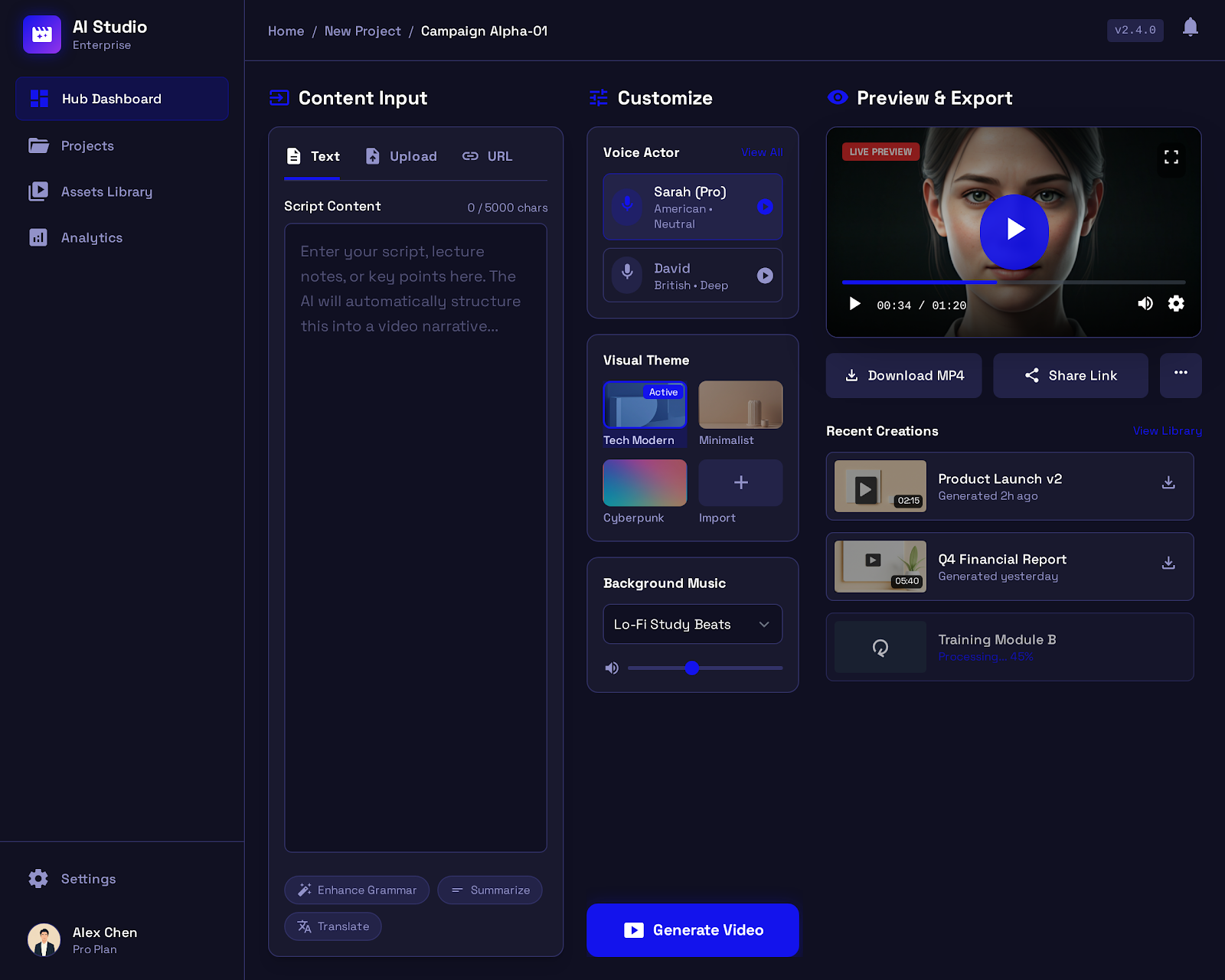
This project focused on automating the creation of videos for multiple subjects by reading the structured document content with an AI-based video generation platform (Pictory AI).
- Automating the creation of videos for multiple subjects using the Pictory AI platform.
- Dynamically reading and processing multiple .doc files organized in subject-wise folder structures.
- Handling secure, session-based login authentication to the platform without interrupting automation flow.
- Mapping document content to subject-specific video creation workflows.
Solution
A scalable automation framework was developed using Java, Selenium WebDriver, and Java native I/O libraries.
- Document Ingestion Layer
- Implemented Java NIO (Files.walk, Path, DirectoryStream) for recursive folder traversal.
- Used FileInputStream and buffered readers, Java native methods to extract document content.
- Authentication and Session Management
- Selenium WebDriver was configured to handle dynamic login workflows.
- Persistent browser sessions were maintained to avoid repeated authentication failures.
- AI Platform Automation Layer
Built Selenium automation scripts to:
- Navigate to content creation modules within the Pictory AI interface.
- Programmatically populate text areas with subject-wise document content.
- Trigger video generation workflows for multiple subjects.
Results
- Significantly reduced manual effort in video creation.
- Improved speed and consistency of video production.
- Enabled scalable video generation for multiple subjects.
- Reduced the risk of human errors caused by repeated manual tasks.
Business Impact (Before and After)
| Metrics |
Before Automation |
After Automation |
| Video Creation Time |
Several hours per subject, fully manual |
Automated generation in around 5 minutes per subject |
| Document Processing |
Manual extraction from DOC files; repetitive and error-prone |
Automated ingestion of multiple DOC files using Java NIO |
| Consistency of Video Content |
Inconsistent formatting and variations between subjects |
Standardized, uniform video creation across all subjects |
| Scalability |
Difficult to scale; linear increase in manual workload |
Highly scalable; multiple subjects processed without additional effort |
| Human Errors |
High risk due to repetitive copying and manual data entry |
Errors minimized due to end-to-end automation |
| AI Workflow Integration |
Not integrated; relied on manual navigation of Pictory AI |
Automated workflows fully integrated with the AI platform |
| Operational Efficiency |
Low efficiency due to manual steps |
High efficiency with continuous, unattended automation |
Development Timeline
The end-to-end automation framework was designed and developed within 2–3 days, covering document ingestion, seamless authentication handling, and AI-driven video generation workflows. The solution efficiently processed over 48 subjects, in which a few subjects contained multiple modules, where automation took around 5 minutes per video and the entire video creation was completed within a week, instead of several weeks of manual effort.
This rapid and large-scale delivery demonstrates Sarvika’s capability to:
- Integrate quickly with third-party AI platforms
- Automate complex, multi-step UI workflows
- Transform time-intensive manual operations into a scalable, repeatable automation pipeline
Conclusion
The automated video creation framework delivered a repeatable, scalable, and error-free process for generating subject-wise videos using Pictory AI. It showcases Sarvika’s expertise in building high-impact automation solutions that seamlessly integrate with modern AI platforms.

 2 min read