
Digital Transformation for Government: How Departments Can Modernize Legacy IT Systems
Government digital transformation is no longer about putting services online. The harder task is modernizing the legacy IT systems behind those services without disrupting the operations, data, and citizen services that departments already depend on. We understand that it’s significant for government departments to modernise their legacy systems. On the contrary, departments need to understand that they do not need to abandon every legacy system. However, you need to develop a controlled modernisation strategy that preserves critical business logic while progressively improving interoperability, security, data accessibility, scalability, and the citizen experience. Government systems often contain decades of institutional knowledge, workflows, and citizen records. That’s where India’s own digital-governance architecture recognises the importance of interoperability and integration rather than simply replacing everything.
For example, the Open API framework was designed to enable different e-governance systems to Contact Sarvika
That’s exactly our narrative we will own throughout this blog. Be it API integrations, cloud, modern security protocols & implementations, AI, or anything – our blog will cover a complete guide for government IT digital transformation. Although there is much public-sector research supporting the idea that legacy systems often remain mission-critical because they contain established business logic and data, modernization must account for technical, organisational, process, and citizen-facing factors. So read more to learn more.
What is Government IT Modernisation?
Government IT modernization is the structured process of upgrading legacy applications, infrastructure, databases, integrations, and digital workflows. It enables government departments to deliver secure, scalable, interoperable, and citizen-centric services without unnecessarily replacing every existing application and portal. The system modernisation process combines application, cloud adoption, API integration, data management & engineering, cybersecurity, and automation to create a technology foundation that can evolve with changing public-service requirements. Many organizations confuse modernisation with building new systems. The truth lies in making the existing systems work better with newer digital platforms while protecting critical data, business logic, and uninterrupted service delivery. It involves certain aspects, such as:
-
Application Modernization
Refactoring, replatforming, rearchitecting, or replacing legacy government applications based on their business criticality, technical debt, and feasibility for modernization.
-
Infrastructure Modernization
Moving suitable workloads toward cloud, containerized, scalable, observable, and resilient infrastructure while maintaining security and operational continuity.
-
API & System Integration
Connecting siloed legacy applications through APIs, integration layers, and interoperable architectures so departments can exchange data and services more efficiently.
-
Data Modernization
Improving legacy databases, data quality, metadata, governance, and accessibility so departments can use reliable data across applications, analytics, and digital public services.
-
Security & Engineering Modernization
Embedding IAM, encryption, vulnerability management, DevSecOps, automated testing, monitoring, and secure software development into the modernized technology environment.
Why Government Departments Need to Modernise Legacy IT Systems?
The real need for government IT modernization arises when the cost and limitations of keeping that system unchanged begin to affect security and delivery. That’s where the departments need to adopt new digital capabilities. However, India’s own digital-governance direction increasingly emphasises interoperability, shared infrastructure and breaking data silos rather than treating every departmental system as an isolated application. For example, the National Data Governance Framework calls for standardisation of data, metadata and APIs and specifically identifies data wrappers for legacy systems.
-
Legacy Technology Creates a Growing Maintenance and Technical-Debt Burden
Older applications often require specialised skills, ageing infrastructure and increasingly complex maintenance just to keep existing services operational. Over time, teams spend more effort preserving the status quo and less on improving services. “Real World Example: A 2025 U.S. GAO review illustrates the scale of this problem: the 11 federal legacy systems it identified as most in need of modernization were 23–60 years old and collectively cost about $754 million annually to operate and maintain.”
Therefore, the Indian Government should identify where technical debt, maintenance dependency, and unsupported components are consuming resources without creating corresponding public-service value.
-
Security Risk Increases When Critical Systems Depend on Aging Components
Modernisation also helps eliminate government cybersecurity concerns. The security controls become challenging to implement and maintain when operational systems are unsupported, obsolete frameworks, outdated libraries, weak authentication mechanisms, and difficult-to-patch applications. That’s where the risk becomes very serious, because your legacy systems are holding sensitive citizen data and government information. Therefore, modernisation provides an opportunity to introduce stronger identity and access management, encryption, vulnerability management, secure APIs, logging, monitoring, and DevSecOps practices rather than simply moving the same weaknesses onto newer infrastructure.
-
Siloed Legacy Systems Limit Government Interoperability
One department may have the data another department needs, yet the two systems may have no practical way to exchange it efficiently. That is precisely why interoperability matters in India’s digital-government architecture. Current government initiatives are also pushing integration across platforms such as API Setu, DigiLocker, UMANG, and MyScheme to improve citizen-centric service delivery.
-
Outdated Systems Can Hold Back Data-Driven Governance
Modern government depends increasingly on data that can be discovered, shared, governed, and used across appropriate systems. But modernization loses much of its value when departments simply migrate applications while leaving fragmented databases.
“India’s 2026 National Data Governance Framework explicitly identifies institutional data silos as a constraint on evidence-based policymaking, AI and innovation, and places standardisation of data, metadata and APIs among its core pillars.”
This means data modernization should be treated as part of legacy IT modernization, not as a separate process afterwards.
What Should Government Departments Modernize First?
Government departments should not modernize every legacy system at once. A better government IT modernization strategy starts with the systems where aging technology creates the highest combination of mission risk, cybersecurity exposure, operational cost, and citizen impact. See what the government should modernise first:
-
Mission-Critical Systems With High Citizen Impact
Prioritize applications that directly support essential government services, such as citizen transactions, welfare delivery, healthcare, taxation, licensing, identity, payments, or other mission-critical functions. A failure or prolonged outage in these systems can affect millions of users, and that makes modernization a significant service-continuity decision.
-
Systems With Serious Cybersecurity or Technology Risks
Your operational systems require a modern government IT strategy if the current systems are running on unsupported software, obsolete infrastructure, outdated programming languages, weak authentication, or components. They will no longer receive any security patches.
Therefore, the systems need urgent assessment. Like, GAO’s recent review found that 7 of its 11 most critical legacy systems had known cybersecurity vulnerabilities, which proves that you must pay first attention to cybersecurity or technological risks.
-
Legacy Systems Creating Data Silos
A system becomes strategically important to modernize when it prevents departments from accessing or exchanging information effectively. Therefore, prioritize applications with fragmented databases, incompatible data formats, limited APIs, poor metadata, or heavy manual data exchange. Especially where multiple departments depend on the same information.
-
Applications That Block New Digital Services
If an application cannot easily support new digital initiatives, like API integration, mobile services, workflow automation, analytics, cloud adoption, or scalable digital service delivery, then it definitely needs modernization even when it is still operational.
The objective should be to remove the architectural constraints that prevent departments from evolving, not to modernize the tech simply because newer technology exists.
-
Systems With Unsustainable Operating Costs or Skills Dependency
Give priority to the applications that require expensive specialist skills, consume disproportionate infrastructure resources, depend on shrinking technology expertise, or require increasingly complex maintenance. The real signal is not merely a high IT bill; it is rising cost without corresponding improvement in service capability.

API Integration To Connect Legacy Systems with Digital Ecosystems
Modernizing a legacy government application becomes far more valuable when it can communicate with other digital services.
API modernization in government platforms creates that connection by exposing controlled interfaces between legacy applications, databases, departmental platforms, and newer digital services.
India’s API Setu is designed around this principle: enabling safe, reliable information exchange across government silos and e-Governance applications. Government API guidelines also explicitly provide a path for legacy systems to connect progressively with newer digital infrastructure.
- Legacy API Wrappers: Expose selected legacy capabilities through APIs without immediately rewriting the underlying application.
- API Gateways: Centralize authentication, authorization, throttling, routing, monitoring, and API governance.
- Interoperability: Use standard APIs and data formats to enable secure G2G, G2C, and G2B information exchange.
- API Security: Protect sensitive government services with strong identity controls, encryption, access policies, and continuous monitoring.
- Reusable Digital Services: Design APIs so multiple applications, portals and citizen-facing channels can consume the same verified government service.
Modernizing Government Data Without Breaking Existing Systems
Government data modernization should go beyond migrating databases. The departments need to make fragmented information discoverable, consistent, governed, and safely exchangeable across systems while preserving critical records and operational continuity.
India’s 2026 National Data Governance Framework specifically identifies standardisation of data, metadata and APIs, alongside data wrappers for legacy systems, as a way to improve interoperability and usability across government data environments.
- Break Data Silos: Connect departmental databases so authorised systems can exchange information instead of relying on manual reconciliation.
- Standardize Data: Establish consistent schemas, metadata and identifiers to make information usable across applications and departments.
- Use Data Wrappers: Create controlled interfaces around legacy data stores where full database modernization is not immediately practical.
- Strengthen Data Governance: Apply ownership, classification, consent, access and security controls to sensitive government datasets.
- Prepare Data for Analytics and AI: Improve data quality and accessibility so departments can support evidence-based decisions, automation and responsible AI initiatives.
Cloud Modernization for Government Legacy Applications
Cloud modernization for government should not mean moving every legacy workload unchanged to a virtual machine. Departments need to assess application dependencies, workload behaviour, security requirements and scalability before choosing between rehosting, replatforming, refactoring or rearchitecting.
India’s e-Governance standards ecosystem includes GI-Cloud architecture, cloud security, disaster recovery, procurement and cloud adoption guidance, reinforcing that cloud transformation must address governance and operational requirements alongside infrastructure.
- Right-Size Migration: Select workloads based on business criticality, performance, dependencies, and cloud suitability rather than migrating everything.
- Modernize Architecture: Introduce containers, managed services, modular components or autoscaling where they provide measurable operational value.
- Build for Resilience: Design backup, disaster recovery, monitoring and failover capabilities into critical government workloads.
- Secure the Cloud Layer: Integrate identity, access control, application security, privacy and cloud-security governance into the target architecture.
- Control Cloud Consumption: Monitor resource utilization, workload performance, and infrastructure spending so modernization does not simply replace technical debt with uncontrolled cloud costs.
Security Must Be Built Into Government IT Modernization
Modernizing a government application without modernizing its security architecture moves an old risk into a new technology environment. Therefore, Government cybersecurity becomes part of the modernization lifecycle.
India’s e-Governance Standards ecosystem provides dedicated information that security should be designed into government systems rather than added after deployment.
-
Secure Application Architecture
Apply secure design principles, threat modelling, encryption, secure APIs, and least-privilege access while modernizing legacy government applications.
-
Identity and Access Management
Strengthen authentication, authorization, role-based access, and privileged-account controls to prevent unauthorized access to sensitive government systems and data.
-
Continuous Vulnerability Management
Combine vulnerability scanning, patch management, penetration testing and remediation to identify weaknesses across applications, infrastructure and cloud workloads. Read detailed info on: https://egovstandards.gov.in/sites/default/files/2026-03/GI%20Cloud%20Reference%20Architecture.pdf?utm_source=chatgpt.com
-
Security Monitoring and Incident Response
Establish centralized logging, threat detection, intrusion prevention, and response processes so departments can detect, investigate, and contain security incidents faster.
-
Cloud Security and Governance
Treat security as a shared responsibility across the department and cloud provider, with defined controls for applications, identities, data, infrastructure, compliance, and operational security.
Read brief details on: https://egovstandards.gov.in/sites/default/files/2026-03/Cloud%20Security%20Best%20Practices.pdf?utm_source=chatgpt.com
AI in Government Digital Transformation
AI is transforming every government portal from static to dynamic responsive digital platforms. When departments connect AI with legacy modernised systems, they can automate repetitive workflows, improve search and service discovery, assist officials with document-heavy processes, and deliver more personalized citizen interactions.
-
AI-Powered Citizen Service Portals
Government websites and mobile applications can use conversational AI, intelligent search, multilingual assistants, and natural-language interfaces to help citizens find schemes, eligibility criteria, application procedures, and service information without navigating multiple pages.
-
Intelligent Document and Workflow Processing
AI can extract information from applications, forms, PDFs, and supporting documents, classify requests, detect missing information, and route cases to the appropriate workflow, reducing manual processing across high-volume government operations.
-
Multilingual and Accessible Digital Services
Generative AI for government services can support translation, summarization, voice interfaces, and conversational experiences across Indian languages, helping departments make digital public services more accessible to diverse populations. AI-generated content should still pass human, linguistic, accessibility, and policy validation.
-
AI-Assisted Government Decision-Making
Modernized data platforms can support predictive analytics, anomaly detection, forecasting, and decision-support systems for areas such as resource allocation, service demand, infrastructure planning, and public-programme monitoring. These systems require strong data governance, model validation, auditability, and human oversight.
-
-
AI-Ready Government Architecture
-
AI delivers better outcomes when departments first establish reliable APIs, interoperable systems, governed datasets, scalable infrastructure, and secure application architectures. In other words, AI implementation in government is a digital-infrastructure and data-readiness problem.
Common Government Legacy Modernisation Mistakes
Legacy modernisation can fail even when the technology itself is sound. Here, the problem is unconceptualized government digital modernization planning.
Recent GAO assessments found that incomplete modernization plans increase the risk of cost overruns, delays, and project failure. For government departments, avoiding these mistakes is as important as selecting the right modernization technology.
-
Replacing Systems Without Dependency Mapping
Modernizing an application without identifying its databases, APIs, downstream systems, workflows, and third-party dependencies can break connected government services.
-
Treating Cloud Migration as Complete Modernisation
Rehosting an application may change its infrastructure without addressing technical debt, architecture limitations, security weaknesses, or poor scalability.
-
Ignoring Undocumented Business Logic
Legacy applications often contain critical rules embedded in old code. Replacing them without first documenting and validating those rules can change how essential government services operate.
-
Underestimating Data Migration Complexity
Moving databases without addressing inconsistent formats, duplicate records, metadata, and data-quality issues can transfer the same problems into the modern environment.
-
Modernising Without a Phased Transition Plan
Mission-critical government applications need defined milestones, testing, rollback mechanisms, and a clear disposition plan for the legacy system. A “big-bang” migration can expose departments to unnecessary service disruption and operational risk.
Practical Government Legacy Modernization Roadmap
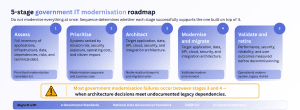
A successful government legacy system modernization roadmap should move in controlled stages rather than attempt a large-scale replacement at once. Start by understanding the existing technology estate, then prioritize systems according to mission criticality, security risk, operating cost, dependencies, and citizen impact. Government modernization frameworks also emphasize documented milestones, modernization activities, and a clear plan for retiring or transitioning the legacy environment.
- Assess: Inventory applications, infrastructure, data, dependencies, risks, and technical debt.
- Prioritize: Identify systems where modernization can deliver the greatest risk reduction and service value.
- Architect: Define the target application, data, API, cloud, security, and integration architecture.
- Modernize & Migrate: Execute phased modernization with testing, data validation, rollback, and service-continuity controls.
- Validate & Retire: Measure performance, security, reliability, and user outcomes before progressively decommissioning the legacy environment.
How Sarvika Can Help?
Sarvika can support government departments through the end-to-end government digital modernization journey. Our capabilities across enterprise legacy system modernization allow departments to address technology transformation as one connected programme rather than isolated IT projects.
We can help identify what to modernize, what to retain, and how to migrate or integrate systems while protecting service continuity. This approach aligns with the government’s increasing emphasis on architecture, standards, security, interoperability, scalability, and measurable digital-service outcomes.
Conclusion
Government digital transformation is no longer about putting another portal on top of legacy technology. It requires departments to modernize the systems, data, APIs, infrastructure, and security architecture that power public services underneath.
A practical government IT modernization strategy should prioritize mission-critical systems, address technical debt, improve interoperability, modernize government data, adopt cloud where appropriate, and introduce AI only where the underlying technology foundation can support it.
The objective is simple: create secure, scalable, interoperable, and citizen-centric digital government services without disrupting essential operations. With the right modernization roadmap and engineering partner, legacy IT can become a foundation for the next generation of digital governance.
Frequently Asked Questions
1.What is government IT modernisation?
>>>Government IT modernisation is the structured process of upgrading legacy applications, infrastructure, databases, APIs, and digital workflows so departments can deliver secure, scalable, interoperable, and citizen-centric services without replacing every existing system. It combines application modernisation, cloud adoption, API integration, data governance, cybersecurity, and automation into a connected programme.
2. What should government departments modernise first?
>>>Departments should prioritise systems where ageing technology creates the highest combination of mission risk, cybersecurity exposure, operational cost, and citizen impact. That typically means mission-critical applications, systems with known security vulnerabilities, applications creating data silos, and legacy platforms blocking new digital service delivery.
3. How does API integration support government IT modernisation?
>>>API integration connects legacy government applications with newer digital services and platforms such as API Setu, DigiLocker, UMANG, and MyScheme without requiring full system replacement. Legacy API wrappers, API gateways, and interoperable architectures allow departments to progressively expose capabilities while maintaining operational continuity.
4. What is the difference between rehosting and refactoring in government cloud modernisation?
>>>Rehosting moves an application to cloud infrastructure with minimal changes, which reduces hardware dependency but does not address technical debt or architecture limitations. Refactoring restructures the application code and architecture to take advantage of cloud-native capabilities, improving scalability, resilience, and maintainability at greater implementation effort.
5. How does the National Data Governance Framework affect government IT modernisation?
>>>India’s 2026 National Data Governance Framework identifies data silos as a constraint on evidence-based policymaking and places standardisation of data, metadata, and APIs among its core pillars. This means data modernisation should be treated as part of legacy IT modernisation rather than a separate process, with departments establishing consistent schemas, data wrappers for legacy stores, and governed data exchanges across systems.
6. How can AI be introduced into government digital transformation?
>>>AI delivers better outcomes in government when departments first establish reliable APIs, interoperable systems, governed datasets, scalable infrastructure, and secure application architectures. AI should be introduced after the underlying data and integration foundation is in place, starting with citizen service portals, intelligent document processing, multilingual accessibility, and decision-support systems with strong human oversight and auditability.

Sarvika Technologies
Sarvika Tech is a team of young, energetic, and technology-loving people on the journey to help companies achieve their goals by supporting their IT needs. In a nutshell, we are a people’s company where the priority is their knowledge enhancement and career development. We believe that focusing on our most important asset, the team, will enable us to push boundaries and deliver ingenious IT solutions.