
Government Website Development in India: Key Technology, Security, and Accessibility Considerations
It’s very common for a government website to be fully functional and still fail the people it is built for.
If a citizen cannot find the right scheme, struggles to complete a form, cannot access a document with a screen reader, or encounters an insecure portal – the problem is bigger than poor website design. It affects access to public information, digital services, trust, and ultimately the citizen experience.
That is why government website development in India should not merely work. It should remain usable, accessible, trustworthy, and secure when citizens depend on it.
For that, it requires a different engineering mindset. A public-facing website must bring together GIGW 3.0 compliance, scalable architecture, accessibility, cybersecurity, multilingual content, API interoperability, search discoverability, and long-term website lifecycle management.
In this guide, we examine what makes government website development different, how GIGW 3.0 shapes implementation, and the technology, security, accessibility, content, and integration considerations organizations should address before taking a government digital platform live.
What Is GIGW 3.0 and Why Does It Matter?
GIGW 3.0 or the Guidelines for Indian Government Websites and Apps is the Government of India’s framework for building and managing government websites, web portals, web applications and mobile apps with defined expectations for quality, accessibility, cybersecurity and lifecycle management.
It is not simply a design checklist. GIGW 3.0 covers the website lifecycle from conceptualization and design through development, maintenance and management, making it relevant to both new government website development projects and existing digital platforms.
For government organizations, its importance goes beyond compliance. A public-facing digital platform must establish authenticity, make information discoverable, remain accessible across devices and abilities, protect users and data, integrate with the wider government digital ecosystem, and stay reliable throughout its lifecycle.
GIGW 3.0 brings these expectations into one framework and was developed with inputs from NIC, STQC Directorate, CERT-In, industry and domain experts.
Why does GIGW 3.0 matter for government website development?
- Quality: Establishes requirements around usability, content quality, responsive design, ownership information, metadata, navigation and reliable citizen-facing experiences.
- Accessibility: Makes digital government services more inclusive by addressing accessibility and usability across websites and apps, including support for assistive technologies.
- Cybersecurity: Brings CERT-In-informed cybersecurity guidance into the same framework, while recognizing that security requirements must evolve with emerging threats and advisories.
- Digital interoperability: Encourages API-level integration with platforms and services such as India Portal, DigiLocker, Aadhaar-based identity, SSO, MyGov and government data platforms.
- Lifecycle management: Requires organizations to consider conformity throughout the website lifecycle rather than treating GIGW compliance as a one-time development or launch activity.
Why Is Government Website Development Different?
A government website often becomes the public’s entry point to information, schemes, applications, documents, benefits, grievances, and essential services. That changes the engineering priorities. A private website can optimize primarily for conversions; a government platform must optimize for accessibility, reliability, trust, security, discoverability, interoperability, and equal access at scale.
-
Citizen-first information architecture
Users should find schemes, services, notices, contacts, forms, and documents without understanding the department’s internal organizational structure.
-
High availability under unpredictable demand
Infrastructure must withstand sudden traffic spikes around examinations, recruitment, scheme launches, application deadlines, public announcements, and emergency communications.
-
Accessibility by design
Government websites must accommodate users with different abilities and assistive technologies rather than treating accessibility as a final-stage compliance check.
-
Security across the entire application stack
Authentication, APIs, databases, CMS, third-party integrations, hosting infrastructure, and administrative interfaces all require appropriate security controls and continuous assessment.
-
Interoperability with public digital infrastructure
Modern government platforms increasingly need API-level connectivity with services such as DigiLocker, Aadhaar-based identity, SSO, government data platforms and other digital initiatives. GIGW 3.0 explicitly addresses these integration requirements.
-
Long-term content and technology governance
Government websites remain operational for years, so government website development must account for content ownership, updates, monitoring, security advisories, accessibility reviews, maintenance and eventual archival.
GIGW 3.0 Checklist for Government Website Development
GIGW 3.0 checklist framework assigns specific responsibilities to the government organization, developer, and evaluator. So the compliance needs to influence architecture, content, accessibility, security, testing, and lifecycle decisions from the beginning.
It’s necessary to build a government website aligned with GIGW 3.0 compliance. Read to know what the compliant website address:
-
Quality
Build intuitive navigation, clear content hierarchy, responsive interfaces, fast-loading pages, authentic ownership information, meaningful metadata, and consistent user experiences.
-
Accessibility
Design against WCAG 2.1 Level AA, including keyboard access, assistive-technology compatibility, accessible forms, meaningful alternatives for non-text content, and usable interfaces across devices.
-
Cybersecurity
Address security throughout design, coding, implementation, testing, and deployment using practices aligned with frameworks such as OWASP ASVS, OWASP Top 10, ISO 27001 and CIS benchmarks, while keeping current CERT-In advisories in scope.
-
Interoperability
Architect APIs and data flows to support relevant government digital ecosystems, including DigiLocker, Aadhaar-based identity, SSO, India Portal, MyGov and government data platforms, wherever the use case requires them.
-
Lifecycle management
Establish ownership, content workflows, monitoring, backups, disaster recovery, security maintenance, accessibility reviews, performance monitoring, and processes for updating or archiving information after launch.
Technology Architecture for Government Websites
Government website development needs an architecture that can remain sustainable when traffic, content volume, integrations, and service requirements grow. The right architecture should be designed around scalability, reliability, interoperability, maintainability, and security rather than simply selecting a popular technology stack.
GIGW 3.0 also expects organizations to consider the website’s design and architecture at the implementation stage, while allowing higher or specific technical norms where a particular use case demands them.
-
Scalable and Resilient Infrastructure
A government portal may experience unpredictable traffic around application deadlines, recruitment, examinations, scheme launches or public announcements. Load balancing, caching, CDN delivery, horizontal scaling, high-availability infrastructure and geographically separated disaster-recovery environments can help maintain service availability when demand or infrastructure failures occur. GIGW guidance also calls for high-availability hosting, business continuity and disaster-recovery environments for government web infrastructure.
-
Responsive Architecture
A government website cannot assume that citizens will access services from a desktop. The frontend should adapt across smartphones, tablets and desktops while preserving navigation, forms, accessibility features and critical service workflows. GIGW 3.0 places significant emphasis on usability, mobile optimization and user-centric experience.
-
CMS Architecture
The CMS is part of the governance architecture, not merely a publishing interface for government organizations. It should support controlled authoring, role-based publishing, content ownership, version management, accessibility-aware content creation, approvals and monitoring. GIGW 3.0 specifically highlights state-of-the-art CMS capabilities, centralized monitoring and technical enablement for content creators and publishers.
Security Architecture for Government Websites
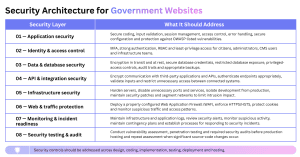
Security in government website development has to protect more than the website itself. Government portals can handle personal information, authentication credentials, documents, transactions and connections to external government systems. GIGW 3.0 therefore expects security controls across design, coding, implementation, testing, deployment and hosting, with security audits before production hosting. It also references practices such as ISO 27001, OWASP ASVS, OWASP Top 10 and CIS Benchmarks.
If you are developing a government website, then you must know what are security measures to consider while development:
User-Centric Information Architecture to Make Government Information Findable
Government websites can contain every required piece of information and still fail its users if people cannot find the right information quickly. That makes information architecture more than a navigation exercise. It determines how citizens, businesses, officials, and other stakeholders move from a question to the information or service they need. GIGW 3.0 places user-centricity and usability at the center of government digital platforms, while NIC’s UX guidance specifically addresses navigation, information architecture, breadcrumbs, sitemaps and task-oriented experiences.
For effective government website development, the information architecture should reflect user intent rather than departmental hierarchy. A citizen should not need to understand which internal division owns a scheme before finding it.
- Task-oriented navigation: Organize services around what users want to accomplish, apply, register, pay, download, track, report, verify or contact rather than forcing them through internal department structures.
- Clear content hierarchy: Use logical categories, descriptive headings, breadcrumbs and consistent navigation so users and search engines can understand where every page belongs within the website.
- Strong internal search: Make schemes, services, circulars, notifications, forms and documents searchable through relevant keywords, filters, metadata and meaningful search results.
- Consistent navigation patterns: Keep menus, labels, breadcrumbs and interaction patterns predictable across the website so users do not have to relearn the interface on every page.
- Citizen-centered content paths: Connect related information such as eligibility, required documents, application procedures, deadlines, fees and FAQs so users can complete a task without repeatedly returning to the homepage.
Consider Accessibility: Building Websites Every Citizen Can Use
The website serves citizens with different abilities, devices, languages, connectivity conditions, and assistive technologies. Accessibility, therefore, cannot be treated as a compliance task at the end of government website development. It needs to influence the interface, HTML structure, forms, navigation, media and downloadable documents from the beginning. GIGW 3.0 adopts WCAG 2.1 Level AA and addresses accessibility across different user needs, including users relying on assistive technologies. So, what does an accessible government website actually require?
-
Semantic and programmatic structure
Use meaningful HTML elements, logical heading hierarchies, labels, roles, states, and relationships so screen readers and other assistive technologies can interpret the interface correctly.
-
Keyboard-operable interactions
Ensure users can navigate menus, forms, links, dialogs, and interactive components without depending on a mouse or complex pointer interaction.
-
Accessible forms and transactions
Associate labels with controls, provide meaningful error messages, preserve focus appropriately, and ensure users can understand and recover from validation failures.
-
Text alternatives and accessible media
Provide meaningful alternatives for images and other non-text content, along with captions and appropriate alternatives for time-based media where required.
-
Responsive and scalable interfaces
Allow content and controls to remain usable when users increase text size or access the website from different devices and screen sizes, without losing content or functionality.
-
Accessible documents
Treat PDFs, forms, reports, circulars, and downloadable government documents as part of the accessibility experience rather than assuming the website becomes accessible once its HTML pages meet WCAG requirements. GIGW also provides guidance for creating accessible documents.
API Integration and the Government Digital Ecosystem
A modern government website development project should not operate as an isolated web property. GIGW 3.0 encourages API-level integration with public digital infrastructure such as India Portal, DigiLocker, Aadhaar-based identity, Single Sign-On, MyGov and government data platforms. Designing these integrations at the architecture stage improves interoperability and allows information and services to move across connected government systems instead of creating disconnected digital silos.
However, Integration should also account for multilingual website development where citizens access information in English, Hindi or other Indian languages. AI-based Indian-language translation tools and seamless content/data access can support more inclusive digital services, provided organizations maintain appropriate content accuracy, consistency and governance across language versions.
Content Management and Lifecycle Governance for Government Websites
The government website development isn’t finished after launch. However, schemes change, notifications expire, officers change, documents get replaced, and services evolve. Therefore, government website development needs a content governance model that keeps information accurate, current, searchable and accountable throughout the platform lifecycle. GIGW 3.0 treats lifecycle management as a core focus area rather than a post-launch activity.
Search Experience and Discoverability for Government Websites
Citizens should be able to search, understand and reach the right information quickly, whether they search for a ministry, scheme, service, notification or document. GIGW specifically considers search visibility, page titles, metadata, heading structure, internal search and multiple navigation paths as part of website quality and usability. Check with the search engine optimization parameters; such as:
- Search-friendly page structure
- Strong internal search
- Search-intent-aligned content
- Multiple discovery paths
- Performance and crawlability
The Cost of Treating Government Websites Like Ordinary Websites
Ignoring GIGW 3.0, accessibility, security and lifecycle requirements can make a public digital service harder to access, less secure, difficult to maintain and more vulnerable to disruption. These weaknesses can directly affect the availability and reliability of information and services. GIGW also expects security auditing before production hosting and defines controls around confidentiality, integrity and availability.
-
Citizens Struggle to Access Services
Poor information architecture, inaccessible interfaces or broken workflows can prevent users from finding or completing essential services.
-
Security Vulnerabilities Become Exploitable
Outdated CMS components, insecure code, weak access controls and unprotected APIs can expose government systems and sensitive information to cyberattacks.
-
Downtime Disrupts Public Services
Weak infrastructure, inadequate backups or insufficient disaster-recovery planning can make critical websites unavailable during traffic spikes or infrastructure incidents.
-
Compliance Becomes Harder to Demonstrate
When GIGW requirements remain unaddressed throughout development, teams may discover accessibility, security, quality or lifecycle gaps only during evaluation.
-
Maintenance Costs Increase
Without proper content governance, monitoring, patching and change control, outdated information and technical debt accumulate, making the platform increasingly difficult to manage.
How Sarvika Can Help?
Sarvika approaches government website development as a long-term digital engineering responsibility, not a one-time website build. Sarvika approaches government platforms across five connected layers: citizen experience, compliant architecture, security and accessibility engineering, digital ecosystem integration, and lifecycle operations.
Final Verdict
A government website is no longer just an online information channel. It is a critical layer of public digital infrastructure where accessibility, cybersecurity, interoperability, performance, discoverability, and lifecycle governance directly influence how citizens access information and services.
Therefore, effective government website development in India requires more than functional code. It requires architecture aligned with GIGW 3.0 and the realities of public-service delivery.
The standard for a government website should therefore not be whether it successfully launches. It should be whether every citizen can reliably find, access and trust the information and services it provides – today, during periods of exceptional demand, and throughout the platform’s operational life.
Frequently Asked Questions
-
What is GIGW 3.0 for government websites?
GIGW 3.0, or Guidelines for Indian Government Websites and Apps, provides a framework for government digital platforms covering quality, accessibility, cybersecurity, and lifecycle management. It helps government organizations build websites and applications that remain usable, secure, accessible, reliable and maintainable throughout their operational lifecycle.
-
What are the key requirements for government website development in India?
The key requirements include GIGW 3.0 compliance, accessible design, cybersecurity, responsive architecture, clear information architecture, reliable hosting, API interoperability, multilingual content, content governance, performance monitoring and lifecycle management. These requirements help government organizations deliver secure, discoverable and inclusive digital services to citizens.
-
Why is accessibility important for government websites?
Accessibility ensures that citizens with different abilities can access government information and digital services. GIGW 3.0 aligns government websites with WCAG 2.1 Level AA, addressing areas such as keyboard navigation, screen-reader compatibility, accessible forms, text alternatives, responsive interfaces and accessible documents.
-
How can government websites be secured against cyber threats?
Government websites should implement secure coding, strong authentication, role-based access control, encryption, API security, network protection, vulnerability assessment, penetration testing, security monitoring and regular patching. GIGW 3.0 also references security practices including OWASP standards, ISO 27001 and applicable CERT-In requirements.
-
Why is lifecycle management important for government websites?
Government website lifecycle management keeps digital platforms accurate, secure, accessible and operational after launch. It includes content reviews, archival, security maintenance, accessibility testing, performance monitoring, backups, release governance and continuous improvement as government services, technology and citizen requirements evolve.

Sarvika Technologies
Sarvika Tech is a team of young, energetic, and technology-loving people on the journey to help companies achieve their goals by supporting their IT needs. In a nutshell, we are a people’s company where the priority is their knowledge enhancement and career development. We believe that focusing on our most important asset, the team, will enable us to push boundaries and deliver ingenious IT solutions.