
What to Do When Your Software Development Partner Goes Silent?
When a software development partner goes silent, the impact can reach far beyond missed calls or delayed emails. Your product roadmap can stall. Critical bugs can remain unresolved. You may lose access to source code, documentation, cloud infrastructure, or technical knowledge. For a growing business, that can quickly become a serious continuity risk. It can also turn a manageable issue into another chapter of When Code Breaks.
This blog explains what to do when a software development company stops responding. We will cover how to protect your software assets, assess the existing codebase, recover a stalled project, and decide whether to continue or start switching software development companies. We will also look at what makes a successful codebase takeover possible and how to choose a reliable development partner for the transition.
The goal is to regain technical control before making your next move. A structured software project rescue approach can help you stabilize the product, uncover hidden risks, and create a practical path toward continued development or modernization.
What Should You Do When Your Software Development Partner Goes Silent?
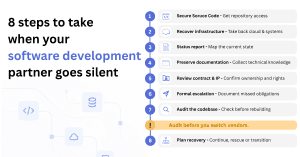
When your development partner stops responding, speed matters, but so does control. Do not let frustration push you into an immediate rebuild or vendor switch. First, secure your software assets and establish the project’s actual condition. A structured response can protect delivery, reduce technical risk, and create a stronger position for software project rescue or codebase takeover.
-
Secure Your Source Code and Repository Access
Your source code is the most critical asset to recover first. Confirm administrator access to Git repositories and all active branches. Check whether the latest production code exists in the repository. Also secure build artefacts, environment configurations, package files, and deployment scripts. Do not depend on a former developer’s personal account for access.
-
Regain Control of Cloud and Production Infrastructure
A development team may manage more than your application code. They could also control AWS, Azure, Google Cloud, servers, databases, DNS, CI/CD pipelines, monitoring, and third-party platforms. Recover these accounts immediately. Review administrator permissions and rotate critical credentials where necessary. This step reduces operational dependency and protects your software infrastructure from further disruption.
-
Create a Technical Status Report
Before planning the next development phase, establish what actually happened. List completed features, pending releases, unresolved bugs, production incidents, technical dependencies, and missed milestones. Record the technology stack and current deployment status. This creates a reliable baseline for a software development company takeover and prevents your next partner from estimating work based on incomplete information.
-
Preserve Documentation and Technical Knowledge
Missing documentation can make a vendor transition expensive. Collect architecture diagrams, API documentation, database schemas, deployment instructions, credentials, test cases, product requirements, and technical decisions. Also identify business logic that exists only inside the code. During a codebase takeover, this information helps the new engineering team understand how the system works before making changes.
-
Review the Contract, SLA, and IP Ownership
Your technical recovery should run alongside a contractual review. Check your agreement for source code ownership, intellectual property rights, SLA commitments, support obligations, termination clauses, data ownership, and knowledge-transfer requirements. These terms can determine how quickly you can transition to another development partner. They also clarify what assets and services you are legally entitled to access.
-
Establish a Formal Escalation Trail
Give the existing vendor one structured opportunity to respond. Send a formal communication that clearly states the missed obligations and required response. Keep records of emails, tickets, meeting requests, deliverables, and previous commitments. Avoid relying only on informal chats. A documented trail makes the situation easier to manage if you eventually move toward switching software development companies.
-
Do Not Start Development With a New Vendor Immediately
This is where many businesses make another costly mistake. They hand the existing codebase to a new team and ask them to “continue from where the old team stopped.” That approach can carry hidden technical debt into the next engagement. Conduct a software codebase audit first. Assess architecture, security, dependencies, testing, infrastructure, and maintainability. Then build a realistic recovery roadmap.
Audit the Existing Codebase Before Changing Development Partners
Before switching software development companies, first understand what the existing team has built. A codebase audit reveals technical debt, security gaps, undocumented dependencies, architecture limitations, and deployment risks. It also tells you whether the project needs a simple takeover or deeper remediation. This assessment gives the next engineering team a reliable technical baseline. Know what a software codebase audit check should include:
-
Architecture and technical debt: Assess whether the current architecture can support upcoming business requirements. Identify tightly coupled components, outdated frameworks, and areas that may require refactoring legacy software architecture.
-
Code quality and maintainability: Review coding standards, duplication, complexity, error handling, and maintainability. Poor code quality can make even small feature changes expensive after a software project takeover.
-
Security and dependencies: Check authentication, authorization, secrets, vulnerable packages, exposed services, and third-party dependencies. Security remediation should happen before the new team expands the system.
-
Database and API architecture: Map databases, schemas, queries, integrations, and API dependencies. This helps identify performance constraints and prevents unexpected failures when the application enters a higher-load environment.
-
Testing and deployment: Review automated tests, CI/CD pipelines, release processes, environments, monitoring, and rollback mechanisms. A new team needs to know whether it can deploy safely or must first rebuild the delivery foundation.
-
Infrastructure and cloud setup: Examine cloud resources, configurations, permissions, scaling policies, backups, and observability. This becomes especially important when the application requires cloud infrastructure scaling consulting.
-
Documentation and knowledge gaps: Identify missing architecture documents, API references, deployment guides, and business logic. These gaps often create the biggest friction during a codebase takeover because the new team must reconstruct decisions made by the previous developers.
Can a New Development Team Take Over an Existing Software Project?
A capable engineering team can take over an existing software project without rebuilding it from scratch. The right approach starts with technical discovery and codebase assessment. The team must understand the architecture, infrastructure, integrations, and business logic before assuming development ownership. This reduces transition risk and protects previous technology investments. Before you hand over, it is a must to know what determines a successful software project takeover:
-
Source code and repository access
The new team needs complete access to repositories, branches, build artefacts, and version history. Missing code or restricted repositories can delay the takeover and make technical assessment harder.
-
Infrastructure ownership
Access to cloud accounts, servers, databases, DNS, CI/CD pipelines, monitoring, and third-party platforms is essential. The development team should not depend on accounts controlled by the previous vendor.
-
Technology stack
The incoming team should have experience with the frameworks, languages, databases, APIs, and infrastructure already used. Strong custom software development expertise also helps when the existing stack needs remediation.
-
Business logic and documentation
Technical documentation may explain how the system works. Product requirements and business knowledge explain why. The new team needs both to avoid breaking critical workflows during development.
-
Technical debt and architecture condition
Some applications need straightforward continuation. Others require refactoring legacy architecture, security fixes, or infrastructure improvements before development can safely resume.
-
Existing integrations
Payment gateways, external APIs, identity systems, analytics platforms, and other dependencies can create hidden points of failure. Mapping these dependencies helps the new team plan the takeover accurately.
-
A structured transition plan
A successful takeover should define responsibilities, knowledge transfer, technical priorities, access recovery, documentation, and release ownership. This creates a controlled transition instead of simply handing the new team an unfamiliar codebase.
Know When to Continue With the Existing Vendor or Switch Software Development Companies?
Once you regain access and understand the codebase, the next decision is strategic: should you repair the existing engagement or move the software to a new development partner? Do not base this decision only on frustration. Evaluate delivery performance, technical ownership, project health, contractual obligations, and the vendor’s ability to recover trust.
When Should You Continue With the Existing Vendor?
-
Communication is the main issue: If the technology remains stable and the vendor can provide a credible recovery plan, formal escalation and stronger governance may solve the problem.
-
The project remains technically healthy: A delayed project does not always require a vendor change. If architecture, code quality, testing, and infrastructure remain sound, continuity may offer better value.
When Should You Consider Switching Vendors?
-
Missed commitments keep repeating: Persistent delays without transparent explanations indicate a delivery-management problem. Another vendor may provide stronger accountability and execution.
-
You lack technical ownership: If the vendor controls repositories, infrastructure, documentation, or critical credentials, the dependency itself becomes a business risk.
-
Technical debt keeps increasing: If every new release introduces defects or slows development, the problem may require software modernization or architectural refactoring rather than another deadline extension.
-
Critical support has disappeared: If production issues remain unresolved and the vendor cannot provide dependable support, business continuity should take priority over maintaining the relationship.
-
The vendor cannot support future requirements: Your next partner should match your technology roadmap. This may include cloud engineering, AI integration, DevOps, API development, cybersecurity, or enterprise software modernization.
How to Choose the Right Software Development Company After a Vendor Exit?
The right replacement vendor should bring technical ownership, transparent delivery, strong engineering practices, and the ability to understand and improve your existing software. However, whenever you search for another software development company, check these below given considerations:
-
Proven takeover experience: Choose a partner that can assess and inherit existing codebases without forcing an unnecessary rebuild.
-
Strong technical discovery: Look for a team that audits architecture, dependencies, security, infrastructure, and technical debt before estimating new work.
-
End-to-end engineering capability: Prioritise expertise across custom software development, cloud engineering, DevOps, APIs, cybersecurity, and software modernization.
-
Clear ownership and communication: Your new partner should provide defined responsibilities, regular reporting, documentation, escalation paths, and measurable delivery milestones.
-
Scalability and modernization expertise: Select a partner that can stabilise today’s application while preparing it for future growth, integrations, AI adoption, and changing business requirements.
-
Knowledge-transfer discipline: Ensure the vendor documents the system and transfers technical knowledge instead of creating another dependency around individual developers.
-
Long-term partnership mindset: The best software development partner should support your product beyond the immediate takeover through maintenance, optimization, modernization, and continuous engineering improvements.
How Can Sarvika Help?
Sarvika helps businesses regain control when a software development partner goes silent. Our engineering teams can assess the existing codebase, identify technical debt, review security and infrastructure, and create a structured software project takeover plan.
We support codebase rescue, custom software development, cloud engineering, DevOps, API integration, and legacy software modernization. Our approach focuses on stabilizing what already works before improving what does not. Whether you need a dedicated development team, vendor transition support, or long-term application modernization, Sarvika brings the technical expertise needed to move your software forward with confidence.
Final Takeaway: Regain Control Before You Rebuild
A silent software development partner does not mean your entire investment is lost. Start by securing access, auditing the codebase, and understanding the technical risks. From there, you can choose recovery, remediation, modernization, or switching software development companies.
The right software project takeover partner will protect business continuity while improving the software for future needs. With the right engineering expertise, legacy software modernization, cloud engineering, and custom software development can turn a stalled project into a stronger digital product.

Sarvika Technologies
Sarvika Tech is a team of young, energetic, and technology-loving people on the journey to help companies achieve their goals by supporting their IT needs. In a nutshell, we are a people’s company where the priority is their knowledge enhancement and career development. We believe that focusing on our most important asset, the team, will enable us to push boundaries and deliver ingenious IT solutions.