
Why Software That Works at Launch Fails at Scale

Software rarely fails at scale because growth itself is the problem. Growth simply removes the assumptions that made the software appear reliable at launch.
At launch, traffic is predictable, datasets are smaller, integrations are limited, and infrastructure has comfortable headroom. As adoption grows, concurrency increases, databases contend for resources, APIs hit limits, synchronous workflows accumulate latency, and previously local failures begin propagating across the system.
That is when enterprises discover an important distinction: software that is launch-ready is not necessarily scale-ready.
Scalability is therefore not just the ability to add servers. It is the ability of the architecture, data layer, integrations, infrastructure, and operational practices to absorb growth without performance, reliability, and cost deteriorating disproportionately.
7 Reasons Why Software Fails at Scale
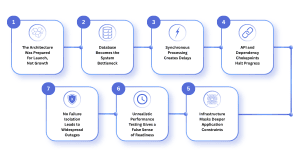
Enterprises often confuse software scalability with heavy system loads and too many users. That’s the visible forefront, so we assume these are the reasons. On the other hand, the major flaws lie in the backend, such as fragmented architecture and data management, API Dependencies, infrastructural issues, etc. We have determined 7 reasons why software fails at scale. Know about these:
-
The Architecture Was Prepared for Launch, Not Growth
Early-stage software often optimizes for speed of delivery rather than long-term scalability. That is reasonable, until tightly coupled components, shared resources, synchronous workflows, or rigid service boundaries start limiting independent scaling.
App crashes under load high traffic. It becomes difficult to change without affecting unrelated functionality. The fix isn’t automatically a microservices rewrite.
Teams should first identify the actual scaling boundary, then refactor the affected components, introduce modular boundaries, or redesign only where the workload demands it.
-
Database Becomes the System Bottleneck
A growing application can add more application servers, but those servers may still compete for the same database connections, CPU, memory, locks, disk I/O, or query capacity. Therefore, ‘why databases bottleneck at scale’ is such an important engineering question.
Inefficient queries, missing indexes, excessive connections, hot data, and read/write contention can push latency upward until requests queue or time out. The right fix starts with workload profiling and query analysis, rather than blindly increasing database capacity.
-
Synchronous Processing Makes Every Request Carry Too Much Work
A request that performs several database writes, calls external APIs, generates a document, sends notifications, and waits for every operation to finish may work perfectly with modest traffic.
However, those dependencies multiply the time and resources required to complete each request under high concurrency.
Asynchronous processing, queues, background workers, caching, and appropriate timeouts can separate user-facing operations from work that does not need to happen in the critical request path. This reduces unnecessary coupling and prevents one slow dependency from holding an entire transaction hostage.
-
APIs and External Dependencies Become Chokepoints
Your application may be capable of handling increased traffic. But there are some heavy loads, such as rate limits, connection limits, latency, timeouts, and retry behaviour can turn a healthy service into a cascading failure.
The teams need rate limiting, bounded retries, circuit breakers, caching, asynchronous integration, and dependency monitoring while going forward with scalability. It ensures that downstream problems remain contained instead of propagating across the application.
Therefore, the API scalability depends as much on dependency design as on the API server itself.
-
Scaling Infrastructure Hides an Application-Level Constraint
Adding instances or increasing CPU can temporarily relieve pressure. However, it cannot fix an inefficient query, serialized workflow, shared lock, exhausted connection pool, or poorly designed state-management pattern.
This is where cloud autoscaling cost failure becomes a real concern. The infrastructure keeps adding capacity while the actual bottleneck remains unchanged.
Effective scaling requires teams to correlate application metrics with infrastructure metrics to determine which resource is saturating before increasing capacity.
-
Performance Testing Does Not Represent Real Production Load
A software can pass a conventional load test, yet fail when real traffic behaves differently.
This unpredictable production introduces some bottlenecks, such as uneven traffic, concurrent transactions, larger datasets, dependency failures, cache misses, long-running processes, and sustained workloads.
That’s where the teams combine load, stress, spike, endurance, and capacity testing with realistic traffic patterns. Testing should also establish measurable thresholds for throughput, error rates, and latency; that includes p95 latency, rather than relying only on average response time.
-
The System Has No Effective Failure Isolation
During the scalability period, component dependencies can trigger queues, retries, connection exhaustion, and cascading failures across multiple services. At that time, systems need fault isolation, graceful degradation, circuit breakers, timeouts, backpressure, health checks, and resilient deployment patterns. It prevents local problems from becoming system-wide outages.
Therefore, scalability is not just about processing more requests. But it is about remaining predictable when individual components become saturated or unavailable.
Hidden Factors Causing Software Scalability Issues
We have discussed why software fails at scale due to code, infrastructure, and databases. But these are not the only root causes of software scalability failures. Besides these lack of engineering capabilities, there are other factors, such as disconnected teams, governance, observability, and delayed diagnosis remain unnoticed, causing challenges in software scalability. Read about these hidden factors causing software scaling issues and failures:
-
Lack of Engineering Governance
Engineering teams can make locally sensible decisions without clear scalability requirements, architecture ownership, capacity thresholds, and technical-debt reviews. It can create system-wide constraints. Therefore, establish non-functional requirements (NFRs) for throughput, latency, availability, concurrency, and recovery, and review architectural changes against those targets as the product grows.
-
Lack of Observability
Basic uptime monitoring can tell you that an application is down; but it cannot necessarily tell you why p95 latency spiked. Hereby, implementing effective observability combines metrics, logs, traces, application telemetry, database performance, dependency health, and business KPIs that identify where degradation originates.
-
Communication Gaps Across Engineering Teams
A scalability issue can sit between teams also. For example, developers optimize application code, database engineers optimize queries, DevOps scales infrastructure, while the product teams increase traffic or feature complexity.
Nobody sees the complete bottleneck without shared performance targets and architecture ownership. However, cross-functional performance reviews and clear service-level objectives help connect those decisions.
-
When Growth Breaks the System
Growth changes workload characteristics, not just user count. More concurrent sessions can increase database connections; more transactions can increase locking; more integrations can increase network latency; and traffic spikes can exhaust fixed quotas or shared resources. Therefore, it’s significant to conduct capacity planning. It addresses the model’s realistic growth patterns and tests the system against expected peaks before production demand exposes the constraint.
-
The Cost of Finding Problems Too Late
A scalability problem discovered during development is an engineering task. But the same problem discovered after a major production launch can become an outage. Therefore, conduct load testing, observability, resilience testing, and post-incident analysis. It can reduce the risk by exposing failure paths before they become expensive production problems.
Real-World Software Scalability Failures
The clearest way to understand why software fails at scale is to look at real-world systems that encountered the problem in production. These incidents show that scalability failure rarely comes from one line of code. It can emerge from underestimating many other factors. These given examples below are particularly useful because the organizations themselves documented what happened:
When Healthcare.gov launched in October 2013, its supporting systems were not provisioned for the number of people attempting to use them. The U.S. GAO found that the Enterprise Identity Management system was overwhelmed as nearly half a million users attempted to create accounts during the first two and a half weeks. Earlier assessments had already identified weaknesses in capacity planning.
We think that the system’s capacity assumptions did not adequately reflect expected demand. A scalability assessment should model more than average traffic.
We would examine peak concurrency, critical user journeys, authentication dependencies, database capacity, API throughput, caching behaviour, and infrastructure headroom.
A later approach to validate those assumptions through controlled load and stress testing before production.
On August 17, 2026, GitHub experienced a 7-hour-47-minute outage affecting GitHub.com, authentication, Actions, APIs, pull requests and Copilot. GitHub’s own postmortem says traffic reached a new peak and a critical infrastructure component in its Central US data centre failed to scale with demand. Capacity pressure then propagated into authentication and other services. During recovery, a client-side retry loop from Copilot increased traffic further and complicated restoration.
What we think: A scalability assessment should identify the critical path and its capacity ceiling before growth reaches it, while also testing retry behaviour and failure propagation, not merely checking whether individual services autoscale.
On June 10, 2026, Gemini experienced an outage affecting web, mobile, and Chrome integrations. Google’s official incident report says the disruption came from extreme read contention in a foundational database service responsible for tool-deployment metadata. An index-design issue concentrated traffic onto a small number of database instances, while a short one-minute cache TTL caused frequent database refreshes. Google reported a 50% error rate at peak impact.
Sarvika’s takeaway says that “For AI-enabled enterprise applications, scalability analysis considers model-serving dependencies, metadata stores, cache behaviour, database access patterns and workload distribution. Adding GPU or compute capacity does not solve a backend data-access bottleneck.”
How AI and Modern Engineering Practices Improve Software Scalability?
AI can help engineering teams find, predict, and respond to scalability constraints faster. On the other hand, it does not make an application scalable by itself. The bigger opportunity comes from combining AI with cloud-native architecture, DevOps, observability, automated testing, platform engineering, and data-driven capacity planning – altogether. See how:
-
AI-Assisted Code and Architecture Analysis
AI coding and analysis tools can inspect large codebases, identify inefficient patterns, trace dependencies, and highlight potential performance hotspots before they become production constraints. For legacy systems, this can accelerate refactoring legacy monolith architecture by helping engineers understand dependencies and prioritize components for modernization. Human architecture review remains essential.
-
Predictive Capacity Planning
Instead of waiting for CPU, memory, database connections, or request queues to reach critical thresholds, AI and machine-learning models can analyse historical telemetry to identify workload patterns and forecast capacity requirements. This can support more informed cloud infrastructure scaling, particularly for applications with predictable seasonal demand or recurring traffic spikes.
-
AI-Powered Observability and Root-Cause Analysis
Modern observability platforms increasingly apply AI to large volumes of logs, metrics, traces, and events to identify anomalies and correlate related failures. This matters because a p95 latency spike may be only the symptom; the underlying cause could be database contention, an overloaded dependency, or connection exhaustion. AI can accelerate that correlation and reduce investigation time.
-
AI-Driven Performance and Regression Testing
Generative AI can help create test scenarios from application behaviour, identify high-risk paths, analyse production telemetry, and expand regression coverage. Research published in 2026 describes observability-driven testing combined with LLMs for test generation and root-cause analysis, while Microsoft’s recent Enterprise Test Platform work demonstrates AI-assisted testing in a large enterprise environment.
-
Modern Engineering Makes the Gains Sustainable
AI works best when the surrounding engineering practices are mature. CI/CD, infrastructure as code, automated testing, containerization, horizontal scaling, service isolation, event-driven processing, observability, and SRE practices provide the foundation on which intelligent tooling can operate safely. India’s cloud-native ecosystem is also moving toward advanced practices such as observability, service meshes, chaos engineering, and multicluster management.
Common Software Scalability Mistakes Enterprises Make
Enterprise applications become difficult to scale due to one dramatic engineering mistake. However, the biggest mistake is treating scalability as a problem to solve after performance deteriorates. Instead, you should continuously validate the architecture and focus on observability. Know some common software scalability mistakes to avoid:
- Scaling infrastructure before finding the bottleneck: Adding servers won’t fix database contention, connection limits, inefficient queries, or serialized workflows. Identify the actual constraint first.
- Assuming microservices automatically improve scalability: Breaking a monolith into services can introduce network latency, distributed transactions, operational overhead, and new failure points. Decompose only where independent scaling or isolation justifies the complexity.
- Testing average traffic instead of realistic peak behaviour: Average load can hide the conditions under which an application actually fails. Test concurrency, traffic spikes, sustained load, dependency failures, and recovery behaviour.
- Monitoring infrastructure but not application behaviour: CPU and memory metrics alone cannot explain a p95 latency spike. Track request latency, database performance, queue depth, errors, dependencies, and distributed traces together.
- Treating autoscaling as a complete scalability strategy: Autoscaling can add compute capacity, but it cannot expand fixed database limits, API quotas, connection pools, or shared locks. Scale each critical component according to its actual bottleneck.
How Can Sarvika Help Businesses with Their Software Scalability?
Scaling software reliably requires more than adding infrastructure after performance starts to decline. Sarvika is a leading custom software architecture consulting firm that approaches software scalability as an engineering and architecture problem. Our approach begins by assessing application design, databases, APIs, cloud infrastructure, performance, observability, and technical debt before recommending the right intervention.
We are capable of designing scalable software architecture, custom product engineering, cloud-native development, DevOps, performance and load testing, application modernization, and AI-enabled engineering.
Whether the requirement is a software scalability audit, refactoring a legacy monolith, cloud infrastructure scaling, or building a new enterprise platform, we focus on identifying the actual bottleneck first and then engineering for measurable performance, resilience, and sustainable growth.
Final Verdict – Launch-Proof Is Not Scale-Ready
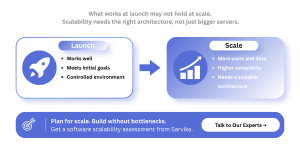
Software performing well at launch does not necessarily mean it is ready to scale. True scalability is the ability to absorb more users, data, transactions, integrations, and traffic without allowing performance, reliability, cost, or operational complexity to deteriorate disproportionately.
Sarvika approaches software scalability as an architecture and engineering challenge rather than simply an infrastructure-sizing exercise. We begin by identifying where the real constraint exists across application architecture, databases, APIs, cloud infrastructure, workload behaviour, observability, and technical debt.
Based on evidence, the right intervention may involve query optimisation, caching, asynchronous processing, application refactoring, workload isolation, infrastructure changes, improved observability, or targeted architecture modernisation.
The objective is not to overengineer software for hypothetical growth. It is to build measurable capacity, resilience, and room to evolve as demand increases. For enterprises planning to scale or modernise critical applications, Sarvika helps identify the bottlenecks early and engineer the right path forward.
Frequently Asked Questions (FAQs)
1. Why does software that works at launch fail when traffic increases?
Software can fail under growth when its architecture, database, APIs, or infrastructure cannot absorb higher concurrency and workload. Common triggers include database contention, inefficient queries, connection exhaustion, synchronous processing, insufficient capacity, and poorly configured scaling policies. Adding more servers does not help when the bottleneck sits in a stateful dependency.
2. How can I tell if my application is ready to scale?
Look beyond whether the application works under normal traffic. Evaluate throughput, p95/p99 latency, concurrent-user capacity, database connections, query performance, queue depth, error rates, dependency limits, autoscaling response time, and recovery behaviour. Load, stress, spike, and endurance testing can reveal capacity boundaries before production traffic exposes them.
3. Why does adding more cloud servers sometimes fail to fix application performance?
Horizontal scaling only increases capacity in components that can actually scale horizontally. If the database, external API, storage layer, connection pool, or another stateful dependency is the bottleneck, adding application instances can simply push more workload toward the same constraint. Scaling should therefore begin with bottleneck identification, not infrastructure expansion.
4. When should an enterprise consider rearchitecting software for scalability?
Rearchitecture becomes worth considering when repeated optimization and infrastructure scaling no longer remove the constraint, tightly coupled components prevent independent scaling, deployments become risky, or a database, service, or workflow repeatedly limits the entire platform. The decision should follow evidence from performance testing and observability—not the assumption that newer architecture is automatically better.
5. How can enterprises reduce the risk of scalability problems before a major product launch?
Start with realistic capacity planning and define measurable scalability targets for throughput, latency, concurrency, availability, and cost. Then validate them through production-like load and spike testing, establish application and infrastructure observability, map downstream dependencies, test failure scenarios, and configure scaling with sufficient headroom. This turns scalability from a launch-day assumption into an engineering discipline.

Sarvika Technologies
Sarvika Tech is a team of young, energetic, and technology-loving people on the journey to help companies achieve their goals by supporting their IT needs. In a nutshell, we are a people’s company where the priority is their knowledge enhancement and career development. We believe that focusing on our most important asset, the team, will enable us to push boundaries and deliver ingenious IT solutions.