
The Real Cost of a Software Security Breach for Growing Businesses
A software security breach rarely ends when the attacker is removed.
The vulnerability may be patched, passwords reset, systems restored, and the incident report closed, but the business can keep paying for the breach through lost revenue, engineering downtime, customer churn, delayed product releases, regulatory work, and damaged trust.
That distinction matters for growing businesses. As companies expand, they accumulate cloud workloads, APIs, SaaS platforms, third-party integrations, customer data, and increasingly complex software environments. The attack surface grows faster than many security programmes.
The financial exposure is already significant. IBM’s 2026 research puts the average cost of a data breach in India at ₹25.5 crore, up 15.9% from 2025. Globally, the average reached $4.99 million.
But averages only tell part of the story.
For a growing business, the real cost of a software security breach is the value of everything the organisation cannot operate, sell, build, or protect while recovering from it.
What Is the Real Cost of a Software Security Breach?
A software security breach occurs when an attacker gains unauthorised access to an application, system, account, database, API or connected infrastructure and compromises its confidentiality, integrity or availability.
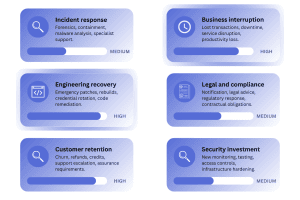
The financial impact extends far beyond incident-response expenses. A useful way to evaluate cybersecurity breach cost is to consider six interconnected areas:
- Incident response: Forensics, containment, investigation, remediation, legal support, and recovery consume immediate resources.
- Business interruption: Downtime can stop transactions, customer access, internal operations, and revenue-generating workflows.
- Engineering capacity: Developers and infrastructure teams may abandon planned product work to investigate vulnerabilities, rebuild systems and implement emergency fixes.
- Customer impact: Service disruption or compromised data can increase churn, refunds, support volume, and contractual pressure.
- Compliance and legal exposure: Certain incidents can trigger reporting, investigation, notification and regulatory obligations.
- Lost growth: Security remediation can delay launches, expansion plans, partnerships, and other investments that would otherwise generate future revenue.
This is why the cost of a software security breach should be measured as business impact, not simply the amount spent fixing the vulnerability.
Why Growing Businesses Face a Different Security Risk?
Growing businesses often sit in an uncomfortable middle ground. They have enough customers, data, integrations, and software complexity to become attractive targets, but their security controls may not have matured at the same pace.
A typical growth-stage technology environment might include a cloud platform, customer-facing application, mobile application, payment gateway, CRM, analytics tools, third-party APIs, open-source dependencies, CI/CD pipelines, and multiple SaaS services.
Every connection introduces another dependency that needs to be secured.
The 2026 Verizon Data Breach Investigations Report found that 31% of breaches began with vulnerability exploitation, making software vulnerabilities the leading breach entry point in its dataset. It also found that breaches involving third parties had increased by 60%, reaching 48% of breaches.
Where Does the Money Actually Go After a Breach?
The visible cost usually appears first. The hidden cost accumulates afterwards.
The Hidden Cost: Engineering and Operational Disruption
One of the least discussed consequences of a breach is the sudden redirection of technical talent.
Imagine a growing SaaS company preparing a major product release. A critical vulnerability appears in production. The engineering roadmap immediately changes. The business may lose weeks of planned development without losing a single employee.
That is an opportunity cost of cybersecurity incidents that rarely appears as a separate line item.
IBM’s 2026 India research reinforces the value of proactive security operations: organisations with extensive AI and security automation reported substantially lower average breach costs than organisations with no such automation. It also identified offensive security testing, including red teaming and penetration testing, as the largest cost-reducing factor in its India findings.
-
A Breach Can Become a Revenue Problem
A security incident becomes financially serious when it interrupts the revenue engine. For a SaaS company, unavailable authentication or application infrastructure can prevent customers from using the product.
Therefore, the damage extends beyond lost revenue during downtime. A breach can slow the entire sales cycle.
Enterprise buyers may ask for additional penetration-testing reports, security questionnaires, architecture reviews, compliance evidence, and remediation documentation. Deals that previously took weeks can take months. That makes application security a commercial capability.
-
Customer Trust Is a Financial Asset
You can restore a database, rebuild infrastructure, or deploy a security patch. But rebuilding customer confidence is harder. Customers expect businesses to protect the information and services they depend on. When a company suffers a breach, customers may question whether its security practices, internal controls, and technology architecture are reliable enough for continued use. That can affect:
- Customer retention
- Renewals
- Referrals
- Enterprise contracts
- Partner relationships
- Brand reputation
- Future sales
The financial impact of a breach therefore continues even after technical recovery. Trust becomes part of the balance sheet indirectly because it influences whether customers continue to buy.
Software Supply Chains Are Part of Your Security Boundary
A modern application rarely consists entirely of code written by your own developers. It may depend on open-source libraries, cloud services, APIs, SDKs, payment providers, authentication platforms, analytics tools, and managed infrastructure. That creates a software supply chain.
If one dependency becomes compromised, vulnerable, or misconfigured, your application can inherit the risk. Therefore, growing businesses should evaluate security beyond their own source code.
A mature application security strategy should include dependency scanning, software composition analysis, API security, secrets management, third-party risk assessment, secure CI/CD pipelines, and continuous vulnerability management.
AI Is Changing the Economics of Software Security
AI is changing security economics on both sides of an attack. Attackers can use AI to accelerate vulnerability discovery, reconnaissance, malicious code development, and other attack techniques, while businesses are simultaneously introducing AI applications, APIs, new data-access paths, and increasingly autonomous systems into their technology environments.
Verizon’s 2026 DBIR reports that 15% of attack techniques in its dataset are being bolstered by Generative AI. IBM’s 2026 research also found that AI-enabled malicious breaches cost an average of $6 million, compared with the $4.99 million global average breach cost.
For growing businesses, the economic concern is therefore not simply whether AI creates new security risks. It is whether security capabilities can keep pace as both the speed of attacks and the complexity of the technology environment increase.
This makes proactive security increasingly valuable. Secure development, vulnerability testing, controlled access, continuous monitoring, and faster incident response can reduce the probability that vulnerabilities become breaches and, when incidents do occur, limit their blast radius, operational disruption, and recovery cost.
The business case for AI security is ultimately the same as the business case for software security: prevent what can be prevented, detect problems earlier, contain failures faster, and reduce the economic impact when something goes wrong.
How Can Growing Businesses Reduce the Real Cost of a Breach?
The objective of cybersecurity services should not be to promise that a breach will never happen. Because there is no such resilient and responsible security strategy that can give a guarantee.
The better objective is to reduce the probability, blast radius, and recovery time of an incident. Therefore, we must suggest that growing businesses prioritise:
-
Secure SDLC
Integrate security requirements, threat modelling and code security into software development rather than testing only before release.
-
Continuous vulnerability management
Identify, priorities and remediate vulnerabilities based on exploitability and business impact.
-
Application security testing
Combine SAST, DAST, SCA, API testing and penetration testing across the development lifecycle.
-
Identity security
Apply MFA, least privilege, RBAC and privileged-access controls across applications and infrastructure.
-
API security
Authenticate, authorize, validate and monitor APIs because integrations increasingly connect critical business systems.
-
Cloud security
Continuously assess configurations, identities, workloads, network exposure and storage permissions.
-
Incident response
Maintain tested response procedures, logging, escalation paths, backups and recovery processes before an incident occurs.
-
Security monitoring
Use SIEM, EDR, SOAR, and threat detection capabilities where they provide meaningful coverage and faster response.
Caution: “For businesses operating in India, security planning should also account for applicable regulatory and incident-reporting requirements. CERT-In’s directions require covered entities to maintain ICT system logs securely for a rolling 180-day period, while specified cyber incidents, including data breaches and leaks, fall under its incident-reporting requirements.”
How Can Sarvika Help Reduce Software Security Risk?
Sarvika approaches security as an engineering discipline embedded into the software lifecycle, rather than a layer added after development. Our engineering capabilities can bring application development, cloud engineering, DevOps, cybersecurity and modernization into the same technology lifecycle.

Conclusion
The real cost of a software security breach is rarely limited to the security incident itself. Businesses pay through downtime, engineering disruption, lost revenue, customer churn, compliance work, delayed product releases, and opportunities that never materialise.
Growing businesses need security that scales with their technology footprint as software ecosystems become more connected and AI accelerates both development and attacks.
Investing in application security services, vulnerability assessment, penetration testing, cloud security, and DevSecOps services can reduce exposure before a vulnerability becomes a business crisis. The smartest security strategy is not built on the assumption that failure is impossible. It is engineered so that when something does fail, the business impact remains contained.
FAQ
What is the real cost of a software security breach for a growing business?
The real cost includes more than incident response or ransom. A breach can create downtime, lost revenue, engineering disruption, customer churn, legal expenses, compliance work and delayed product launches, making its total business impact significantly higher than the initial recovery bill.
How does a software security breach affect business revenue?
A software security breach can interrupt customer-facing applications, transactions and internal operations. Beyond immediate downtime, businesses may lose customers, delay sales, postpone product launches and face longer enterprise procurement cycles because buyers demand additional security validation before signing contracts.
Why are growing businesses increasingly vulnerable to software security breaches?
Growing businesses expand their cloud infrastructure, APIs, applications, employees, third-party integrations, and customer data faster than their security controls often mature. This expanding attack surface creates more opportunities for vulnerabilities, misconfigurations, compromised credentials, and third-party weaknesses to affect critical business systems.
How can businesses reduce the financial impact of a security breach?
Businesses can reduce breach impact by combining secure software development, vulnerability management, penetration testing, API security, identity controls, cloud security, continuous monitoring and tested incident-response procedures. The goal is to prevent attacks where possible and minimize their blast radius, downtime and recovery costs.
What cybersecurity requirements should businesses in India consider after a data breach?
Businesses operating in India should evaluate applicable CERT-In reporting and logging requirements alongside their contractual and regulatory obligations. CERT-In directions require covered entities to maintain ICT system logs securely for 180 days and report specified cyber incidents within the prescribed timeframe.