
Vibe Coding Is Entering the Enterprise: Why Unreviewed AI-Generated Code Is Becoming a Risk Audit Problem
AI coding assistants have quickly moved from experimental tools to everyday AI development agents.
Developers today use GitHub Copilot, Cursor, Claude Code, Windsurf, ChatGPT, and other AI-powered tools to generate functions, create APIs, write tests, and debug issues. Even, it builds entire application components.
What once took hours can now be completed in minutes.
For engineering teams under pressure to deliver software faster, the value is obvious. But as AI-generated code begins making its way into production systems, a new question is emerging:
Can organizations explain how that code was created, reviewed, tested, and approved?
This is where the conversation shifts from productivity to governance.
The biggest enterprise risk associated with AI-generated code is that organizations may deploy it without the same controls, visibility, and accountability traditionally applied to software development.
In the beginning, the software seemed to be working fine with all the functionalities and features. Later, in a few months, security and usability issues will happen.
As AI-assisted development becomes mainstream, enterprises are beginning to recognize that the challenge is ensuring that AI-generated code enters production through secure, auditable, and well-governed engineering processes.
What Is Vibe Coding and Why Is It Growing So Fast?
The term “vibe coding” refers to a development style in which engineers use natural-language prompts to generate substantial portions of code using AI tools.
Instead of manually writing every function in code, developers describe what they want to build, and the AI generates code suggestions, application logic, test cases, documentation, or entire workflows in simple language over AI platforms.
An AI coding assistant may generate hundreds of lines of code within seconds. This approach has gained rapid adoption because it offers several advantages:
- Faster Development Cycles
Developers spend less time writing repetitive boilerplate code and more time solving business problems.
- Rapid Prototyping
Teams can quickly validate ideas, build proofs of concept, and test product hypotheses.
- Improved Developer Productivity
AI coding assistants help reduce context switching, automate routine tasks, and accelerate implementation.
- Knowledge Assistance
Developers can access explanations, documentation, and code recommendations without leaving their development environment.
Why Enterprises Are Embracing AI-Assisted Development?
Many discussions around AI-generated code focus exclusively on security risks and worst-case scenarios. While these concerns are valid, they do not explain why adoption continues to accelerate.
Organizations are embracing AI-assisted development because it delivers measurable business value.
- Accelerating Time-to-Market
In competitive markets, delivery speed matters.
AI coding tools can significantly reduce the time required to build internal tools, customer-facing features, integrations, and prototypes.
- Addressing Developer Capacity Challenges
Many organizations face growing software demands while struggling to hire experienced engineering talent.
AI tools help developers accomplish more without proportionally increasing team size.
- Reducing Repetitive Work
Tasks such as writing CRUD operations, generating documentation, creating unit tests, and implementing standard patterns can often be automated effectively.
- Supporting Innovation
By reducing implementation overhead, teams can spend more time exploring new ideas and solving complex business problems.
AI Is Becoming Part of the Software Supply Chain
Most discussions about AI coding focus on productivity. But the more important conversation is about accountability. However, the software development follows a relatively straightforward process: consultation, development, and deployment.
The AI-assisted Development Cycle has changed the dynamics, which includes:
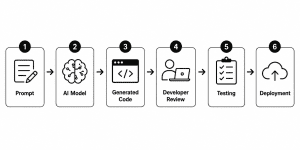
This change may appear small, but it introduces important governance questions.
For example:
- Which model generated the code?
- Which prompt influenced the output?
- Was the generated code modified before deployment?
- Was AI-generated content independently reviewed?
- Can the organization trace how the final implementation was produced?
These questions become increasingly important in regulated industries such as healthcare, banking, insurance, telecommunications, and government sectors.
From an audit perspective, AI-generated code becomes part of the software supply chain.
Why Unreviewed AI-Generated Code Is Becoming an Audit Problem?
The software industry has spent decades building controls around code quality and software delivery. Code reviews, testing frameworks, change management processes, approval workflows, and security scans exist for a reason.
They help organizations demonstrate that software has been developed responsibly. When AI-generated code bypasses these controls, new risks emerge.
Lack of Traceability
Modern development platforms already provide commit histories, pull request records, reviewer assignments, and deployment logs. The emerging challenge is not whether activity can be traced.
The challenge is proving how AI-generated code influenced the final implementation. Organizations often lack visibility into:
- Which portions of a codebase originated from AI assistance
- Whether the generated code was materially modified before deployment
- Which prompts or workflows produced critical business logic
- How much generated code bypassed traditional engineering review depth due to delivery pressure
Lack of Review Evidence
Code review remains one of the most effective quality assurance practices in software engineering. However, when developers accept AI-generated suggestions without proper review, organizations lose an important layer of validation.
Most enterprise teams already perform code reviews. The concern is review effectiveness.
AI-generated code can significantly increase the volume of changes being introduced into repositories. As a result, reviewers may spend less time evaluating implementation details and more time validating overall functionality, increasing the likelihood that subtle logic flaws, architectural inconsistencies, or security assumptions go unnoticed.
Compliance and Regulatory Exposure
In regulated industries, organizations are often required to demonstrate that software changes followed approved development procedures. Auditors may request evidence showing:
- Security reviews
- Testing results
- Change approvals
- Segregation of duties
- Risk assessments
If AI-generated code enters production without these controls, organizations may struggle to demonstrate compliance. This transforms an engineering issue into a governance issue.
Accountability Gaps
When defects appear in production, organizations typically investigate who introduced the change and how it passed review processes. AI-generated code can complicate this process if ownership and review responsibilities are not clearly defined.
The question is whether humans exercised appropriate oversight before deployment.
According to industry surveys, AI-assisted development has moved beyond experimentation and is becoming part of everyday engineering workflows across startups, enterprises, and software service providers.
The Hidden Risks of Vibe Coding in Enterprise Environments
The discussion around AI-generated code often starts with productivity benefits. However, enterprise leaders are increasingly focusing on a different question:
What happens when AI-generated code reaches production without sufficient review and governance?
The answer goes beyond security vulnerabilities, but risks span software quality, maintainability, compliance, operational resilience, and long-term business continuity.
Security Vulnerabilities
The challenge is that the generated code often appears correct at first glance. Developers under delivery pressure may accept recommendations quickly without thoroughly evaluating security implications. This creates a situation where vulnerabilities can enter production faster than ever before.
Modern coding assistants are increasingly capable of generating secure-by-default implementations for common patterns. The larger risk is not obvious vulnerabilities but subtle logic flaws introduced through incomplete context.
For example, generated code may:
- Omit edge-case validation
- Make incorrect assumptions about authorization boundaries
- Introduce unsafe business logic paths
- Handle exceptions inconsistently
- Create unexpected interactions between services
Hallucinated APIs and Non-Existent Functions
Large Language Models occasionally generate code that references packages, libraries, or functions that do not actually exist. While experienced developers can usually identify these issues, problems arise when generated code is accepted without sufficient validation.
In some cases, developers may unknowingly install similarly named third-party packages, creating software supply chain risks. As AI-generated development scales across organizations, these seemingly small mistakes can create larger security and operational challenges.
Hardcoded Secrets and Sensitive Information
Another common concern involves the handling of credentials and sensitive data. Generated code may include:
- API keys
- Access tokens
- Database connection strings
- Authentication secrets
- Sensitive configuration values
If these practices are copied into production systems, organizations expose themselves to unnecessary security risks. Modern secure development practices require secrets management solutions and proper credential handling, regardless of whether code is written by humans or generated by AI.
Technical Debt at Scale
One overlooked risk is the speed at which technical debt can accumulate. Traditionally, writing code required deliberate effort. Whereas the AI-generated development dramatically reduces that effort. While this accelerates delivery, it can also accelerate the creation of:
- Duplicate functionality
- Inconsistent coding patterns
- Poor architectural decisions
- Over-engineered solutions
- Under-documented implementations
Shadow Development
Perhaps one of the most significant enterprise concerns is the rise of what many organizations now describe as “shadow development.” Business users, analysts, product managers, and non-engineering employees can increasingly generate applications using AI-powered development tools. While this expands innovation opportunities, it also creates governance challenges. Applications may be deployed without:
- Security review
- Architecture review
- Compliance validation
- Data governance oversight
- Operational ownership
Why “The Code Works” Is No Longer Enough
Software quality was often measured by a simple question:
Does the application work as intended?
In modern enterprise environments, that question is no longer sufficient. A feature can work perfectly and still introduce significant organizational risk.
For example:
An AI-generated customer onboarding workflow may function correctly.
However:
- Is it secure?
- Is it compliant with internal policies?
- Is it maintainable?
- Is it documented?
- Can another engineer understand and modify it?
- Can its behavior be explained during an audit?
Enterprise software is evaluated on reliability, security, governance, scalability, and accountability. This distinction is becoming increasingly important as AI-generated code becomes a larger percentage of the enterprise codebase.
The reality is that working code and production-ready code are not the same thing.
Production-ready software must satisfy a broader set of requirements that extend far beyond implementation correctness. Organizations that overlook this distinction often discover the consequences later during security reviews, compliance assessments, operational incidents, or customer-impacting failures.
What Enterprise-Grade Governance for AI-Generated Code Looks Like?
The solution is to establish governance frameworks that allow organizations to benefit from AI-assisted development while maintaining control over quality and risk. Most successful enterprises are approaching AI-generated code the same way they approach any other software asset.
Mandatory Code Reviews
Human review remains one of the most effective quality controls in software engineering. Regardless of how code is generated, it should be reviewed by qualified engineers before deployment. Code review helps identify:
- Security issues
- Logic flaws
- Maintainability concerns
- Architectural inconsistencies
- Policy violations
Secure Software Development Lifecycle (SSDLC)
Organizations should ensure AI-generated code follows existing secure development practices. This includes:
- Security testing
- Threat modeling
- Code scanning
- Dependency validation
- Change management controls
Static Application Security Testing (SAST)
Automated security scanning tools help identify vulnerabilities before software reaches production. These tools should be integrated directly into CI/CD pipelines to ensure AI-generated code receives the same scrutiny as manually written code.
Dependency and Supply Chain Scanning
Software supply chain attacks continue to increase across industries, making this control particularly important. AI-generated code frequently introduces external libraries and dependencies. Organizations should validate:
- Package legitimacy
- License compliance
- Known vulnerabilities
- Dependency freshness
AI Usage Policies
Many organizations now recognize the need for formal AI development policies. These policies may define:
- Approved AI tools
- Acceptable use cases
- Data handling requirements
- Review expectations
- Security obligations
Audit Logging and Traceability
One of the most important governance capabilities is maintaining visibility into how software was developed. Organizations should be able to answer:
- Which AI tool was used?
- Who accepted the generated code?
- Who reviewed the changes?
- When was the code deployed?
- Which controls were applied?
Building an Audit-Ready AI Development Lifecycle
Traditional SDLC controls remain essential. However, AI-assisted development introduces additional governance requirements that many organizations are only beginning to address.
AI Tool Governance
Organizations should define:
- Approved coding assistants
- Approved model providers
- Acceptable use cases
- Data sharing restrictions
Prompt and Context Governance
Sensitive information should not be exposed through prompts, uploaded repositories, or model context windows without appropriate controls.
Generated Code Visibility
Engineering leaders need visibility into:
- Where AI assistance is being used
- Which repositories are heavily AI-assisted
- Whether the generated code is increasing the review burden
AI-Assisted Review Workflows
Review processes may need to evolve to account for larger pull requests and faster code generation cycles.
Model and Vendor Risk Management
Enterprises must evaluate:
- Data retention policies
- Training practices
- Intellectual property concerns
- Compliance obligations
This is the section that actually differentiates AI governance from normal SDLC
Why Auditors Are Paying Attention to AI-Assisted Development
Auditors are not concerned with whether code was written by a developer or generated by an AI assistant.
They care about whether organizations can demonstrate that appropriate controls were followed throughout the software development lifecycle.
As AI-generated code becomes more common, auditors increasingly focus on:
- Change management evidence
- Review effectiveness
- Security testing coverage
- Software supply chain visibility
- Third-party AI tool governance
- Data handling and privacy controls
How Sarvika Helps Enterprises Adopt AI Development Responsibly?
Sarvika Technologies helps organization modernize their software development practices while maintaining the governance, security, and operational controls required for enterprise environments.
Our teams work with enterprises to design AI-enabled development frameworks that integrate seamlessly with existing DevSecOps, compliance, and software delivery processes. This includes:
- Secure AI-assisted development workflows
- Application modernization initiatives
- DevSecOps implementation
- Code quality and governance frameworks
- Security testing integration
- Software supply chain risk management
- Enterprise AI adoption strategies
Conclusion
AI coding assistants are rapidly becoming a standard part of software development. The productivity gains are real, and business value is significant. The pace of adoption will continue to increase.
However, enterprise success will not be determined by how quickly organizations generate code. It will be determined by how effectively they govern it. The real risk is not AI-generated code.
The real risk is AI-generated code entering production without review, oversight, accountability, and traceability. Organizations that establish strong governance frameworks today will be better positioned to capture the benefits of AI-assisted development while maintaining the security, compliance, and operational standards that enterprise software demands.

Muskan Lakhotia
Senior Content Writer
Muskan Lakhotia is a Senior Content Writer at Sarvika Technologies, where she turns complex ideas into content that feels clear, sharp, and worth reading. She works across digital transformation, enterprise solutions, and service-led storytelling, with a focus on creating narratives and strategies that inform & engages with the audience. Curious by instincts and strategic with plans, she enjoys shaping content that gives brands a stronger voice, a clearer point of view, and a more human way to speak to modern businesses.