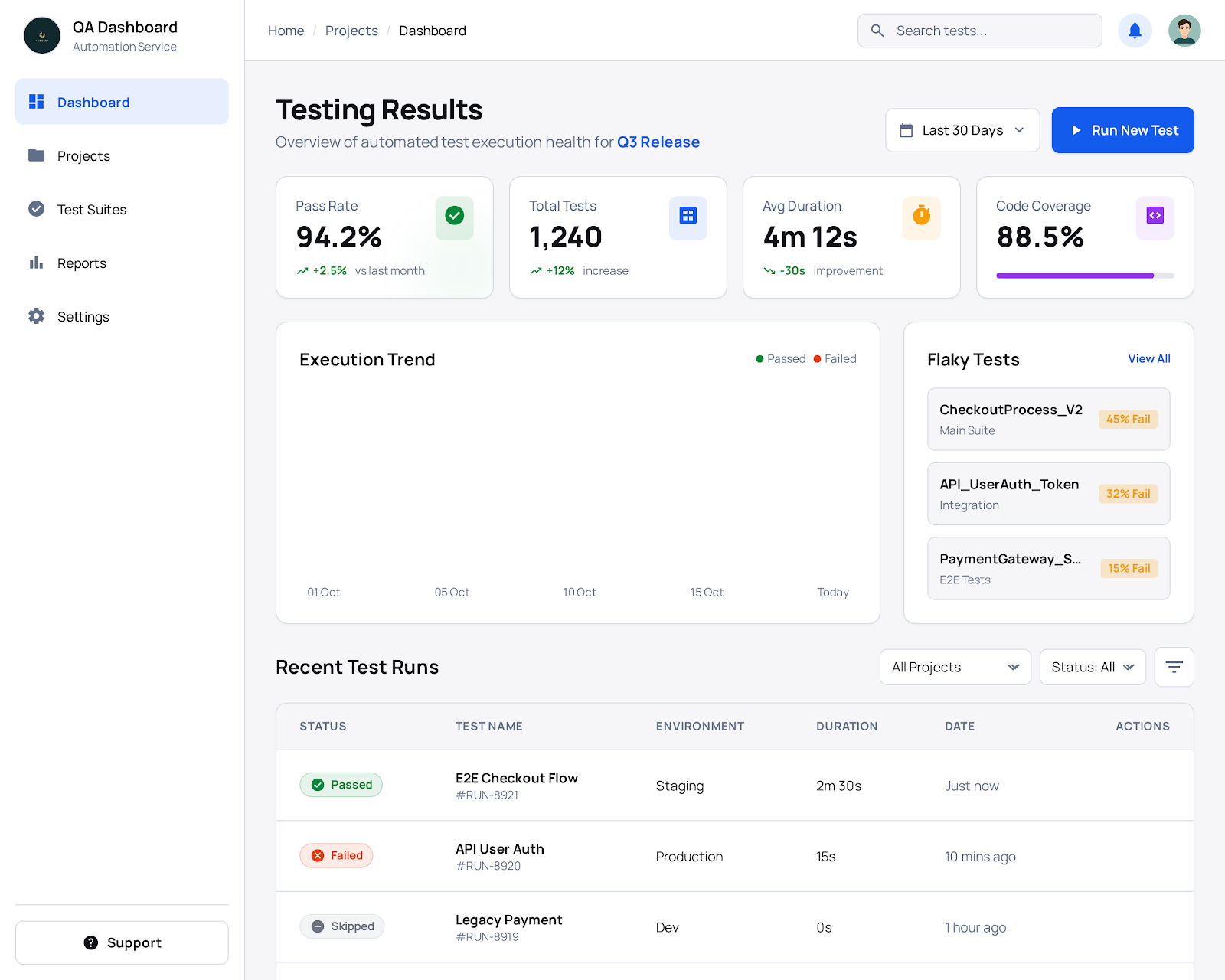
How Sarvika Enabled Seamless QA Automation Across Business-Critical SaaS Workflows
A fast-growing SaaS platform operating with multiple distributed development teams faced mounting challenges in keeping up with rising product complexity and release frequency. With teams shipping features weekly or biweekly, their manual QA processes could no longer sustain the growing volume of regression checks, resulting in delayed deployments, inconsistent coverage, and increased operational risk.
Problem
- Slow Testing Cycles and Release Delays: Manual test execution stretched across several days, slowing release velocity and increasing the likelihood of missing critical issues during high-pressure releases.
- High Effort, Low Coverage: Manual entry introduced inaccuracies, duplication, and inconsistent data, complicating retrieval and analysis.
- Scalability Challenges: As the platform expanded, demand for testing grew exponentially. Team capacity, however, stayed constant—creating a widening gap between product delivery and QA readiness.
- Human Error and Inconsistency: Manual test execution introduced variability, especially during rapid release cycles or late-night deployments, increasing the possibility of skipped steps or overlooked defects.
Solution
- Unified Automation Architecture: A single Python framework capable of validating UI, APIs, backend logic, and integrated workflows—reducing fragmentation across testing tools.
- Reusable, Plug-and-Play Components Python modules enabled rapid script development with reusable libraries for login flows, data creation, environment setup, and verification.
- Parallel Execution at Scale The system leveraged Python’s async capabilities and parallel execution to achieve high-volume testing in significantly reduced time.
- Smart Data Handling Dynamic data generation removed the need for manual preparation, eliminated conflicts, and ensured clean, predictable test runs.
- Seamless CI/CD Integration The automation suite is integrated with tools like GitHub Actions / Jenkins, triggering test runs automatically with every merge or release branch creation.
- Maintenance-friendly Clear folder structures, modular code, and automated failure screenshots/logging helped keep long-term maintenance costs low.
Why Python?
Python is chosen for its simplicity, rapid development speed, and rich automation ecosystem. Its PyTest framework offers a clean, easy-to-maintain structure, making test development and scaling straightforward across teams. Combined with seamless CI/CD integration and strong library support, Python becomes the ideal foundation for a unified automation framework.
Results
- Accelerated Testing Cycles
- Higher Test Coverage
- Improved Product Quality
- Massive Time Savings
- Consistent and Reliable Execution
Business Impact (Before and After)
| Metrics |
Before AI Solution |
After AI Solution |
| Regression Cycle Duration |
1–2 days |
~45 minutes |
| Data Accuracy |
High error rate (~40–50% errors) |
>90% accuracy achieved |
| Candidate Retrieval Time |
Low due to delayed assistance |
High with continuous support |
| Shortlisting & Decision-Making Speed |
Many unresolved issues |
Near 100% resolution |
| Scalability |
Limited and impersonal |
Highly scalable and personalized |
Development Timeline
The complete Python automation system —including UI, reporting, environment utilities, and CI/CD integration—was designed, developed, and deployed within 8 weeks, demonstrating the efficiency and adaptability of Python-powered QA.
Conclusion
The Python-powered automation ecosystem fundamentally reshaped the client’s QA operations—eliminating bottlenecks, improving release confidence, and enabling the product to scale without increasing QA effort. By replacing slow, manual regression cycles with a unified, modular, and highly scalable automation framework, the organization achieved faster delivery, higher quality, and seamless collaboration across teams. This approach not only transformed software testing but also created a reusable automation foundation that can be extended to data workflows, enterprise applications, compliance processes, and other business-critical operations. With this Python-driven solution, the client is now equipped to deliver features rapidly, maintain consistent quality, and support long-term product growth with ease.

 2 min read