
SEO isn’t Dead: GEO is Becoming a New Layer of Search Visibility
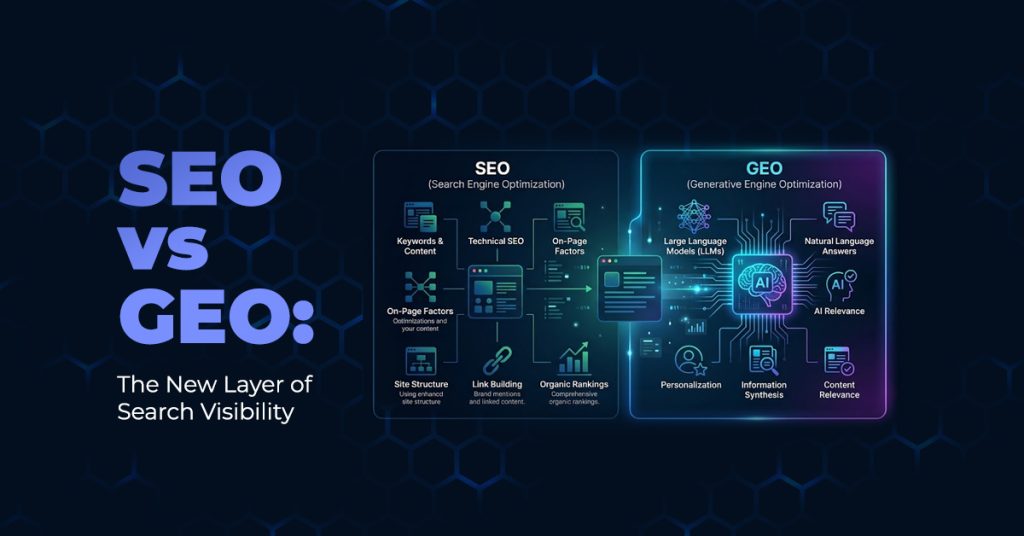
Is SEO dead? Are keywords not enough to rank? How to rank over Gen AI engines?
Well, every marketer is right now exploring the dynamic change that happened through the recent Google core updates. Some say SEO is dead, and GEO is taking its place. On the contrary, some are amalgamating search engine and GenAI engine strategies for optimum outputs.
Earlier, brands measured search visibility through rankings, impressions, clicks, and traffic. That model still matters. But it is no longer complete.
Today, Google AI Overviews, AI Mode, ChatGPT Search, Perplexity, Gemini, Microsoft Copilot, and other AI-led discovery systems are changing how users find information. Users no longer depend only on a list of links. They now receive synthesized answers, product comparisons, summaries, recommendations, and citations inside the search experience itself through relevant contextual searches.
This shift has created a new visibility layer: Generative Engine Optimization or GEO.
It’s significant to know the differences. GEO does not replace SEO, but sits on top of it. SEO helps search engines discover and rank your content. AEO helps your content answer user questions clearly. GEO helps generative AI systems understand, trust, and reference your content when they build answers.
For enterprises, it is a visibility architecture problem. Therefore, brands focus on building reliable, structured, expert-led, technically accessible content ecosystems that search engines and AI systems can confidently use.
Problem Isn’t SEO Dying, But Visibility Comes with Contextual Understanding
SEO is not dead. The old definition of search visibility is.
For a long time, visibility meant one simple thing: rank higher on Google and get more clicks. That still matters. But today, users may get the answer before they ever click a website. They may see an AI Overview.
That is the real shift. GEO matters because search is about content with a unique point of view, first-hand experience, expert insight, strong organization, useful media, and clear technical accessibility. It retrieves information, compares sources, extracts claims, summarizes context, and presents an answer.
In the AI-search era, content must prove why it deserves to be used. Search is becoming an Answer Infrastructure, rather than working like a directory to find high-ranking links.
The infrastructure has four moving parts:
- Discovery: Can the system find your content?
- Understanding: Can it understand what your content is about?
- Trust: Does your content look credible enough to use?
- Extraction: Can the system pull a clear answer from your page?
SEO helped websites become discoverable. But AI search creates pressure on the remaining three parts. If your content is vague, repetitive, poorly structured, or thin, it may get indexed but still fail to become useful for AI-generated answers.
This is where many enterprise websites struggle. AI search exposes this weakness.
When the interface changes from “show me pages” to “give me an answer,” average content loses value.
Google’s May 2026 Core Update Reinforces GEO
Google’s May 2026 Core Update was not officially called a GEO update. Google did not say that GEO is a ranking factor, but the timing and language matter.
The May 2026 Core Update started on May 21, 2026, and was completed on June 2, 2026, according to Google’s Search Status Dashboard. Google described it as a regular core update designed to better surface relevant and satisfying content from all types of sites.
“That phrase is important: Relevant and Satisfying.”
Relevance means the content matches the user’s intent. Satisfaction means the user gets enough value from the result.
Around the same period, Google published guidance for optimizing websites for generative AI features in Search, including AI Overviews and AI Mode. Google made one thing clear: SEO still matters because generative AI features rely on Google’s core Search ranking and quality systems.
Google also explained two important mechanisms: retrieval-augmented generation and query fan-out.
“Retrieval-augmented generation means the AI response uses retrieved search results to ground its answer. Query fan-out means the system may generate related sub-queries to understand the topic more deeply.”
A page should not only target one exact keyword. Content should cover the intent around the topic, answer the main question and the natural follow-up questions. Connecting entities, explaining context, and providing enough substance ensures both a human and a machine can fully understand the topic.
The May 2026 update should not make enterprises panic. But it should make them audit.
SEO, AEO, and GEO Are Not Separate Strategies
The industry loves new labels: SEO, AEO, GEO, SXO, LLMO, and AI SEO.
The labels can help explain the shift, but they can also confuse businesses. Enterprises do not need ten disconnected strategies, but need one modern search visibility system.
Here is the simplest way to understand it:
- SEO gets you discovered. It focuses on crawlability, indexability, technical structure, content relevance, authority, and rankings.
- AEO makes you answer-ready and focuses on direct answers. It helps your content respond clearly to the questions users ask
- GEO makes you reference-worthy, focusing on AI-generated responses. It helps generative systems understand, trust, cite, or reference your content when they produce answers.
A technically weak page will struggle with SEO. A vague page will struggle with AEO. A generic page will struggle with GEO. That is why modern content strategy must combine all three.
A GEO approach goes deeper. It explains architecture, tool use, orchestration, memory, permissions, monitoring, failure handling, security, integration, and use cases. It shows that the company understands the implementation. That is the difference between content that ranks and content that earns trust.
Ranking First Does Not Always Mean Being Chosen by AI
This is one of the most important shifts for enterprise marketers.
Ranking well still matters, but first does not automatically mean an AI system will cite or reference your content.
Recent research around AI Overviews shows that AI-generated search systems can retrieve and present sources differently from traditional organic search results. Some studies have found that AI Overview citations do not always overlap fully with first-page organic results. It means rankings are no longer the only visibility metric.
A brand may not rank first, but may still get referenced because its content has a clearer answer, stronger authority, better structure, or more useful passage-level information.
For enterprise teams, this changes reporting. GEO adds new visibility indicators:
- AI Overview citations,
- brand mentions in AI answers,
- presence in ChatGPT Search or Perplexity responses,
- entity association,
- citation frequency,
- answer share,
- referral traffic from AI platforms,
- assisted conversions from AI-led discovery.
Why Generic AI Content Will Lose in the GEO Layer
AI has made content creation easier, but it has also made average content worthless. The internet is now full of articles that follow the same pattern:
“What is X?”
“Why X matters”
“Benefits of X”
“Top 5 use cases”
“FAQs”
This structure is not always wrong. But when every article says the same thing, none of them creates a reason to be selected.
Google’s generative AI guidance directly warns against recycling what others have already said or what a generative AI model could easily produce. It recommends unique, useful, non-commodity content.
That is exactly the standard enterprise brands need to follow.
A generic blog on “Benefits of Data Engineering” will not create strong authority.
A stronger blog would say:
“Why Enterprise AI Projects Fail Without Reliable Data Pipelines: The Engineering Layer Most Teams Underestimate.”
That title has a point of view. The topic connects data engineering with AI failure, speaks to a real enterprise problem, and creates room for technical explanation.
The same applies to GEO. You cannot earn AI-search visibility by producing more generic pages. You earn it by creating content that helps AI systems and users understand something better than the existing web does.
What Makes Content GEO-Friendly?
GEO-friendly content is not content written for bots. It is content structured so well that both humans and machines can understand, verify, and reuse it confidently. Here is what that looks like.
-
Original Point of View
Original POV does not mean being controversial for the sake of attention. It means adding a clear interpretation.
-
First-Hand or Practitioner-Led Insight
Practitioner-led content includes implementation details, such as how a solution works, where it fails, what trade-offs exist, and how to evaluate vendors.
-
Clear Entity Relationships
AI systems need to understand relationships. Who is the brand? What service does it offer? Which industry does it serve? What problem does it solve? Which technologies are involved? What outcomes does it create? A GEO-friendly page connects these entities clearly.
-
Structured Answers
AEO and GEO both benefit from clear answers. A human should be able to scan the page and understand the argument. A search system should be able to identify the core answer without guessing.
- Evidence and Citations
Trust needs proof. Citations do not make weak content strong. But they make strong content more credible.
-
Technical Accessibility
GEO still depends on technical SEO.
Google says generative AI features rely on crawlable, publicly accessible content from the Search index. Technical accessibility includes:
- clean crawl paths,
- proper indexing,
- logical internal linking,
- useful HTML structure,
- mobile usability,
- fast page experience,
- canonical clarity,
- helpful structured data where relevant,
- Content that is eligible for snippets.
-
Useful Media
Google’s AI guidance also mentions images and videos as opportunities in generative AI search experiences. For technical and enterprise content, visuals can make the difference between a generic article and a useful asset.
The Enterprise GEO Framework
Enterprises should not treat GEO as a blog-writing tactic. They need a system. A strong GEO framework has five layers.
Layer 1: Technical Discoverability
Before AI systems can understand your content, search engines must find it.
This includes crawlability, indexability, sitemap hygiene, internal linking, canonical tags, page speed, mobile usability, JavaScript rendering, and duplicate content control.
If this layer fails, everything above it becomes weaker.
Layer 2: Content Architecture
One blog will not build authority.
Enterprises need topic clusters around high-value services, industries, and buyer problems. A strong content architecture connects service pages, solution pages, blogs, case studies, comparison pages, and FAQs in a logical structure.
For example, an AI development cluster may include:
- AI development services,
- AI agents in enterprise workflows,
- AI governance,
- AI data pipelines,
- AI observability,
- model evaluation,
- RAG architecture,
- case studies,
- and industry-specific AI use cases.
This gives search engines and AI systems a stronger topical map.
Layer 3: Authority and Trust
GEO depends heavily on trust.
Enterprises should show authorship, expertise, company experience, case studies, source references, original research, and transparent claims.
Trust is not built by saying “we are experts.” It is built by showing how you think, how you solve problems, and what evidence supports your point.
Layer 4: Answer Readiness
Every strategic page should include answer-ready sections.
Use direct answers, definition blocks, comparison tables, decision frameworks, summary boxes, and clear takeaways.
This helps users. It also helps AI systems extract accurate context.
Layer 5: AI Visibility Measurement
Enterprises must measure beyond rankings.
Monitor where your brand appears in AI Overviews, AI Mode, ChatGPT Search, Perplexity, Gemini, and Copilot. Citation visibility matters, know whether your content gets referenced or overlooked. Competitive positioning is equally important, so identify when rivals are being surfaced in your place. Finally, map the topics you own and the ones where your brand is completely invisible.
What Enterprises Should Build Instead?
Enterprises should build visibility assets. A visibility asset is a page that earns trust, answers questions, explains decisions, and strengthens the brand’s authority in a specific topic.
- Build topic authority around high-value service areas.
- Create expert-led service pages that explain process, technology, risks, and outcomes.
- Add original research, benchmarks, surveys, POV articles, and case studies.
- Use diagrams, workflows, and architecture explainers.
- Write for humans first, but structure the content so machines can understand it.
- Track AI visibility alongside SEO performance.
- Refresh high-impact content when the market, technology, or Google guidance changes.
How Sarvika Technologies Helps Businesses Build AI-Search-Ready Visibility?
As search moves from rankings to recommendations, businesses need more than traditional SEO content.
Sarvika Technologies helps enterprises build digital ecosystems that search engines can crawl, users can trust, and AI systems can understand.
That includes AI-search-ready content strategy, technical SEO, website architecture, enterprise service-page development, topic cluster planning, content modernization, GEO/AEO-friendly blog frameworks, and visibility measurement across traditional and AI-led search surfaces. The bigger goal is to help businesses become trusted sources in their category.
If you are interested in mobile app development or software integrations in operations, we have skilled programmers for that. Alongside, take our marketing consultancy, where we build scalability of your solution into the competitive niche market.
Conclusion: The Future of Search Belongs to Reliable Sources
SEO is not dead, but it alone is no longer the full story.
Search visibility now has a new layer, “Generative Engine Optimization”. Users still search, but they also ask, compare, refine, and rely on AI-generated summaries. Search engines still rank pages, but they also synthesize answers.
GEO is becoming important because it responds to this new reality. It pushes businesses to think beyond keywords and rankings. It asks a harder question:
“Is your content useful, clear, credible, and structured enough to become part of an answer?”
Buying journeys are getting more complex. Search interfaces are changing. AI systems are influencing what users see before they click. Generic content will not carry enough authority in this environment.
Brands that win will be the ones that build content with substance. The next search battle will not be won by the brand that publishes the most.
It will be won by the brand that becomes the most trusted source for the questions its buyers actually ask.
FAQ
1. Is SEO dead because of GEO?
SEO is still the foundation of search visibility. GEO builds on SEO by helping content become more understandable, trustworthy, and reference-worthy for generative AI systems.
2. What is the difference between SEO and GEO?
SEO focuses on discoverability and rankings in search engines. GEO focuses on increasing the chances of being referenced, cited, or surfaced inside AI-generated answers.
3. What is AEO?
AEO stands for Answer Engine Optimization. It focuses on structuring content so it can answer user questions clearly and directly. AEO supports both traditional search features and AI-led search experiences.
4. Why is GEO important for enterprise websites?
Enterprise buyers use search to compare vendors, evaluate risks, validate expertise, and make decisions. GEO helps brands stay visible when those journeys happen inside AI-generated answers.
5. Does Google officially treat GEO as separate from SEO?
Google acknowledges AEO and GEO as terms used for AI-search visibility. However, Google says optimization for generative AI features in Search is still part of the broader Search experience and is rooted in SEO fundamentals.
6. What type of content performs best for GEO?
Content with original insight, expert explanation, clear structure, trusted sources, practical examples, strong entity relationships, and technical accessibility performs better than generic rewritten content.
7. How can companies measure GEO visibility?
Companies can track AI citations, AI Overview presence, brand mentions in AI responses, referral traffic from AI platforms, entity association, and visibility across tools like ChatGPT Search, Perplexity, Gemini, and Copilot.
8. How should enterprises start preparing for GEO?
Start with a content and technical SEO audit. Identify high-value pages, improve their depth, add expert insight, strengthen citations, improve internal linking, and make sure the website is crawlable, indexable, and easy to understand.
9. Does GEO mean creating content only for AI systems?
No. Strong GEO content is still written for people. The difference is that it is structured clearly enough for AI systems to understand and reference accurately.

Muskan Lakhotia
Senior Content Writer
Muskan Lakhotia is a Senior Content Writer at Sarvika Technologies, where she turns complex ideas into content that feels clear, sharp, and worth reading. She works across digital transformation, enterprise solutions, and service-led storytelling, with a focus on creating narratives and strategies that inform & engages with the audience. Curious by instincts and strategic with plans, she enjoys shaping content that gives brands a stronger voice, a clearer point of view, and a more human way to speak to modern businesses.