
Distributed Commerce Operating Infrastructure
 2 min read
Enterprise commerce rarely fails because a storefront exists. It fails because the operations behind that storefront become too complex to coordinate.
At smaller scale, commerce can look straightforward. Products are listed, customers place orders, and teams manage fulfillment through familiar workflows.
But as the ecosystem grows, commerce becomes more than transactions.
It becomes a distributed operating environment involving multiple stakeholders, approval hierarchies, tenant structures, supplier dependencies, vendor coordination, catalog rules, fulfillment logic, brand governance, and operational visibility.
For this client, the challenge was not simply to build commerce functionality.
The real challenge was to create infrastructure that could support distributed commerce operations at scale.
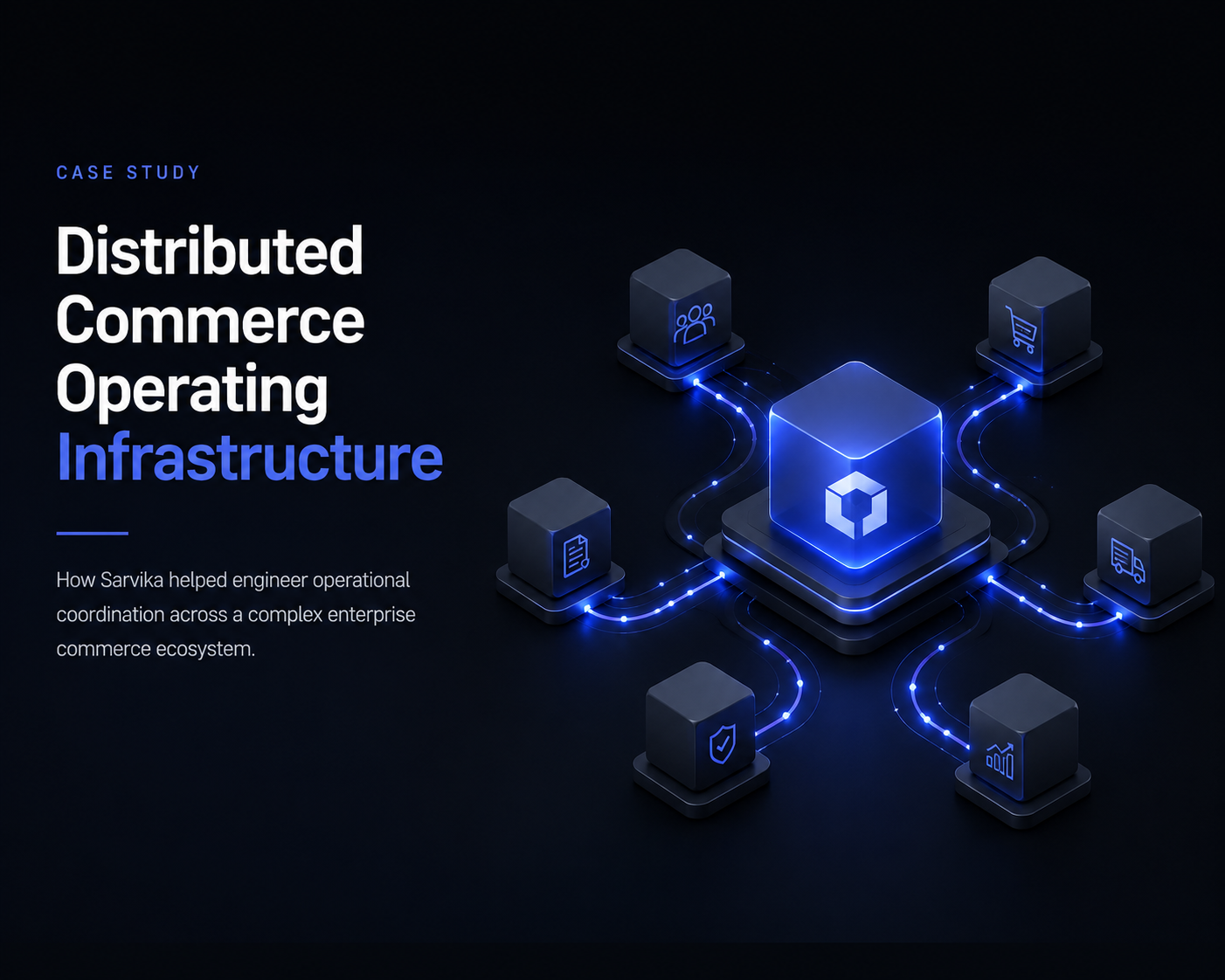
Sarvika helped architect a distributed commerce operating infrastructure designed around workflow orchestration, operational continuity, multi-tenant coordination, and system interoperability.
This was not a storefront story.
It was a systems engineering story.
The Challenge
The client operated in a commerce environment where operational complexity had grown beyond what a traditional storefront-centric system could comfortably support.
As the business expanded, the number of workflows, stakeholders, dependencies, and operational rules increased rapidly.
There were multiple roles involved in the commerce process. Different users needed different levels of access. Different teams needed visibility into different parts of the operation. Approvals had to move through structured paths. Catalogs needed to remain synchronized. Vendor and supplier coordination had to be managed consistently. Fulfillment workflows needed to stay connected to commercial operations.
The problem was not isolated to one feature.
It was a coordination problem across the entire commerce ecosystem.
Most commerce systems are designed around transactions. They are good at helping users browse, select, and purchase. But enterprise commerce operations require much more than that.
- Scalable Workflows They require workflows that can scale.
- Organizational Boundaries They require permissions that respect organizational boundaries.
- Operational Dependencies They require systems that understand operational dependencies.
- Distributed Visibility & Continuity They require visibility across distributed activity. They require continuity when teams, tenants, vendors, catalogs, approvals, and fulfillment processes are all moving at the same time.
At enterprise scale, even small workflow gaps can create significant friction.
A delayed approval can slow fulfillment. A catalog mismatch can create downstream errors. A permission issue can block operational teams. A disconnected vendor workflow can create visibility gaps. A fragmented process can multiply manual effort.
The client needed more than a commerce platform. They needed an operating infrastructure for distributed commerce.
Sarvika’s Approach
Sarvika approached the project from an infrastructure perspective.
Instead of treating commerce as a storefront-first problem, the team focused on the operational systems behind commerce.
The key question was not only, “Can users place orders?”
The more important question was, “Can the entire commerce operation continue functioning smoothly as scale, complexity, and dependencies increase?”
That shift changed the architecture.
Sarvika focused on building a commerce environment that could support distributed workflows, multi-role access, approval orchestration, operational routing, catalog coordination, tenant-aware experiences, and system interoperability.
The goal was to create a connected operational foundation where commerce activity could move across teams, tenants, vendors, and workflows without creating unnecessary friction.
This required designing for coordination, not just transactions.
From Transaction-Centric Commerce to Workflow-Centric Infrastructure
Traditional commerce systems are often built around the customer interface.
They prioritize the visible experience: product discovery, cart behavior, checkout, account flows, and order placement.
Those elements matter, but they are only one part of enterprise commerce.
Behind every transaction is a chain of operational activity.
Products need to be governed. Catalogs need to be maintained. Approvals need to be routed. Vendors need to coordinate. Tenant boundaries need to be respected. Data visibility needs to be controlled. Fulfillment dependencies need to be connected. Operational teams need reliable workflows.
Sarvika’s work focused on this deeper layer.
The architecture was designed to help commerce operations move from fragmented processes to orchestrated workflows.
This meant treating the commerce ecosystem as an operating environment, not just a selling interface.
Building for Distributed Operations
A core part of the system was the ability to support distributed commerce operations.
In a simple commerce environment, there may be one team, one catalog, one approval path, and one operational model.
In a distributed environment, that simplicity disappears.
Different teams may operate under different permissions. Different tenants may require different visibility. Different workflows may depend on different approval rules. Different suppliers and vendors may interact with the system in different ways.
Sarvika helped design infrastructure that could support these operational differences without fragmenting the ecosystem.
The system needed to remain flexible enough for distributed operations, but structured enough to maintain control.
That balance was critical.
Too much rigidity would slow operations.
Too much flexibility would create inconsistency.
The architecture had to support both scalability and governance.
Ecosystem Core Realities
- Multi-Tenant Complexity Multi-tenant commerce systems introduce complexity at almost every layer. Permissions become more important. Data visibility becomes more sensitive. Workflow rules become more conditional. Account structures become more layered. Operational boundaries become harder to maintain. Brand governance becomes more difficult to enforce. Sarvika’s architecture accounted for these realities. The system was designed to support tenant-aware experiences, role-based access, operational boundaries, and scalable workflow structures. This allowed different participants in the commerce ecosystem to interact with the infrastructure according to their role, responsibility, and operational context. The result was not a one-size-fits-all commerce system. It was a structured operating environment capable of supporting different stakeholders within a connected ecosystem.
- Workflow Orchestration and Approval Structures One of the most important parts of enterprise commerce is approval orchestration. At scale, approvals are not simple. They may depend on user roles, catalog rules, vendor relationships, order type, operational region, fulfillment conditions, or internal governance requirements. If approvals are handled manually or inconsistently, they quickly become bottlenecks. Sarvika helped create a workflow-oriented architecture where approvals and operational routing could be managed as part of the system infrastructure. This helped reduce dependency on disconnected communication, manual follow-ups, and unclear ownership. Instead of forcing teams to manage coordination outside the system, the infrastructure supported coordination inside the operational flow.
- Catalog Coordination and Operational Visibility Catalogs are often treated as simple product data. In enterprise commerce, they are much more than that. Catalogs influence ordering, pricing, fulfillment, availability, permissions, brand consistency, vendor relationships, and customer experience. When catalog information becomes inconsistent across teams, tenants, or systems, the downstream effects can be significant. Sarvika’s approach treated catalog coordination as part of the broader operational infrastructure. The system needed to support synchronization, governance, and visibility so that commerce teams could operate with more confidence and fewer manual checks. Operational visibility was equally important. Distributed commerce teams need to understand what is happening across workflows, approvals, vendors, catalogs, and fulfillment dependencies. Without visibility, operational teams are forced to rely on manual tracking, spreadsheets, follow-ups, and fragmented updates. The infrastructure was designed to reduce those gaps by creating a more connected view of commerce operations.
- System Interoperability Enterprise commerce ecosystems rarely exist in isolation. They often depend on surrounding systems, internal tools, vendor processes, fulfillment workflows, reporting structures, and operational data flows. That made interoperability a key part of the architecture. Sarvika focused on ensuring that the commerce infrastructure could work as part of a broader operational ecosystem rather than functioning as a disconnected platform. This interoperability helped support workflow continuity and made it easier for commerce operations to scale without creating new silos. The goal was not to add more tools. The goal was to make the operational environment more connected.
The Architecture
The distributed commerce operating infrastructure was designed around several connected layers.
At the foundation was the multi-tenant commerce architecture, supporting different operational participants, account structures, permissions, and data boundaries.
Above that was the workflow orchestration layer, helping route approvals, operational tasks, and dependencies across the ecosystem.
The catalog coordination layer helped maintain consistency across product and merchandising operations.
The vendor and supplier coordination layer supported distributed collaboration across external and internal stakeholders.
The operational visibility layer provided clearer insight into activity across workflows and commerce processes.
The interoperability layer helped the infrastructure connect with surrounding systems and operational dependencies.
Together, these layers created a commerce operating environment built for scale, coordination, and continuity.
The Outcome
Sarvika helped the client move beyond storefront-centric commerce thinking and toward a more resilient operational infrastructure.
The resulting system supported distributed commerce operations, scalable approval structures, tenant-aware access, catalog coordination, vendor workflows, operational routing, system interoperability, and improved visibility across commerce activity.
The project helped reduce the friction that often appears when enterprise commerce ecosystems grow in complexity.
Instead of treating commerce as a collection of disconnected transactions, the infrastructure supported commerce as a coordinated operating system. This gave the client a stronger foundation for scale.
Why This Matters
Modern commerce is changing.
The old model was monolithic and storefront-centric.
The new model is distributed, interconnected, and workflow-driven.
Enterprise commerce now depends on orchestration layers, modular infrastructure, operational intelligence, and connected systems.
That means the most important engineering work often happens behind the visible interface.
It happens in the workflows.
It happens in the permissions.
It happens in the approvals.
It happens in the catalog logic.
It happens in the tenant structures.
It happens in the operational routing that keeps everything moving.
At enterprise scale, commerce stops being a customer-interface problem and becomes an operational coordination problem.
That is the problem Sarvika helped solve.
A distributed commerce operating infrastructure.
Built to coordinate complexity.
Designed for operational continuity.
Engineered for scale.