
Software Engineering Becomes Context Engineering
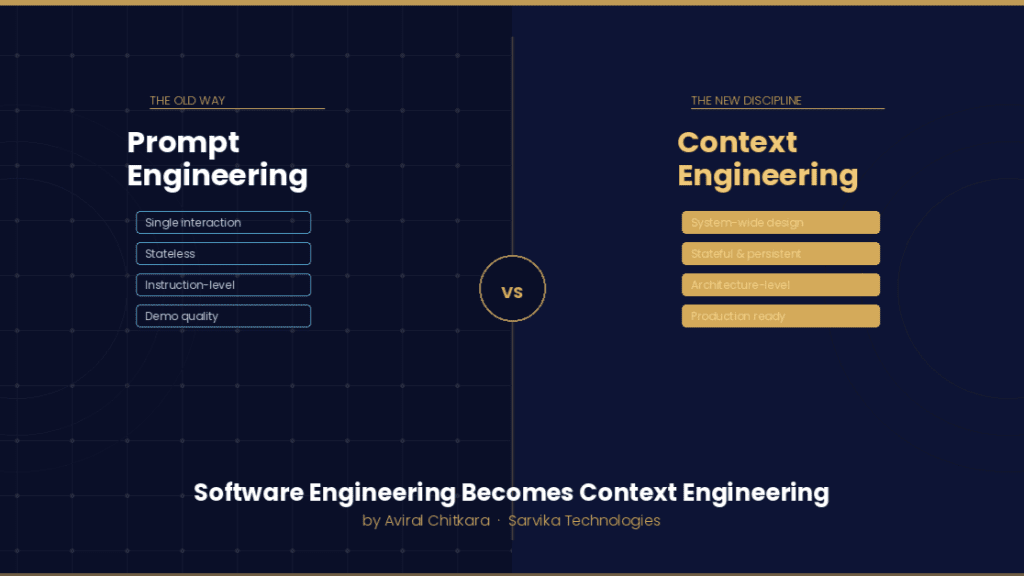
What Changes, What Doesn’t, and What Your Team Needs to Do About It
Every few years, something shifts in how software actually gets built, not the tools, not the languages, but the underlying mental model. We’re in one of those moments right now.
The conversation has moved from prompt engineering to something called context engineering, and the difference matters more than most of the coverage on it suggests. For engineering teams building real production systems, this isn’t a terminology debate. It changes how you architect, how you staff, and where your biggest reliability risks actually sit.

What Prompt Engineering Actually Was
Cast your mind back to 2022. ChatGPT had just launched. “Prompt engineering” became the job title on everyone’s LinkedIn. The game was: write a clever enough instruction, and the model would perform.
And it worked, for simple things. A product description. A draft email. A regex snippet.
The problem was that prompt engineering treated LLMs like vending machines. Put the right words in, get the right output out. It assumed the model had everything it needed if you just asked correctly. Most tasks, especially in software development, are not like that. They require history, dependencies, business rules, prior decisions, codebase conventions, and continuity across sessions.
A prompt is a single instruction. It doesn’t carry any of that.
By mid-2025, this had become impossible to ignore. Teams building production AI systems, real systems, not demos, kept running into the same wall: prompts were not the bottleneck. Context was.
What Context Engineering Actually Is
Context engineering is designing what an AI model knows, remembers, and has access to at any given point in a workflow, filling the context window with exactly the right information for the next step, no more, no less.
Where a prompt is a question, context is the entire briefing that happens before the question. The architecture diagrams, the relevant source files, the decisions already made, the constraints that can’t be changed, the user’s history. A model with a well-engineered context doesn’t just answer, it reasons within a system.
Think about how a new engineer joins a project at Sarvika. They don’t just get a ticket and a Slack message. They get onboarded: codebase walkthrough, architecture docs, stakeholder context, past decisions and why they were made. The ticket is the prompt. Everything else is context.
Context engineering builds that onboarding for AI, systematically, at every step of a workflow.
Why the Difference Matters for Software Teams
This isn’t a semantics debate. The shift from prompt engineering to context engineering changes how teams build, architect, and staff AI-powered systems.
Prompts are stateless. Context is not.
A well-crafted prompt gives you one good response. Context engineering gives you consistent, coherent behavior across 50 steps of an agentic workflow. The difference between a demo that impresses and a system that ships.
Prompts assume the model knows your system. Context ensures it does.
One of the most common failure modes we see in AI-assisted development is the model making plausible-sounding architectural decisions that contradict how the actual system works. The model isn’t wrong, it just doesn’t know. Context engineering is how you fix that.
LLM accuracy drops when relevant information is embedded within longer, poorly structured contexts, even when the model is technically attending to the right tokens. The quality of what surrounds the prompt matters as much as the prompt itself.
Prompts optimize individual interactions. Context optimizes the system.
If your AI is producing inconsistent outputs, rewriting the prompt is usually the wrong fix. The fix is usually upstream: what information is the model missing? What’s contaminating its working memory? What should be retrieved versus included by default?
These are context questions, not prompt questions.
The Elastic Analogy: A Field Is Splitting
Elasticsearch’s engineering team put it well. They compared the prompt-to-context shift to what happened in web development when “design” split into UI and UX, two disciplines that overlap, require different expertise, and are both necessary.
Prompt engineering lives inside a single interaction. It’s about clarity of instruction, zero-shot examples, chain-of-thought formatting. Still relevant. Still requires skill.
Context engineering designs the system around that interaction. It’s about what data flows to the model and when, how memory is structured and retrieved, how multi-agent workflows are coordinated, and how context windows are managed under real production conditions.
Most teams right now are treating these as the same thing. They’re not. And the gap between teams that know the difference and those that don’t is widening.
What This Looks Like in Practice
We’ve worked with engineering teams across EdTech, Health Tech, and enterprise software, and the context engineering challenges look similar regardless of domain. Here’s what actually comes up:
Retrieval design. The model doesn’t need your entire codebase, it needs the right three files, at the right moment, retrieved accurately. Building that pipeline (RAG, semantic search, file indexing) is a context engineering problem. Getting it wrong means the model hallucinates business logic that was in a file it never saw.
State persistence. LLMs don’t consolidate knowledge across sessions, every conversation starts fresh. Every conversation is a fresh start. Context engineering addresses this by designing external memory stores, writing critical decisions to retrievable locations, and structuring handoffs between agents so nothing falls through.
Context poisoning. When stale, incorrect, or contradictory information enters the context window, model reliability degrades fast. Production systems need active management of what’s in context, not just at the start of a workflow, but throughout it.
Multi-agent coordination. Once you’re running parallel agents, one doing research, one writing tests, one checking security, context engineering becomes the coordination layer. Each agent needs focused, relevant context for its specific task. Dumping everything into every agent’s prompt is the fastest way to get inconsistent, conflicting outputs.
Where Developer Skill Actually Goes
We are moving through three eras of software: writing code, programming through datasets and neural networks, and now programming through language, where the context window is your primary lever over the system.
In this third era, the highest-leverage skill for an engineer is not typing speed or syntax recall. It’s judgment: knowing what context the model needs, designing the information architecture that delivers it, and verifying outputs against a system the engineer understands deeply.
The developers who will be most valuable over the next five years aren’t the ones who write the most code. They’re the ones who can define context, design feedback loops, set guardrails, and maintain human understanding of systems that are increasingly generated rather than written.
At Sarvika, we’ve seen this shift in how our teams engage with clients. The questions that matter are earlier in the process: What does the system need to know? Where does that information live? How do we make it available to AI components reliably? These used to be data architecture questions. Now they’re context engineering questions, and they’re inseparable from how you build AI-integrated software.
What Teams Should Actually Do
Most of what’s written on this topic stays at the level of “context engineering is important.” That’s not very useful. Here’s what’s actually actionable:
Audit what your AI components know. For every AI touchpoint in your system, write down: what information does the model have access to at runtime? Is it complete? Is it accurate? Is it the right information for this specific task? You will find gaps immediately.
Stop optimizing prompts when context is the problem. When a model produces bad output, the instinct is to rewrite the instruction. Often the better fix is to look at what the model didn’t know. Build the habit of asking “what’s missing from context?” before “how do I reword the prompt?”
Design for compression from the start. Long conversations with LLMs should automatically compact without losing critical state. Build summarization into your architecture rather than letting context windows fill with irrelevant history.
Write important decisions to external storage. Anything the model needs to “remember” a constraint it discovered, a decision the team made, an integration dependency, should be persisted somewhere retrievable. Not assumed to survive across sessions.
Hire for systems thinking, not just prompting skill. The job isn’t “write good prompts.” It’s “design the information environment in which AI operates reliably.” That requires a different way of thinking about software architecture.
The Part That Doesn’t Change
Here’s what I keep coming back to: for all the disruption, the fundamentals of good software haven’t moved.
Systems still need to be secure. Code still needs to be maintainable. Business logic still needs to be correct. Integration contracts still need to hold. The client’s actual problem, not a plausible approximation of it, still needs to be solved.
What context engineering changes is where engineer judgment gets applied. Less in writing the implementation. More in designing the information architecture that makes AI-generated implementations reliable. More in verification, oversight, and system design.
Most of the developers don’t trust AI-generated code without human review. That’s not a confidence problem with developers, that’s engineers correctly understanding that the model doesn’t know the full system. Context engineering is how you close that gap. Not by replacing the engineer’s judgment, but by giving the model what it needs so that judgment can be applied at the level where it matters most.
The engineer’s role isn’t disappearing, it’s changing. AI agents are powerful but they operate within whatever context you give them. The engineer becomes the person who knows what good looks like, designs the system that produces it, and maintains oversight of the output.
Where Sarvika Fits Into This
We’ve spent over twelve years building bespoke software for clients who needed solutions that fit their specific reality, not off-the-shelf products with workarounds bolted on. That instinct, understanding the system deeply before building anything, is exactly what context engineering requires.
Technology-agnostic architecture, the kind we’ve built across healthcare, logistics, EdTech, and enterprise software, becomes especially important here. Context engineering doesn’t care what language your system is written in. It cares how information flows through it, how components communicate, and how boundaries are maintained. Those are the questions we’ve always worked on.
If your team is building AI-integrated systems and running into the reliability wall, outputs that look right but aren’t, inconsistent agent behavior, models that seem to forget what the system does, the problem is probably context, not prompting.
That’s a solvable problem. It just requires thinking about software architecture in a new way.

admin
Vice President - Operations
Aviral is the Vice President - Operations at Sarvika Technologies. His research skills are unquestionable, and so is his ability to provide constant motivation to the team. An engineer turned business expansion enthusiast, Aviral is a knowledge bank when it comes to politics. Whatever the confusion or problem, he is always the one with answers.