
Users Don’t Care That AI Built It. They Care That It Works.
There’s a question I’ve started asking engineering teams when they tell me their AI integration isn’t performing the way they expected.
Not “which model are you using?” Not “how are your prompts structured?” The question I ask is: what does the AI actually know about your users?
Not your users in the abstract. Not “enterprise logistics professionals” or “healthcare administrators.” The specific users. What they’re trying to do at 7am on a Monday when the system is slow. What they misunderstand about the interface every single time. Where they give up. What they’re afraid of getting wrong.
Nine times out of ten, the answer is: the AI knows none of that. And that’s where the product is failing.
This is the part of the context engineering conversation that almost nobody is having. There’s a lot of talk right now about giving AI the right code context, the right architecture diagrams, the right technical dependencies. All of that matters. But context isn’t only technical. For a product to work -really work, for real users -the AI operating inside it needs to understand the human context too. And that doesn’t happen automatically. Someone has to build it in.
Following up on our earlier piece, Software Engineering Becomes Context Engineering: What Changes, What Doesn’t, and What Your Team Needs to Do About It, we must critically examine what AI is actually building and whether it solves genuine business problems or simply adds layers of complexity.
The Slide That’s Lying to Everyone
“AI-Powered. Built for the Future.” Sometimes there’s a graphic -a brain, a network of nodes, the word “intelligent” in a sans-serif font. The implication is clear: we used AI to build this, and that makes it better.
I want to push back on that. Hard.
Not because AI doesn’t matter in software development, it does, profoundly, and we’ve built enough AI-integrated systems at Sarvika Technologies over the last few years to know exactly how much it changes what’s possible. But because “AI-powered” has become a product strategy for teams that don’t have one. And the users those products are supposed to serve are not fooled for long.
Here’s the thing about users that hasn’t changed in twenty years of software: they don’t care how it was built. They care whether it works.
The Confusion Between the Build and the Product
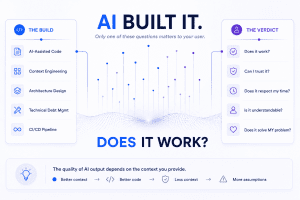
Somewhere along the way, the industry started conflating two separate things: how software is developed and what software delivers. AI changes the first one dramatically. It has almost no automatic effect on the second.
The reason is straightforward once you understand how context engineering works. This is the core problem. Technical context and user context are two entirely different things, and most teams are investing in one while ignoring the other.
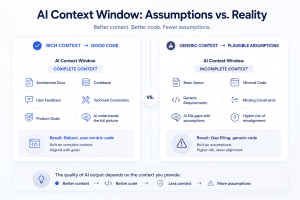
When we started integrating AI into our development workflows at Sarvika, and this happened gradually, not overnight, the efficiency gains were real. Certain tasks that used to take days started taking hours. Code that would have required a senior developer’s focused attention for a week could be scaffolded in a morning and refined from there. For a team with 220+ full-stack developers already working across complex domains, this was genuinely significant.
But here’s what we noticed almost immediately: the speed of generation had no bearing on the quality of the outcome unless you kept supplying the context that the AI couldn’t infer on its own. The AI didn’t know what the user actually needed. It didn’t know where the previous version had failed. It didn’t know that the client’s end users were logistics coordinators who checked this dashboard on a mobile phone in a warehouse with bad lighting and no time to read instructions.
None of that was in the model. It had to be engineered in deliberately, structurally, before the first line of AI-generated code was written.
The teams that skipped that step ended up with code that was fast to write and slow to fix. The teams that treated user context as infrastructure as something that had to be built, maintained, and fed into the system at every stage; shipped better products faster.
The difference wasn’t the AI. It was whether anyone had done the work of telling the AI what it was actually building for.
What “AI-Powered” Actually Tells a User
Nothing. It tells them nothing.
Ask yourself: when was the last time you chose a product because it was built with a particular framework? Or hosted on a specific cloud provider? Or developed by a team that used a certain project management methodology?
You didn’t. You chose it because it solved your problem, loaded quickly, didn’t confuse you, and didn’t break at the wrong moment.
Users have always been ruthlessly indifferent to implementation details. A healthcare professional using a patient records system doesn’t think about the database schema when they’re trying to pull up a chart during a consultation. They think about whether the screen they need is one tap away or four. An operations manager reviewing a logistics dashboard at 7am doesn’t care whether the anomaly detection was built with machine learning or a rules engine. They care whether it catches the right problems and doesn’t flood them with false alarms.
“AI-powered” is a build-side fact. The user is on the product side. These are different conversations, and conflating them is how products end up over-marketed and under-delivered.
The irony is that the products winning on user experience right now aren’t the ones loudest about AI. They’re the ones quietest about it because they used it in the build and then got out of the way, leaving users with something that simply works.
Context Engineering Has a User Layer. Most Teams Skip It.
Here’s where this gets specific, because I want to be concrete about what “user context” actually means in practice not as a UX concept, but as an engineering input.
Context engineering, at its core, is about designing what an AI knows, remembers, and has access to at every step of a workflow. Most teams focus this effort entirely on technical inputs: codebase structure, API contracts, architecture decisions, business logic. That’s necessary. It’s not sufficient.
The user layer of context engineering asks different questions. Not “what does the AI need to know about the system?” but “what does the AI need to know about the people this system serves?”
In practice, this means encoding things that most teams leave implicit:
Usage patterns, not just use cases. A use case says “user views monthly report.” Usage context says “the ops manager pulls this report at 6:45am before the weekly leadership call, on a laptop with two other tabs open, looking specifically for the three numbers that have moved since last week -everything else is noise.” An AI building a reporting interface with the first description and the second will produce different results. Only one of them matches how the product actually gets used.
Failure modes from previous versions. If your last iteration had a specific feature that users consistently misunderstood, that information needs to be in the context that guides the next build. AI systems don’t carry institutional memory across sessions. If you don’t feed it forward, it gets rebuilt the same wrong way.
The emotional context of the task. This sounds soft. It isn’t. A clinician using a diagnostic support tool is under cognitive load, time pressure, and carries the weight of consequential decisions. A student using an EdTech platform might be anxious, easily distracted, or checking in from a phone with spotty connectivity. These aren’t edge cases, they’re the normal conditions under which your product will be used. Context engineering for user experience means making these conditions explicit inputs to the build, not afterthoughts discovered in user testing.
What “good” looks like for this user, in their language. When we build AI-assisted features at Sarvika, one of the inputs we engineer into the process is a description of success from the user’s perspective not from the product spec. Not “the feature will surface relevant anomalies.” But “a warehouse manager sees exactly what needs their attention today without having to interpret anything.” That distinction changes what gets built.
None of this replaces UX research. All of it makes the AI a better builder when it’s being guided by human judgment that’s been properly structured and fed in.
The Gap That’s Opening Up
Here’s where it gets interesting, and a little uncomfortable.
Because AI makes it faster to generate software, the bar for shipping something has come down. A team that three years ago would have needed six months and significant investment to build a functional product can now produce something credible in a fraction of that time. That’s mostly good news. More things get tried. More problems get attempted.
But it also means more things get shipped that were never really interrogated. Requirements that were assumed rather than validated. UX that was generated rather than designed. Edge cases that were skipped because velocity felt more urgent than coverage.
And underneath all of that: user context that was never engineered in, because nobody stopped to ask what the AI needed to know about the humans on the other end.
The output looks like software. It behaves like software. It passes basic testing. And then real users touch it, and the gaps appear because real users do unexpected things, have context the development team never considered, and face situations that no model anticipated.
We see this pattern across almost every domain we work in. EdTech platforms where the AI-assisted content generation is impressive but the actual learning flow confuses the students it’s supposed to serve. HealthTech tools where the AI-powered analysis is genuinely capable but the clinician-facing interface creates extra steps instead of reducing them. Enterprise software where the AI integration works technically but the outputs don’t fit how the actual team uses information on a given day.
The technology did what it was supposed to. The product didn’t.
The gap between those two things is where user experience lives and it’s a gap that AI cannot close on its own, because closing it requires context the AI was never given.
The Fundamentals That Don’t Move
I’ve been in this industry long enough to have watched several waves of “this changes everything” wash through. Service-oriented architecture. Cloud-native development. Mobile-first. Each one genuinely changed how software was built. None of them replaced the fundamentals of what made software worth using.
Those fundamentals are boring to talk about, which is probably why they get skipped in the rush toward whatever’s new. But they’re what separate products that retain users from products that get uninstalled after the first week.
Does it solve the right problem? Not a plausible approximation of the problem. Not the problem as described in a requirements document written without enough user research. The actual problem, as experienced by the actual person trying to do the actual thing. AI accelerates development. It doesn’t replace the discovery work that tells you what to build. And discovery work is, at its heart, context gathering for the team, and increasingly, for the AI systems that will do the building.
Does it work when it matters? Users forgive a lot when something generally works. They forgive very little when it fails at the moment they need it most. A logistics platform that goes down during peak dispatch hours. A healthcare tool that errors during patient intake. A financial dashboard that shows stale data during a board meeting. These aren’t just technical failures -they’re trust failures. AI-generated code that hasn’t been tested against real load, real data, and real edge cases fails the same way any other code does.
Is it understandable without explanation? The best software interfaces explain themselves. Users shouldn’t need a manual, a training session, or a tooltip to figure out what happens when they click something. This is a design problem, not a development problem. AI is extremely good at generating UI. It is not good at understanding how a specific set of users, in a specific context, with specific mental models, will interpret what they see. That understanding has to be engineered in or it won’t be there.
Does it respect the user’s time? Every extra click is a tax. Every unnecessary step, every redundant confirmation, every piece of information the user didn’t ask for -these accumulate. Users don’t document these frictions. They just quietly stop using the product. Speed of development means nothing if the thing you built efficiently is inefficient to use.
Does it hold up under scrutiny? This matters especially in domains where the stakes are high healthcare decisions, financial reporting, legal workflows, enterprise data. AI-generated outputs that look authoritative but are occasionally wrong are, in some contexts, worse than no AI at all. Users in highstakes environments learn quickly whether they can trust a system. Once they don’t, recovery is very hard.
None of these questions are new. They’ve been the right questions for as long as software has had users. What AI changes is the speed at which you can build something that fails all of them if user context was never treated as an engineering input in the first place.
What the Best Teams Are Actually Doing
The teams building AI-integrated products that genuinely work, not just demo well have something in common. They’re not the most vocal about AI. They’re the most disciplined about what they feed it.
They’ve understood that context engineering has two sides: the technical side (what does the AI know about the system?) and the human side (what does the AI know about the users?). They invest in both. Requirements aren’t just handed to AI as bullet points -they’re structured with user context: who, in what situation, trying to accomplish what, with what constraints, and what does failure look like for them. That becomes an input to the build, not a document that gets archived after kickoff.
They also haven’t replaced any of the checkpoints that catch problems before users do. Design decisions are still grounded in how actual users work. QA still covers edge cases, not just happy paths. And there’s still a human being whose job is to know what “good” looks like for this specific product, for these specific users, in this specific context. “We often joke that, in the near future, the ultimate leverage will be human validation and testing”.
What AI has done for these teams is compress the time between idea and testable reality. That’s genuinely valuable. It means more iterations before launch. More time to find out what doesn’t work before it ships. More capacity to respond to user feedback after launch.
At Sarvika, we made a decision early on that AI augments our developers, not our process. The process client discovery, architecture review, UX validation, QA rigour, iterative feedback that stays intact. What’s changed is how much context we now deliberately structure before development begins. Not just technical context. User context. Business context. Failure-mode context. The things that tell our team and the AI tools they’re working with, what this product actually needs to do for the humans who will use it.
A Word About Trust
There’s a longer game here that gets missed in the noise around AI productivity.
Software products are, at their core, a trust relationship. A user chooses to give a product access to their time, their workflows, sometimes their data, sometimes their livelihood. That trust is built slowly and lost quickly. A product that fails in a critical moment that shows the wrong information, that loses data, that behaves unpredictably doesn’t just get a bad review. It damages the user’s willingness to trust software in that category for a long time.
The rush to ship AI-powered products is, in some sectors, eroding that trust faster than it’s building value. Users are getting better at recognising when AI is doing something confidently wrong. The hallucination problem, which is well-documented at the model level, has a product-level version: systems that present uncertain outputs with certain-looking interfaces. Users who’ve been burned by that once become sceptical of everything.
The teams that win over the next five years are the ones that earn trust by being right more than they’re wrong. That requires discipline the kind that doesn’t disappear because the build got faster. And it requires context engineering that takes user reality seriously, not just system architecture.
Users don’t give credit for the engineering. They give credit for the experience. Nobody downloads an app and thinks, “this is impressively architected” or “the context window management on this is excellent.” They think, “this is easy to use,” or “this actually solved my problem,” or “I can rely on this.”
That’s the standard. It hasn’t moved. AI doesn’t raise it or lower it. It just changes how fast you can fail to meet it if the user layer was never built in.
What This Means If You’re Shipping Product
Stop using AI capability as a feature. Unless your user is specifically coming to you for AI, “powered by AI” is a build detail, not a value proposition. Your value proposition is what the user can do, not how you made it possible.
Treat user context as an engineering input, not a design deliverable. User research doesn’t end in a deck that gets presented and filed. It needs to be structured, maintained, and fed into the AI systems guiding your build the same way you’d maintain an architecture document or a business logic spec. Context that isn’t accessible to the AI at build time isn’t context engineering. It’s just documentation.
Reinvest the time AI saves into the parts it can’t do. If AI is saving your team 30% of development time, spend that time on user research, on QA, on design iteration, on the edge cases you used to skip. The efficiency gain is most valuable when it buys you more rigour, not just more speed.
Test with real users, not ideal ones. AI-generated code is often optimised for the described use case. Real users take shortcuts, make unexpected inputs, use software in contexts it wasn’t designed for, and interpret interfaces differently than the designer intended. There’s no substitute for watching actual users try to use what you built and then feeding what you learn back into the context that guides the next iteration.
Measure what users experience, not what you shipped. Velocity is a build metric. Retention, task completion, error rates, support ticket volume ;these are product metrics. The gap between your build metrics and your product metrics is where the missing user context is hiding.
The Bottom Line
Context engineering is changing how software gets built. Understanding that has become a genuine competitive advantage for teams who take it seriously.
But here’s what the conversation often misses: context engineering isn’t only about what the AI knows about your system. It’s about what the AI knows about your users. Their situations, their pressures, their failure modes, their definition of what “works” looks like on a Tuesday afternoon when everything else is going wrong.
The teams that get this right aren’t just building faster. They’re building things that actually land because the human reality was engineered in from the start, not hoped for at the end.
Your users don’t know what context engineering is. They won’t know whether you did it well or skipped it entirely. They’ll just know whether the product works. Whether it understood what they needed. Whether they can trust it.
That’s still the only verdict that matters.

admin
Vice President - Operations
Aviral is the Vice President - Operations at Sarvika Technologies. His research skills are unquestionable, and so is his ability to provide constant motivation to the team. An engineer turned business expansion enthusiast, Aviral is a knowledge bank when it comes to politics. Whatever the confusion or problem, he is always the one with answers.